
Solar PV on Your Electric Vehicle’s Roof

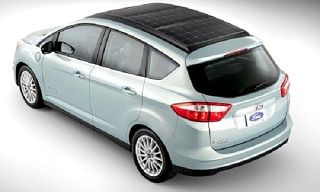 Apparently, Ford is offering its customers an opportunity to improve the range they experience with their new line of electric vehicles, by installing solar PV on the roof. This is certainly not a unique concept; I recall a company about five years ago that was converting Toyota Priuses to EVs, and took this approach with PV.
On a sunny day and under optimum driving conditions, I’m guessing drivers may get two or three extra kilowatt-hours, sufficient to drive another 10 – 15 miles. Not too bad.


Craig,
As always, I’m going to have to be the downer on this party… But Fueleconomy.gov rates the Ford Focus Electric at 32 kWh/100 miles, or ~3.125 miles/kWh.
We agree on the power derived from the unit… it’s possible that the panels might have a basic efficiency of ~10-12%% (they won’t be industry leading efficiency – they’ll have to be extremely secure for both wind resistance and vibration). The roof of a boxy mini-hatchback might have ~2.5-3 m3 of space, so your estimate of ~2-3 kWh matches well for a sunny region.
However, if the car only gets 3.125 miles/kWh, that’s good for 6-9 miles of driving, max. I cannot see this estimate increasing, as a smaller car (necessary for better fuel economy) would have a smaller area of rooftop.
So you have a possibility of saving at most a single gallon of gasoline every 4-5 days of driving, or ~50 gallons a year. A 15-year longevity for the car would save a total of ~$2500, and ~10 tons of CO2.
If you assume that an average investment in a wind farm would yield ~5% (a VERY low estimate), then you would only have to invest ~$1200 in a wind farm in order to exceed the total savings seen in fuel costs… and such an investment in a wind farm would have a net impact of reducing CO2 emissions by ~80 tons.
So the question is: how much does the optional solar system cost? When Toyota tried this gimmick, the solar roof costed ~$10,000 (that was an even worse payoff – it just kept the AC running for you on hot days, saving only a few gallons of gasoline/year). What do you suspect Ford’s price point will be on this?
Fair points. And good question at the end. I have no idea. I would think they would want to make it very attractive, so most car-buyers accept the option, and Ford becomes more visible in the EV space.
Btw, there are other minor benefits associated with the product: Tangible (slightly better range) and intangible (psychological — “I’m using the sun!”).
I agree with Glenn, although I think both of your calculations are high, mainly because there is no way a car’s solar panels will be oriented properly, so they will have a low capacity factor. Over the course of a year, I’d expect no more than 1 kWh/day, even for someone who always parks in full sun.
On the other hand, I agree with Craig that this is all about the sales pitch and perception. If car buyers paid attention to economics or true greenery, we’d all be driving 2nd-hand compact cars. Or taking the bus.
For typical efficiency, you get about 150w/sq meter, and the usable surface area of a car is no more than 3 square meters. Assume a normal 15% capacity factor and you get:
150 w/m^2 / 1 kw/1000 w x 3 m^2 x 24 h / day x 15% = 0.72 kWh/day. Optimistically you can drive 3 miles/day on that… unless you park in the shade!
Tom,
Our calculators don’t agree… I was indeed assuming a higher cf, but if you take:
the following equation: 0.15 * 3 * 24 *0.15 = x. you get x = 1.62.
You’re probably right that the vehicle would get much lower cf than I assumed, but in Ford’s promotional information they say they incorporate tracking, and that it’s a concentrated PV cell… so I was giving them the benefit of the doubt and giving a range of optimistic cf values – again for sunny regions only.
🙂
I wasn’t arguing whether or not it would sell… I have no idea whether it would sell… I just questioned the overall value it provided vs the cost. My guess (and it’s just a guess) is that it will add at least $6000 to the MSRP, and it will not possibly add that much value, either in economic returns or environmental returns.