
Making Renewable Energy Happen in Maine

 Like every other country on Earth, the United States is not at all homogeneous, but, rather, composed of regions that have their own character, some charming, others not so much. Maine is known for its bountiful lobsters and its boots from outdoor clothing outfitter LL Bean boots (shown), befitting its cold and wet climate, but also for its unusual social fabric, where it seems that everyone knows everyone else’s business.
Politically, it’s quite conservative, especially by comparison to the neighboring New England states; for the eight years before this one, it was governed by Paul LePage, best known for his rabid antagonism to gun control, his claim that global warming will have a net positive effect, and his indifference to the state’s school system (“If you want a good education in Maine, go to private schools. If you can’t afford it, tough luck. You can go to the public school.”).
Perhaps as a “pendulum swing,” 2019 saw the election of Democrat Janet Mills, who stands in stark contrast, especially with respect to environmental stewardship in general and renewable energy in particular. Mills’ approach to the latter invokes Maine’s renewable portfolio standard (RPS), as discussed here:
From Solar Industry Magazine: On Wednesday, standing in front of a solar array in the presence of lawmakers and renewable energy stakeholders, Gov. Janet Mills, D-Maine, signed into law three major pieces of bipartisan clean energy legislation. The bills establish in law the governor’s 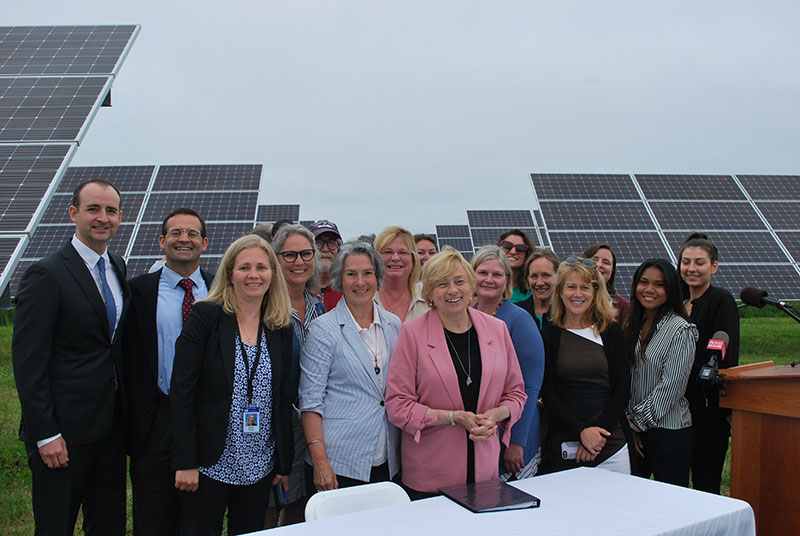 proposed Maine Climate Council, which is charged with developing action plans to reduce Maine’s greenhouse-gas (GHG) emissions 45% by 2030 and 80% by 2050; an increase in Maine’s RPS from 40% to 80% by 2030 and a goal of 100% renewable energy by 2050; the creation of new incentives for energy-efficient heating; and the institution of new solar incentive programs.
Great news to kick off a new era.


Craig,
The announcements by Maine are not really significant, more symbolic than real.
Before and especially during the Obama Era, Maine’s traditional
industries paper, leather, and textiles etc, began moving elsewhere and the average age of residents in Maine advanced until Maine has the oldest population in the USA.
2050 is long way off and it’s unlikely any of the current politicians will be around to answer for the results. The planet is a biosphere, transferring emissions laden industries elsewhere may make you feel self-righteous, but it’s also meaningless hypocrisy.
Just as shipping all those highly pollutant obsolete solar panels elsewhere (mostly very poor third world nations or simply ocean dumping) for others to deal with the problem of disposal is also hypocritical.