
Why the U.S. Can’t Build Highspeed Rail

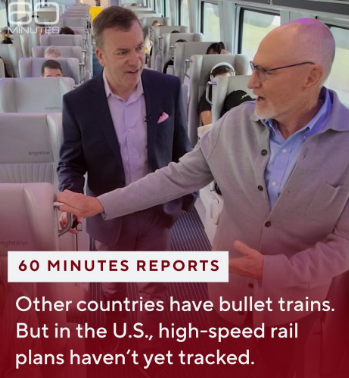 The lead story on tonight’s episode of the long-running CBS show “60 Minutes” proposed to answer how is it possible that the rest of the developed world, as well as communist dictatorships like China, offer their citizens and visitors the opportunity to travel around the land speeds of hundreds of miles per hour, where such projects in the U.S. have never gotten close to even the feeblest level of success.
They imply that the answer lies mainly in government mismanagement and outrageous over-promises for political purposes.
In the process of creating 2GreenEnergy, I coincidentally tripped across a story that explains this far more convincingly.
I happened to interview a very bright and dedicated young man in the Texas state legislature about 20 years ago, who told me that he and his team had done a great deal of research and legal work surrounding connecting Dallas, Austin, Houston, and San Antonio with highspeed rail, and had offered their plans to the public for comment.
One of the first comments came in the form of a phone call he received from Herb Kelleher, then-CEO of Southwest Airlines, which operated out of airports in those four cities. He said, “Normally, tickets between any of these cities are priced at $80 each. If you drive your first spike, I’ll reduce that price to $8. Perhaps with free parking and cocktails on the house. Let’s see how that works out for you.”
What I inferred from the interview I conducted with the young, perhaps naive Texan who was bold enough to propose low-carbon mass transportation to the Lone Star state, was this: money and power talk here, and nothing else matters.
Yet that’s not true elsewhere around the globe.
Had Kelleher publicly taken this position in China and pushed after it, he would have likely been executed by a firing squad. Though we hate to see the threat of violence as public policy, we all must admit that the Chinese are quite effective in carrying out their plans, regardless of what those plans might be or how they are brought to bear.
In Europe and the rest of the OECD nations, the situation is, fortunately, far more nuanced and less savage. People are highly educated, and they understand the need for decarbonizing their electric grid and transportation sectors. Having some billionaire jackass strong-arm their culture would not have enjoyed any success there either.
Many things in these parts of the world get done simply because they are right, as mystifying as that seems to us in the U.S.


