
Nuclear Fusion Holds Great Potential

 In the history of the nuclear energy space, most of the world’s attention has been focused on fission, the breaking apart of large atoms, like uranium, into smaller ones, and the capture of the huge amounts of energy that happens as a result. Though traditional processes carry significant dangers, e.g., operational failures (e.g., Fukushima) and the disposal of waste, cutting-edge technology invokes the decay of thorium, a process which, when brought fully to fruition, eliminates these issues almost entirely.
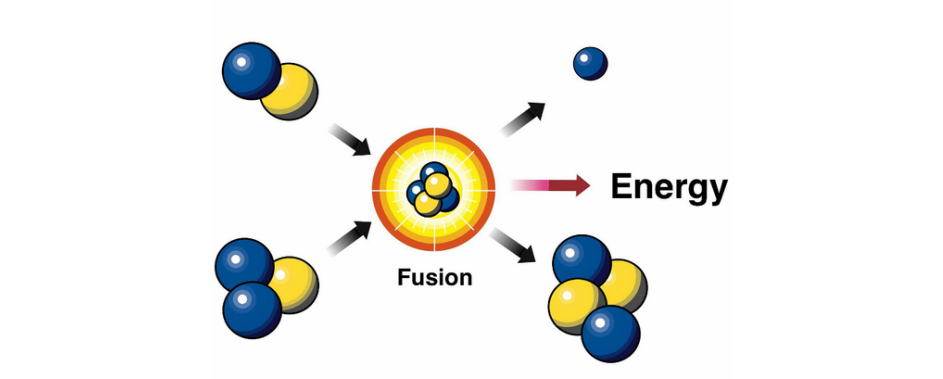
On the other side of the coin we have fusion, the smashing together of two small atoms. This, of course, is what happens at the core of our sun, where there is enough heat to cause deuterium (hydrogen atoms whose nucleus has both a proton and a neutron) to fuse into helium. Replicating this process safely on Earth has proven to be quite difficult, since most ways of going about this, like the one diagrammed above, spit out deadly high-energy neutrons.
This challenge has spawned another approach, one that is aneutronic (doesn’t eject neutrons), and that is the fusion of boron, the most common form of which has five protons and six neutrons, with hydrogen with its one proton, to form three helium atoms, each with two protons and two neutrons.
A company in California has been at this for 21 years: TAE Technologies, formerly “Tri Alpha Energy,” since a helium nucleus is also called an alpha particle. In order to focus enough energy on the target to make the process occur, TAE employs plasma, held in place by a strong magnetic field. How close they are to bringing all this together is anyone’s guess; they play their cards very close to their chest.
A similar slant on the boron/hydrogen concept has arisen recently, and to much fanfare, involves delivering the required energy in a closely targeted space with lasers–one to deliver the jolt and the other to contain it. As discussed here, Australia’s University of New South Wales has been granted a set of international patents for this technology, one that could become a reality in the near future.
As much as we’d all like to see renewable energy cause the obsolescence of fossil fuels, advanced nuclear is a far more elegant solution that offers numerous advantages over solar, wind and the rest. Let’s all hope for rapid progress in this space. Humankind could really use a break at this point.


