
Assessing the Relative Value of Energy Resources

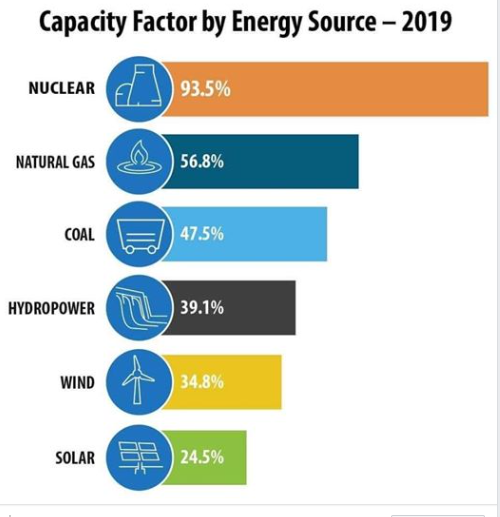 Capacity factor is a percentage, calculated by dividing the unit’s actual electricity output by the maximum possible output, i.e., it’s a measurement of how fully a unit’s capacity is used. Nuclear has a huge CF, because, except for downtime for maintenance, it runs at full capacity 24 hours a day; it’s not ramped up and down according to the changing load. Solar and wind have low CFs for the obvious reason that they are variable/intermittent energy sources by nature; in addition, wind is often “curtailed,” meaning shut off due to low electricity demand.
CF is an important criterion in assessing the value of an energy resource, since once we’ve made a capital investment, it’s good to use it as much as possible.
Proponents of nuclear also like to talk about power density. If you want a gigawatt of power, you need a huge area on which to erect a wind farm, compared with an extremely compact nuclear plant.
In addition, nuclear, like renewable sources, has a very low carbon footprint.
Of course, there are other key considerations, chief of which is cost, and this is where nuclear struggles, as permitting, building, insuring and maintaining nuclear plants is an expensive proposition. By contrast, energy from wind is extremely inexpensive. Power purchase agreements are being signed at various places in the U.S. at $0.015 per kWhr.
All these factors come together to form a very interesting and dynamic blend. As public perception shifts and government (one hopes) responds accordingly with new policies and regulations, the costs of each of the different resources moves with considerable speed over time, in directions that favor the clean over the dirty. The reason coal is going away is that, because of its toxicity/lethality, regulations requiring clean-up are now in place that drive up its costs, and this has reached the point, at least in the U.S., at which coal is going away quite quickly–especially since the costs of solar and wind continue to fall.


