Sarah, my hat’s off to you. You nailed one of the two main modalities of Trump’s second term: retaliation against anyone who has dared to challenge Trump and his wantonly criminal behavior.
The other, of course, is his relentless drive to acquire ever more wealth and power, so as to make it impossible for the United States to have a free and fair election in 2028.
I remember a sixth-grade science class in which our teacher, Mr. Tokeida, brought in a number of meal worms and a large petri dish. He told the class, “I’m going to take a few meal worms, one at a time, and put them in the center of the petri dish. I want you to watch what happens.” Each one moved in a straight line until it encountered the edge of the petri dish, then followed the rim in a circle, never veering away back towards the center.
“Why do you think they all did this exact thing?” he asked us.
One of us said, “Because they think they can get out.”
Mr. Tokeida smiled and asked my classmate in response, “So you’re attributing a meal worm with the ability to think?”
I was stunned; I hadn’t seen this coming. Here was an introduction to philosophy that hit me like a ton of bricks. There must be some mechanism that drove the meal worms to follow the rim, but it couldn’t properly be called “thinking,” could it?
There is an analogy to a recent monologue that Bill Maher did, aimed at Trump supporters, asking them to consider what “America” actually means in terms of rule of law, due process, no-one above the law, and the U.S. Constitution. He concluded: “What good is Making America Great Again if you wind up losing the ‘America’ part?”
When I heard this, I traveled back to sixth grade, and I asked myself: are we over-attributing the capacity to think to these people?
I just came across the rules at left, and thought I’d make a few comments:
1) The word “their” in the sentence “Each student (singular) should bring their (plural) book,” is a workaround for “Each student should bring his or her book.” Since the latter is clumsy, I prefer, “Each student should bring his book.” This is sexist, of course (why not “her?”) Yet, I think this is the best option.
2) “Ain’t” is most definitely a real word; it’s slang for “isn’t,” and should be used in appropriate settings, e.g., “Farmer Bob said, ‘My corn crop ain’t what it was last year.'”
3) I see no reason that emoji/emojis should be treated differently than any other noun.
4) Misusing “literally” like this merely shows one’s ignorance. I know it’s common among young undereducated people, and I’m sure it works in conversations with their peers. I can assure you that it wouldn’t work at all in job interviews for med-law school, Deloitte, Boston Consulting, etc.
5) “Impactful” is a legitimate word, and I can’t understand why some people (pedants?) are critical of its use.
I suppose it’s true that Trump is “beyond repair,” but that somehow implies that Trump and/or the American people would like to see an improved president in the White House. Not true.
Trump himself thinks he’s God’s gift to the U.S. presidency, and his supporters are in 100% agreement.
Briefly: His first term passed largely without incident.
The next presidential term, served by Biden, was contentious to say the least, in that it consisted of Trump’s contesting the election with a stream of lies and violence, including the insurrection against the U.S. Capitol, and arrest, trial and conviction of more than 900 violent offenders.
Near the end of the term, grand juries from four different jurisdictions brought a total of four indictments against Trump totaling 91 felony counts. Though Trump did everything in his power to stave off the criminal proceedings, he went to trial in the case of falsifying business records in the 34-count felony indictment, brought by the Manhattan District Attorney’s Office and heard in the New York State Supreme Court. He was convicted on all counts.
Trump was re-elected in the 2024 election, and the first eight+ months of his second term has been a cyclone of lawlessness, with each day bringing a new volley of savage attacks against American democracy, the U.S. Constitution, and rule of law. The president is clearly amassing wealth and power, making it difficult or impossible to remove him from office in 2028.
There is a negligible portion of the U.S. electorate that would like to see Trump “repaired.” Again, the voters who support him think that he’s doing a perfect job in “making America great again.” The rest of us would like to see his presidency ended asap via the 25th Amendment or some other legal vehicle that applies to the insane, to traitors, and anyone else clearly unfit to continue to lead the nation.
The primary answer to the question here is that most Americans are indoctrinated into believing that this country is the best in the world. It’s so good, in fact, that it’s not susceptible to things like fascism.
This reminds me of all the conversations I’ve had with Europeans over the past couple of years, in which I asked people about their reactions to what’s happened in the United States. Most people say, “We just can’t believe it happened to America. If you had said that Paraguay or Mali has a new authoritarian leader, no one in Europe would have batted an eyelash. But America? Unthinkable.”
Many of us remember the short and ridiculous tenure of Anthony Scaramucci as White House Communications Director.
Here, Scaramucci seems to be asserting that something fundamental has changed in the character of Donald Trump, now that he’s become addicted to power.
I think a more plausible explanation is that Trump was born without a soul. All we know about his life is that he’s never done a single thing that wasn’t calculated to bring himself pleasure, wealth, and power.
The purpose of his first term was to be re-elected, and to use his second term as a lame duck to do exactly what we’re seeing him do now: ignore the law to consolidate power, making it as hard as possible for him to be removed from office in 2028.


 Well, that depends. Do you think it’s a good idea to invest in a product you know nothing about, in a market you know nothing about?
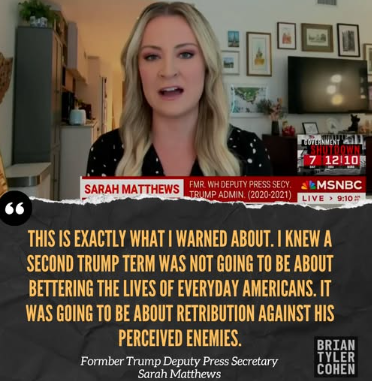 Sarah, my hat’s off to you. You nailed one of the two main modalities of Trump’s second term: retaliation against anyone who has dared to challenge Trump and his wantonly criminal behavior.
 I remember a sixth-grade science class in which our teacher, Mr. Tokeida, brought in a number of meal worms and a large petri dish. He told the class, “I’m going to take a few meal worms, one at a time, and put them in the center of the petri dish. I want you to watch what happens.” Each one moved in a straight line until it encountered the edge of the petri dish, then followed the rim in a circle, never veering away back towards the center.
 Here’s a scene from one of our “war-ravaged” cities.
 I suppose it’s true that Trump is “beyond repair,” but that somehow implies that Trump and/or the American people would like to see an improved president in the White House. Not true.
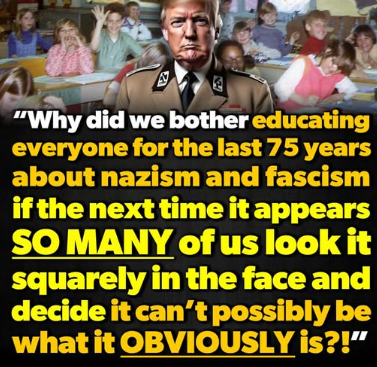 The primary answer to the question here is that most Americans are indoctrinated into believing that this country is the best in the world. It’s so good, in fact, that it’s not susceptible to things like fascism.
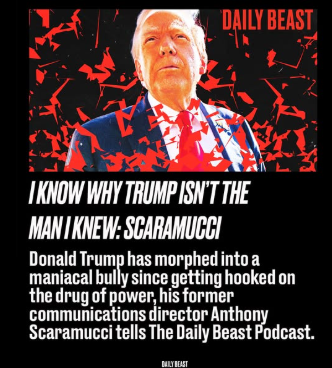 Many of us remember the short and ridiculous tenure of Anthony Scaramucci as White House Communications Director.
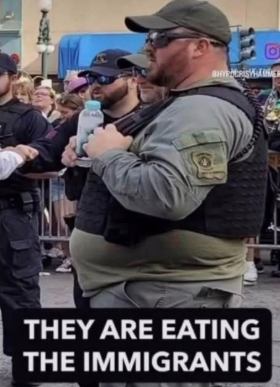 I normally eschew body-shaming, but this is so funny that I’m making an exception.
 People may be wondering how it’s possible that Americans support Trump and his policies. Maybe all we’re talking about is stupidity.


Comments on Word Usage in Modern Times
1) The word “their” in the sentence “Each student (singular) should bring their (plural) book,” is a workaround for “Each student should bring his or her book.” Since the latter is clumsy, I prefer, “Each student should bring his book.” This is sexist, of course (why not “her?”) Yet, I think this is the best option.
2) “Ain’t” is most definitely a real word; it’s slang for “isn’t,” and should be used in appropriate settings, e.g., “Farmer Bob said, ‘My corn crop ain’t what it was last year.'”
3) I see no reason that emoji/emojis should be treated differently than any other noun.
4) Misusing “literally” like this merely shows one’s ignorance. I know it’s common among young undereducated people, and I’m sure it works in conversations with their peers. I can assure you that it wouldn’t work at all in job interviews for med-law school, Deloitte, Boston Consulting, etc.
5) “Impactful” is a legitimate word, and I can’t understand why some people (pedants?) are critical of its use.