At left we see someone’s assessment of why Norwegians are staying put. Note that the reasons provided here are largely pragmatic.
Yet I would guess that most of these folks have, in addition, a philosophic take on the matter. Scandinavians in general actually care about the well-being of others, as evidenced by their deep commitment to environmental responsibility, the value they put on education and the absence of poverty. They don’t have hungry children living in the streets, or people dying of treatable diseases.
And guess what? They’re happy. Norway, Denmark, Finland and Sweden are all in the top 10 countries in the World Happiness Rankings. The United States comes in at #24.
It seems that an integral part of being human is the idea of empathy and taking care of others. This is something we all understand innately, as illustrated by the joy we take in giving gifts. It’s not as if America doesn’t have a large number of fine people, but as a society, we appear not to have gotten the memo.
Here’s my response to the reader who sent me the meme at left.
Democrats tend to be:
• Followers of science, and most scientists are atheists.
• Tolerant of the religious beliefs of others, but aware of the fact that fanatical Muslims are far more dangerous than fanatical Christians.
• Admirers of the social democracies that exist in places like Northern Europe, Iceland, New Zealand, Costa Rica, etc., which bear little if any resemblance to communism.
FWIW, I’m deeply concerned that the American republic is in the process of coming undone and disappearing, and I base my fear on one thing: stupidity, as exemplified above at left.
Here’s Trump’s response to the 60% of Americans who are struggling financially, living paycheck-to-paycheck, and starting to move their support away from him. Our president says, at least according to the meme at left, is that his priority is “affordability.”
Of course:
1) That’s today. Yesterday, affordability was a “Democratic hoax,” just like the Epstein file hoax, the climate hoax, the inflation hoax, the E. Jean Caroll hoax, and the national debt hoax.
Tomorrow, the next hoax will be whatever challenges Trump’s authority, and whatever its supporters are stupid enough to believe. Could be the “Pete Hegseth is a war criminal hoax.” Who knows?
2) He knows essentially zero about economics and has less than zero interest in listening to those who have made this subject their life’s work.
His decisions to punish other countries with tariffs has already begun to raise prices in the United States, not to mention destroy the lives of our farmers and factory workers.
At left is a piece of racist fearmongering, written for true hateful idiots.
The U.S. annual military budget is just under $1 trillion, larger than the next 14 countries on Earth combined. What do you think is the level of threat to your children that some African kids will paddle a boat across the Atlantic, buy a few assault rifles, unnoticed by our armed forces, and kill your son or daughter?
Your kid is thousands of times more likely to die from one of our shootings by a deranged American who bought an assault rifle at Walmart without a background check and opened fire at some school, music concert, shopping mall, or movie theater. Mass killings like this happen so frequently here that they’re like car crashes; many of them don’t even make the news.
It looks like ExxonMobil wants to tell you what the future of energy is. Clearly, they want you to believe that there are no important environmental issues associated with the combustion of fossil fuels.
They need you to agree with Trump’s anti-scientific claims that climate change is a hoax, and that American energy independence can only be achieved with a “drill baby drill” strategy.
If Exxon is right, and it actually is the future of energy, we will not have an organized human society here by the end of the 21st Century. Are they rich, powerful, and evil enough to pull this off? Let’s all hope not.
Helen Hicks Baker writes, “For several years, it was my honor to serve on a rural health committee with Dr. Doyle. He’s an impressive guy, and absolutely right on health care policy.”
We can keep raising our defense budget, currently just under $1 trillion annually, spent by the Pentagon that has failed seven consecutive audits.
We can provide enormous tax breaks to our nation’s billionaires.
All the while, we’re sentencing the poorest of the poor to short lives and painful deaths.
If you believe Trump is a true patriotic leader who is making America great again, that’s sad. If you think Trump is just a few days away from announcing a plan that will replace Obamacare with better and less expensive overall coverage, that’s just pathetic.


 What makes America unique?
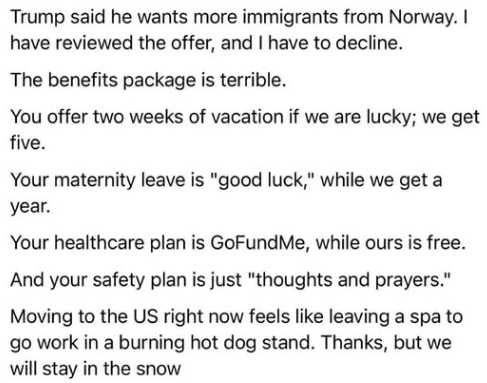 At left we see someone’s assessment of why Norwegians are staying put. Note that the reasons provided here are largely pragmatic.
 Here’s my response to the reader who sent me the meme at left.
 It’s weird that about 65% of U.S. voters have this syndrome. It’s an epidemic!
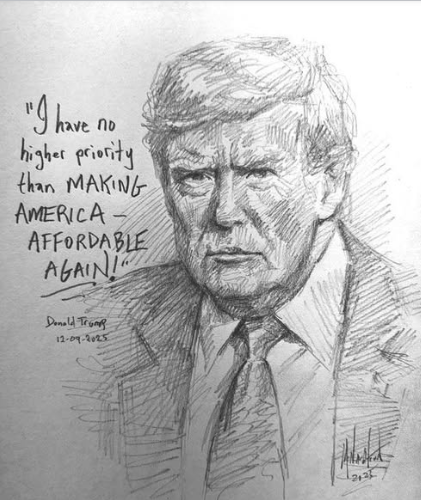 Here’s Trump’s response to the 60% of Americans who are struggling financially, living paycheck-to-paycheck, and starting to move their support away from him. Our president says, at least according to the meme at left, is that his priority is “affordability.”
 At left is a piece of racist fearmongering, written for true hateful idiots.
 It looks like ExxonMobil wants to tell you what the future of energy is. Clearly, they want you to believe that there are no important environmental issues associated with the combustion of fossil fuels.
 The so-called
  Here’s a
  This assumes that Hegseth, an alcoholic Fox News host, had some credibility as Defense Secretary in the first place.


