Big ag steps up and cleans up: …. after evaluating hundreds of companies around the world, we found and profiled 57 with important new clean agricultural science (more…)
Fans of highly efficient internal combustion engines will be interested in this: a modern-day variant on a Wankel rotary engine of 50 years ago. By firing 16 times per revolution, it achieves extremely high torque in a very small volume; thus the name “MYT” or “Massive Yet Tiny.”
When I walk along the beach and take in the beauty of the Pacific, it sure does look big. Sure, the volumes of pollution pouring into our oceans is growing steadily, but won’t the sheer volume of water and abundance of aquatic plants and animals serve to hold all this in check?
Not to the degree most people imagine.
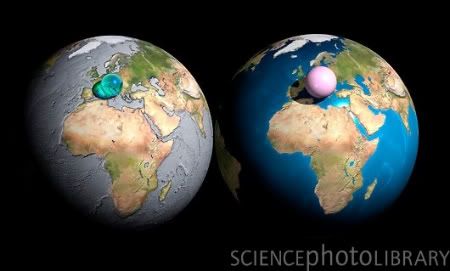
Here’s a picture I came across, done by Adam Nieman, whose aim is to get us to appreciate the environmental challenges we face, due to the fact that the volumes of water in our oceans and air in our skies really aren’t as large as we imagine. The graphic depicts the actual size of the Earth’s oceans (the small blue sphere on the left) and atmosphere (if it were at sea-level air pressure, the small white sphere on the right).
Since everything seems to come down to dollars and cents nowadays, I’l close with this reminder: It may be expensive to keep our planet clean, but it’s even more so to clean it up once it’s dirty.
What wealthy folks are investing in saving our 750,000,000 acres of public trust lands? In housing for homeless? In cleaning up the plastic island in the Pacific larger than Alaska? In cleaning up the mercury from the oceans, the Great Lakes, the Chesapeake Bay, and the Caribbean Sea? In cleaning up sewer and gray flush water? In getting rid of Africanized Bees? In finding solutions to the 20 million malnourished American kids who go to sleep hungry every night? In the 27,000 square mile Navajo Nation with 400,000 citizens that are 50% unemployed? In finding a cure for diabetes for 60% of the children on the 585 First American Nations?
What wealthy folks are investing in the rusting inner cities or the 23,000 rural communities at risk of extinction? In saving millions of homes in foreclosure? In Veterans Administration Hospitals? In our crumbling bridges and highways? In closing and protecting our borders? In soil restoration after prolonged drought? In 20,000,000 Americans who are unemployed or underemployed?
Last night we published our 2500th blog post. My sincere thanks to all of our contributors and supporters, and to the many dozens of fine friends I’ve made along the way.
I smile sadly when I hear about people rushing into retirement, and at my age (57) I’m surrounded by them. I want to be doing this until I take my final breath on this planet.
Renewable energy worldwide received six times less support — an imbalance that is just starting to earn attention in the divisive negotiations on curbing the carbon emissions blamed for heating the planet.
“We need to stop funding the problem, and start funding the solution,” said Steve Kretzmann, of Oil Change International, an advocacy group for clean energy.
Right on, Steve. It’s really just that simple. As long as the world keeps dumping huge sums of cash into making fossil fuels financially attractive, we’ll keep running 100 miles per hour into a global catastrophe. Thanks for your efforts to shine a light onto this tragedy. Keep up the good work.
Here’s an article that presents the subject of waste-to-biofuels in a very readable, high-level way. In the U.S., we’re converting about 3% of our organic waste to some form of useful energy, as compared to 37% in Europe. Of course, this points to the huge potential remaining here, if we are able to assemble the public-private partnerships that are required to collect and process the waste.
When I was still a kid, one of the movies I loved was Back to the Future. Yeah, and you can bet your dollar that one of my most favorite machines would be the time-travelling car that Marty McFly rode to get back into the past. Back then, everything that came from the said movie seemed “futuristic” and the energy that powered up the car’s time-travelling engine fascinated kids and adults alike. Unfortunately, that kind of energy capacitor has not yet been invented, but who knows? Perhaps a genius inventor may finally discover or make one.
Speaking of energy, I’ve chanced upon an article in the Internet that talks about the possibility of using human fat into energy. Are you kidding me? Human fat? (more…)
In the recent past, the goal for many business school graduates was to pursue their MBA in order to find a more lucrative salary. Today, a simple MBA may not be enough. As the world goes green, business school grads find it more beneficial to concentrate on a defined degree once they head to graduate school. Here’s where a green MBA can take you:
1.Finance Jobs in the financial sector are sought after by hundreds of business school graduates every year thanks to their high salaries. Because demand for these jobs is so high, it makes sense to stand out from the crowd. With a green MBA, you can find a job as an economic analyst for existing and new businesses who want to enhance their green status and reduce their negative impact on the environment. You may take part in corporate sustainability efforts, help to develop new technologies or even work on cost-analysis projects. (more…)
Sara Biddle writes grants for 2GreenEnergy clients in small business and agricultural production who may be looking for funding from government entities, utilities, or private foundations. Sara’s background makes her a perfect fit for this position; she earned her Master’s in Environmental Law and Policy from the Vermont Law School, then began working in the solar industry, where she focused on residential sales, grant writing and some renewable policy work. Sara continues to work in solar, now in commercial sales.





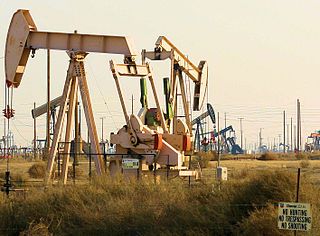 As those of us who are concerned about global climate change turn our attention to the COP-18 meetings in Qatar, we note that