When a captain of industry like FedEx CEO Fred Smith makes a statement on our nation’s dependence on oil like:
“What is needed now is an urgent, national commitment to action. As oil prices once again top $100 a barrel, we’re unveiling a video that we hope will help bring more attention to doing just that.”
You can question Mr. Smith’s motives for wanting government support for a less expensive and more stable/predictable source of fuel for his trucks and airplanes, but it’s certainly good to see him on the right side of the issue.
I just got off phone with frequent commenter and insurance pro Bill Waite, who called my attention to an interesting article. I know essentially nothing about the risk modeling that insurance people do in their sleep, but I’d like to call readers’ attention to this piece on the import of the fact that of the 104 nuclear power plants in this country, 23 are within 30 miles of a geologic fault. My intent isn’t to make people any more worried than they should be, but to point out the great number of disciplines that go into analyzing things like this.
To the surprise of no one, The Clean Air Act is under siege in the Senate. Fortunately, four amendments attacking our clean air each failed to get the required 60 votes to pass in yesterday’s sessions. But I was a bit shocked to see that 17 democrats sided with big polluters and radical republicans, and cast at least one vote to undermine the Clean Air Act’s ability to limit carbon pollution. What’s even more alarming is that several democrats — Jay Rockefeller, Debbie Stabenow, Sherrod Brown, and Max Baucus — were actually the sponsors of three of the four anti Clean Air Act amendments.
But how astonishing is this really? Let’s keep it in perspective. So politicians show that they have no spine, and go whatever direction the wind blows. Didn’t we already know that?
I’d much rather drive than fly if the trip is less than about five hours by car. For that reason, I’ll be driving to San Jose this afternoon for one of my “Craig Shields…At Your Service” sessions, in which I’ll be advising a client on a business strategy for his synthetic fuels concept. From what I can determine, this looks like a real breakthrough.
These are the kind of projects I love: working with a smart guy whose strength lies in the science, wide open to a range of business possibilities, and richly appreciative of the value that I bring to the table. With any luck, we can change the world.
Clean Energy Trends 2011, the annual report from Clean Edge, Inc., was recently published. This is the 10th annual report the company has written on green energy, with now a full decade of accumulated information of the industry.
The authors, including Ron Pernick, tell us that ten years ago when the first Clean Energy Trend report was released, the concept of “clean tech” was virtually unknown in the mass media, among politicians or in business circles. In fact, they say, “At the time, there (more…)
Here’s a continuation of my conversation with a reader on the EV adoption curve, where he writes:
You are so right. Maintenance is an issue if you decide to own your car for a long, long time. But with a 4-year payback, the Focus will probably get by on just oil changes and some light maintenance. Leaf offers a 3-year $349/month lease with $1,999 down. So maybe a 3-year payback is necessary.
Fast charging is not a solution to anything. Fast chargers are very expensive and will never pay back ever. With electricity at 10 cents per kWh, they just don’t make sense…take a 100A at 240 VAC – 24kW, now you charge for 30 minutes = you use 12kWh times 10 cents = $1.20. Not much there for anyone.
Will EV costs come down? Maybe but very, very slowly. The (more…)
A reader who predicts a slow EV adoption curve writes:
Americans are addicted to not only to oil but also to driving. Most Americans see automobiles as freedom to do whatever, whenever they like. They do not like to be restricted by anything, including their vehicles. Early adopters are slightly different and are probably wealthy enough to have a bunch of cars to drive on any given day. So it is more a fashion statement or “I am green” statement.
At $26,220 for a Leaf and $21065 for 5 dr Focus with automatic trans; the cost penalty is $5,155. Assume 12,000 miles driving per year. Focus get 31 mpg composite = 387 gallons gas at $4 per gallon = $1,548 for gas and the Leaf gets 100 miles on 23 kWh which takes $2.53 per charge ($0.11 per kWh) x 120 charges = $303 for electricity. Net savings per year is $1,244 and divide that into $5,155 = 4.14 year payback. Marginal but add into that the fact that you can’t drive it if you have to go more than 100 miles. Logical answer for today’s mainstream customer is no thank you.
To which I reply:
This is very good stuff, but here are a couple of points:
Total cost of ownership over years of oil changes, tune-ups, valve jobs, radiator leaks, exhaust systems, smog checks, etc. on ICEs is replaced by a car with almost no moving parts, no explosions going on in it, almost no maintenance expense and better peace of mind.
Until we have a good, ubiquitous fast-charging solution (decades), most EVs will be sold into multi-car families who can always take the ICE if they want to go on a road trip. How many such families like that are there? Tens of millions.
Costs will be coming down as technology improves and scale is achieved.
In addition to making the statement that “I am green,” the driver is making the statement “I am patriotic” (by not driving my country into debt to foreign enemies, not to mention wars that are costly in terms of both dollars and lives). As a marketing guy, I only hope I get the chance to tell this story; I promise you, I’ll have a FIELD DAY with it.
But my friends at OnGreen seem undaunted. Check this out. They’re plunging in head first, with a very creative marketing idea: a contest in which the first five CEOs of prospect companies they select to make presentations to Chinese cleantech investors are given free roundtrip air fare from Los Angeles to Shanghai.
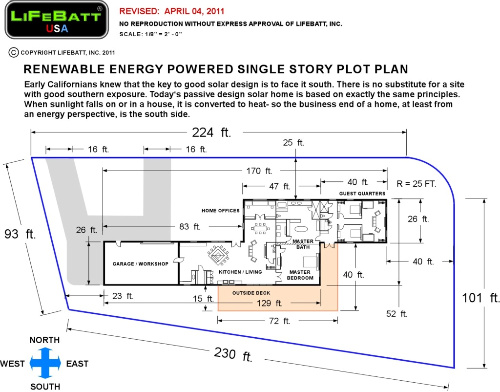
While researching this article to learn more about how to design an Energy Efficient Home, I spent much of my time on the internet to see just what is out there right now that could be incorporated into a new Model for Residential Houses. So, most of this information is not mine – but freely available to anyone who wants to conduct their own research. I put much of what I found here just to save you the time to do your own homework – but at least it will give you a few ideas and you can then do your own further investigation. (more…)
The problem with Cold Fusion is not the energy, nor the impossibility of it, but that in order to acknowledge it, someone has to admit that what they thought they knew is not what ‘is’. Beliefs are tough to shed.
Funny you mention that. When I was out at Tom’s place last week, this is exactly what he told me. And he’s right, of course. The reason paradigms stay in place and blind us in our research is that we feel much better confirming rather than disconfirming what we believe.










 Clean Energy Trends 2011, the annual report from Clean Edge, Inc., was recently published. This is the 10th annual report the company has written on green energy, with now a full decade of accumulated information of the industry.