I’ll be at the IEEE Energy show in Boston next week, a trip during which I’ll be meeting with numerous other 2GreenEnergy associates and clients – and also knocking out a few interviews for my next book on Renewable Energy Job Creation.
If you’re in the area, and you’re available for a cup of coffee, please let me know.
We need to get government OUT of control or manipulation over energy. The only role of government is to protect citizens from excessive pollution (excluding the CO2 global warming farce). Let the private sector invest and develop the technologies and let the most ECONOMICAL and CLEAN energy win. A job created by government taking of wealth does NOT create wealth…..it just destroys it.
Alex: I actually agree with most of this. The problem lies in extricating government fully — not just out of the clean energy side, but from the fossil fuel side as well, which, according to reports I find credible, receives 12 times the level of funding that renewables does. And it goes without saying that the nuclear energy industry couldn’t exist for 10 minutes without enormous government subsidies. The U.S. nuclear industry has received $100 billion in government subsidies over the past half-century, and federal subsidies now worth up to $13 billion a plant.
I like to think of myself as a man who doesn’t have to be right all the time. But once in a while, it really ain’t so bad. I have to think that this article on young people’s auto buying/driving habits is an indication that there might be some substance to my theory that we’re facing a paradigm shift in this space, in which we, as a society, cease to define ourselves according to the price of the car we drive. Linked above is a video I made not too long ago in which I mention this phenomenon.
Again, not to brag, but the author repeats my thesis virtually verbatim:
Unlike their elders, Generation Yers own fewer cars and don’t drive much. They’re likely to see autos as a source of pollution, not as a sex or status symbol.
Ta-da!! Just kidding. Sort of. 🙂
Thanks to avid supporter Cameron Atwood for bringing this to our attention.
I deeply appreciate those of you who follow my observations of the renewable energy industry. Not everyone agrees with everything I write, but that’s quite OK with me, as disagreement is what helps us all get to the root of important matters — in this case, those that surround the technology, economics, and politics of clean energy.
Here’s another idea I thought I’d provide about which there is also room for controversy: strategic marketing. As I’ve documented in my website that describes my marketing consultancy — The Shields Group — marketing has an extremely specific function: driving sales revenues. (more…)
I’m always interested in what the folks in electric vehicle auto design come up with. Common wisdom dictates an approach in which an EV driver makes a bold and clear statement of his choice — and his environmental consciousness — to the world around him. And, from a design perspective, this isn’t at all hard to accomplish (but of course, that’s easy for me to say). Simply building something a bit smaller and more aerodynamic than our standard coupes and sedans of the early 21st Century gets the job done nicely, while extending range and thus improving driver convenience. The recently unveiled four-passenger electric car (pictured here) designed by a team of entrepreneurs based near Paris, called NEOMA, is a terrific example — though some might find it a bit extreme. (more…)
The Seoul Metropolitan Government reports that it plans to install more than 100 EV chargers by the end of 2010. The government recognizes that lack of EV charging facilities slows down promotion of green vehicles, and so took the step of signing agreements on May 28th with three Seoul-based retailers to install the needed chargers. The agreement would allow visitors to these retailers to charge their vehicles free until the end of this year – and it may be extended. A number (more…)
Each year, we come across a new set of discussions on the subject of Moore’s Law — the idea that the potency of technology doubles every two years. Intel co-founder Gordon Moore observed that the number of transistors that could be put onto an integrated circuit doubled with that regularity — and that this exponential growth persisted for an astonishingly long period of time.
Of course, we look upon this “law” figuratively. There is no secret force that makes it apply to every technology – or that requires the period of time in question to be exactly two years. But we’ve all seen adequate proof of the “spirit of the law,” i.e., that many technologies do, in fact, experience some sort of geometric expansion.
As we should have expected, it was only a matter of time until pundits began to debate the relation of Moore’s law to the energy industry. Recently we’ve seen numerous conversations regarding its application to the development of renewable energy technologies.
However, many people say that it simply doesn’t apply in this case, as such projected growth ignores the basic realities of energy: the long-term maturation of technologies, and the hard limits in efficiency that are put on us by more senior laws – namely those of physics itself. But here are a few points to consider: (more…)
A reader points out that in talking about utility scale solar, only mature technologies are used — usually 20 to 30 years mature or more. He observes how long it’s taken PV to be seriously considered for plants over 10mW. But he goes on to talk about the Stirling Dish System, noticing that the system holds the efficiency world record for sun to grid electricity at 31.5%, and has minimal water use and half the land area and prep requirements of PV.
The only caveat I would offer about CSP and Stirling is energy storage. Once heat energy is converted to electricity, it has to be used, since storing electrical energy is expensive, and converting it back into some other form of energy is inefficient. The beauty of CSP is that storing heat energy (e.g., in molten salt) is much easier and less expensive than storing electricity.
I try to pay attention to the activity of the big boys, figuring that multi-billion dollar companies are extremely unlikely to bet on the wrong horse. Note, in particular, that earlier this year, French energy giant Areva bought Ausra, a venture-capitalized CSP innovator interest in molten salt technology is quite obvious.
I’m trying to develop solid ideas for a path to pursue this upcoming book on Renewable Energy Job Creation. I woke up this morning with what I think is a good one: Why not head back to alma mater Georgetown with a plea from an alumnus? Please let me interview a few economics professors. The idea makes sense, but it makes me wish I’d been more generous in my donations.
When I’m in Washington DC, of course, I can knock out talks with folks at the Brookings Institute and a few other organizations. Voila! Instant book!
Of course, this content can have additional purposes. I’m thinking webinars, blogposts, and lectures. And here’s another idea: consulting to politicos. My friend Bruce Allen spends a great deal of time working with US senators and representatives, helping them define their stance on off-shore oil drilling. Couldn’t I do the same on renewable energy vis-a-vis jobs?
My wife points out that this direction is so much narrower than the one I took in Renewable Energy Facts and Fantasies. True, but I think that’s a good thing. Now, I think it’s time for a few deeper dives.



 I’ll be at the IEEE Energy show in Boston next week, a trip during which I’ll be meeting with numerous other 2GreenEnergy associates and clients – and also knocking out a few interviews for my next book on Renewable Energy Job Creation.
 I like to think of myself as a man who doesn’t have to be right all the time. But once in a while, it really ain’t so bad. I have to think that this article on
 I deeply appreciate those of you who follow my observations of the renewable energy industry. Not everyone agrees with everything I write, but that’s quite OK with me, as disagreement is what helps us all get to the root of important matters — in this case, those that surround the technology, economics, and politics of clean energy.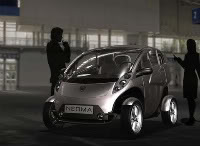
 I’m always interested in what the folks in electric vehicle auto design come up with. Common wisdom dictates an approach in which an EV driver makes a bold and clear statement of his choice — and his environmental consciousness — to the world around him. And, from a design perspective, this isn’t at all hard to accomplish (but of course, that’s easy for me to say). Simply building something a bit smaller and more aerodynamic than our standard coupes and sedans of the early 21st Century gets the job done nicely, while extending range and thus improving driver convenience. The recently unveiled four-passenger electric car (pictured here) designed by a team of entrepreneurs based near Paris, called NEOMA, is a terrific example — though some might find it a bit extreme.

 Each year, we come across a new set of discussions on the subject of
 I don’t know how many readers check out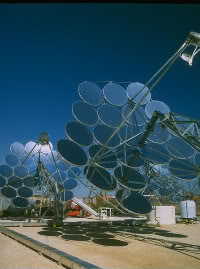
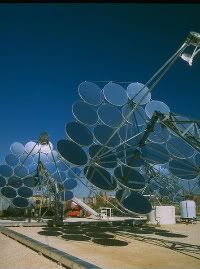 A reader points out that in talking about utility scale solar, only mature technologies are used — usually 20 to 30 years mature or more. He observes how long it’s taken PV to be seriously considered for plants over 10mW. But he goes on to talk about the Stirling Dish System, noticing that the system holds the efficiency world record for sun to grid electricity at 31.5%, and has minimal water use and half the land area and prep requirements of PV.
 I’m trying to develop solid ideas for a path to pursue this upcoming book on Renewable Energy Job Creation. I woke up this morning with what I think is a good one: Why not head back to alma mater Georgetown with a plea from an alumnus? Please let me interview a few economics professors. The idea makes sense, but it makes me wish I’d been more generous in my donations.


