The press office at Massachusetts Institute of Technology (MIT) announced this week that a team of researchers has made a breakthrough on battery technology in the form of lightweight lithium-air batteries could have three times the energy density of current models.
Lithium-ion batteries currently dominate the field of small electronics — and are the prime candidates for electric vehicles. Lithium-ion batteries use a light metal (lithium), and they don’t suffer power loss when they are charged up time and time again. However, for such applications as in an electric vehicle, they are still heavy, and researchers have been working hard to improve energy density – the amount of energy stored by kilogram. Lithium-air batteries use the same general concepts, but replace the heavier compounds found in lithium-ion batteries, which makes them lighter. In fact, the research team says that their breakthrough could lead to batteries with three times the energy density of existing batteries. (more…)
Many of us were saddened to hear of the retirement of US Supreme Court Justice John Paul Stevens. In no way am I qualified to comment on the breadth of his career and the numerous positions he took on the thousands of cases he heard over 35 years on the bench. I will, however, mention three aspects of his legacy that affect every one of our lives: (more…)
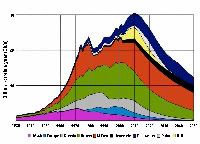
I’m delighted to see the flurry of recent activity from a few guest bloggers. I note that Kathy Hershelow writes volumes on Peak Oil. It’s good, well-constructed stuff – but I simply can’t get excited about it. In my discussions on the subject, I just try to make sure I’m hitting the broad side of the barn.
As I note in my blog on Renewable Energy World, I think the issue is moot. Regardless of whether Peak Oil happened a couple of decades ago, or won’t for a couple of decades to come, there are five or six excellent reasons to curtain our use of petroleum. It’s the single most important imperative facing mankind today.
Oxford University’s Smith School of Enterprise and Environment recently released a report that indicates the ‘tipping point’ is now here for world oil reserves, and that demand will start to outstrip supply of oil as we head to the middle of the decade. They state that the need to accelerate renewable energy resources is urgent.
It seems the peak oil situation is starting to be noticed and recognized more generally, though alarms have been sounded for decades from some very notable sources. The stress of the situation includes: (more…)
I received an email from renewable energy rock star Bill Paul just now:
just fyi — following is from tom friedman’s column this morning.
Obama-ism posits that we are now in a hypercompetitive global economy, where the country that thrives will be the one that brings together the most educated, creative and diverse work force with the best infrastructure — bandwidth, ports, airports, high-speed rail and good governance. And we’re in a world with a warming climate that is growing from 6.8 billion people to 9.2 billion by 2050, so demand for clean energy is going to go through the roof. Therefore, E.T. — energy technology — is going to be the next great global industry.
…to which I respond:
It’s funny, I read the bottom before reading to the top, and I thought, “Gosh that sounds like Tom Friedman.” As you know, I read his books, I try to catch him on Charlie Rose, and I greatly admire him overall. But this predictability is what slightly irritates me about him: when you look at exactly what he’s saying, it’s pretty non-controversial. “We are now in a hypercompetitive global economy, where the country that thrives will be the one that brings together the most educated, creative and diverse work force with the best infrastructure?” Wow, I don’t know Tom; you’re really going out a limb there, my friend.
From today’s Tom Friedman column in the New York Times:
Obama-ism posits that we are now in a hypercompetitive global economy, where the country that thrives will be the one that brings together the most educated, creative and diverse work force with the best infrastructure — bandwidth, ports, airports, high-speed rail and good governance. And we’re in a world with a warming climate that is growing from 6.8 billion people to 9.2 billion by 2050, so demand for clean energy is going to go through the roof. Therefore, E.T. — energy technology — is going to be the next great global industry.
Craig Shields predicts a paradigm shift in American consumers’ driving habits, based on increasing sensibilities re: sustainability. Citing the backlash against the fur industry in the 1960s, Craig predicts a larger-than-expected demand for electric vehicles based on his belief that people are re-thinking their identification of themselves with the car they drive.
In his blog, my friend Paul Scott has written a marvelous post on calculating the pollution caused by charging electric vehicles with energy from fossil-fuels. He makes several astute comments and suggestions regarding how the EPA should, in fact, make this determination fairly.
He asks such questions as:
How do you compute the amount of pollution generated from coal and natural gas? Do you take the national average for a kilowatt hour of energy? I’ve read it’s just over one pound of CO2 per kWh. Or do you allow for regional variation? California is among the best in terms of per capita efficiency and a low CO2 grid, and we’ll be the first state to mass adopt EVs. Oregon and Washington have an even cleaner grid and will match CA in per capita EV ownership. Seems only fair to allow for our cleaner grid in the calculations.
In my estimation, a far bigger factor here is that the vast majority of the energy used to charge EVs comes off-peak, where it would largely be wasted (dumped back to ground) anyway. Therefore, even EVs powered by the dirtiest of coal-fired power plants represent very little additional pollution. We could put an estimated 90 million EV on the road this afternoon without the need for a single additional power plant — coal, nuclear, or whatever. Thus this issue, I believe, is largely moot.
But don’t expect the EPA to grasp this point too quickly. These are the same people who are still trying to determine the MPG ratings for a plug-hybrid like the Chevy Volt. Apparently, the fact that this is number that has no possible definition (it could be 50, 500, 5,000 or 50,000 depending on how the car is driven) does not deter them from spending many man-years studying and debating the issue. It makes just as much sense to argue about the number of angels that can dance on the head of a pin.
In any case, I applaud Paul for his incisive and fair-minded article, and I encourage readers to check it out here.
I just spoke with Omar Passons — a terrific young man with a novel idea aimed at sustainability — a shuttle bus that would connect parts of cities that contain two or more islands with great deal of foot traffic, but whose islands are sufficiently far apart that people would not walk between them. The first such instance of this is San Diego, as described on his website: Park-2-Park. He describes the shuttle as a fun, new, convenient way to see and do more when you’re in North Park, South Park, Normal Heights or University Heights. The “Park-2-Park” connects these communities with 9 shuttle stops at local restaurants, bars, studios, and music venues.
“…Yesterday I listed a few of the hottest new innovations coming our way in clean tech. Here are a few more.
DuPont and Bio Architecture Lab are developing a process to produce bio-butanol from seaweed. This project is funded through ARPA-E. (Geology. “Renewable Natural Gas from Algae”. May 2009).
CalStar Products plans to build a factory that would make bricks from a by-product of coal burning (fly-ash). This may help reduce carbon-dioxide emissions.
The Bloom Box from Bloom Energy has received much press since they revealed themselves publicly in February 2010. The chief officer K.R. Sridhar used sand to create wafers similar to floppy disks that serve as electrolytes. Says the New York Times, as fuel passes over the cells and mixes with oxygen ions, the reaction is electricity. Each cell generates 25 watts, and a 100 KW Bloom Server fits into the size of a parking space. A box of fuel cells could allow homes and businesses to generate their own electricity. Bloom spent about a decade working on its fuel-cell tech, and on a proprietary low-cost seal to prevent cracks and seals. About a year and a half ago, they installed 100 KW Bloom Boxes at several corporate giants for testing: eBay, Google, Wal-Mart, Bank of America, etc. These boxes apparently cost between $700,000 – $800,000 each, and a great deal of work will be needed to bring pricing down though Sridhar says the actual cost to generate electricity is low. Sridhar believes his application could power homes in five to ten years. (New York Times. “A Secretive Start-Up Raises the Curtain.” By Todd Woody. February 24, 2010).
The world’s largest independent rotor blade manufacturer, LM Glasfiber, and several partners are developing a new laser-based wind sensing system. This is a three-year research project in Denmark that started in 2009 with financial support from the Danish National Advanced Technology Foundation. They believe the system, called ‘wind Lidar’, can predict wind direction, gusts and turbulence and the application will improve overall reliability and efficiency. Instead of measuring wind load after the fact, they will be able to measure wind in real-time and have the blade or turbine react instantly. This would not only create more efficiency but better energy yield, they say.
A Virginia-based company, Catch the Wind, is working on a similar onshore system that will sense wind direction, speed and variations, called the Vindicator Laser Wind Sensor. The technology is a spin-off of the U.S.–based Optical Air Data Systems (OADS), an optical remote sensing technology founded in 1990. The OADS system is covered by 27 patents, and was created to improve flight safety. Catch the Wind acquired a technology license from OADS for non-aviation applications in 2008. By September 2009, Catch the Wind announced it had a manufacturing agreement with Canadian BreconRidge Corp, a fiber- optics specialist, who will provide design, technical, engineering and other services for manufacture of the Vindicator. Subsequently, Catch the Wind and the Nebraska Public Power District collaborated on a joint trial. The successful trial confirmed the Vindicator’s capabilities, says the company President. The system can see approaching winds 300 yards out, and allows the turbine to make changes immediately – for more efficiency. The company is also testing an offshore application. (Renewable Energy World. “Eye on the Wind: Innovations Designed to “See” and Track Gusts”, by Eize de Vries. March 16, 2010).
Dr. Yet-Ming Chiang of MIT is working to improve the chemistry of lithium ion batteries that could be used for solar residential power and for hybrid vehicles. The current generation of these batteries, when used for large-scale storage, tends to burst into flames. Finding a safe way to store the sun’s unlimited sunlight is necessary to advance solar power and use of stronger batteries in cars.
I would like to highlight Daniel Nocera and his breakthrough work:
Daniel Nocera, a chemist and Dreyfus Professor of Energy at Massachusetts Institute of Technology (MIT) also runs the SunCatalytix company. He and fellow Matthew Kanan discovered an inexpensive and easy way to store energy which could change energy around the world. In a nutshell, he developed a technology that splits water into hydrogen and oxygen to enable storage of solar and wind energy for 24-hour use. The idea is that when the sun isn’t shining (at night, rainy days), you will have already collected and stored the solar power. Nocera says energy stored in the size of a water bottle could power an average U.S. home. The technology could be groundbreaking for areas where there is no power or power grid (countryside, third world countries, islands) but could also allow typical households to power themselves.
This project received some funding from ARPA. Nocera thinks this process will bring solar mainstream, stating that we can’t hope to have a solar economy unless it can be produced 24/7. The discovery was made in mid 2008 and the team has been working at improving, testing and finding the right way for all to use. His goal is a robust system that is low maintenance.
“Solar power has always been a limited, far-off solution. Now we can seriously think about solar power as unlimited and soon,” he said in Science on July 31, 2008. He is confident and hopes that within 10 years
U.S. homeowners will be able to power their homes in daylight through solar photovoltaic cells and power their own household fuel cell at other times with the excess stored energy.
Nocera asks on the MIT website – what will be the oil of the future? He hopes it is as simple as water plus sun.
There are many more technological advances in the works in many places and exciting technologies seem to be bubbling up. Turning a bottle of water into energy storage for a home is just one example. These advances will help green tech advance to become more efficient and more financially viable.



 The press office at Massachusetts Institute of Technology (MIT) announced this week that a team of researchers has made a breakthrough on battery technology in the form of lightweight lithium-air batteries could have three times the energy density of current models.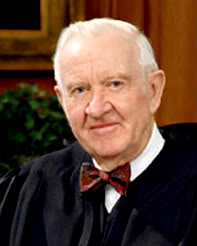
 Many of us were saddened to hear of the retirement of US Supreme Court Justice John Paul Stevens. In no way am I qualified to comment on the breadth of his career and the numerous positions he took on the thousands of cases he heard over 35 years on the bench. I will, however, mention three aspects of his legacy that affect every one of our lives: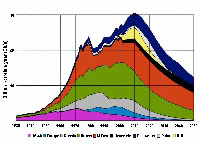
 I’m delighted to see the flurry of recent activity from a few guest bloggers. I note that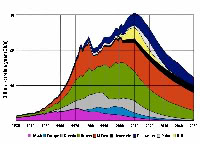

 I received an email from renewable energy rock star Bill Paul just now:
 In his blog, my friend Paul Scott has written a marvelous post on
 I just spoke with Omar Passons — a terrific young man with a novel idea aimed at sustainability — a shuttle bus that would connect parts of cities that contain two or more islands with great deal of foot traffic, but whose islands are sufficiently far apart that people would not walk between them. The first such instance of this is San Diego, as described on his website:
  “…Yesterday I listed a few of the hottest new innovations coming our way in clean tech. Here are a few more.


