
Energy Subsidies

Frequent commentor Alex C. writes:
We need to get government OUT of control or manipulation over energy. The only role of government is to protect citizens from excessive pollution (excluding the CO2 global warming farce). Let the private sector invest and develop the technologies and let the most ECONOMICAL and CLEAN energy win. A job created by government taking of wealth does NOT create wealth…..it just destroys it.
Alex: I actually agree with most of this. The problem lies in extricating government fully — not just out of the clean energy side, but from the fossil fuel side as well, which, according to reports I find credible, receives 12 times the level of funding that renewables does. And it goes without saying that the nuclear energy industry couldn’t exist for 10 minutes without enormous government subsidies. The U.S. nuclear industry has received $100 billion in government subsidies over the past half-century, and federal subsidies now worth up to $13 billion a plant.
As I noted, this list of subsidies for fossil fuels takes many forms, some of them (deliberately?) hidden: (more…)

 I like to think of myself as a man who doesn’t have to be right all the time. But once in a while, it really ain’t so bad. I have to think that this article on
 I deeply appreciate those of you who follow my observations of the renewable energy industry. Not everyone agrees with everything I write, but that’s quite OK with me, as disagreement is what helps us all get to the root of important matters — in this case, those that surround the technology, economics, and politics of clean energy.
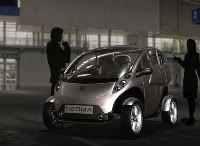 I’m always interested in what the folks in electric vehicle auto design come up with. Common wisdom dictates an approach in which an EV driver makes a bold and clear statement of his choice — and his environmental consciousness — to the world around him. And, from a design perspective, this isn’t at all hard to accomplish (but of course, that’s easy for me to say). Simply building something a bit smaller and more aerodynamic than our standard coupes and sedans of the early 21st Century gets the job done nicely, while extending range and thus improving driver convenience. The recently unveiled four-passenger electric car (pictured here) designed by a team of entrepreneurs based near Paris, called NEOMA, is a terrific example — though some might find it a bit extreme.

 Each year, we come across a new set of discussions on the subject of
 I don’t know how many readers check out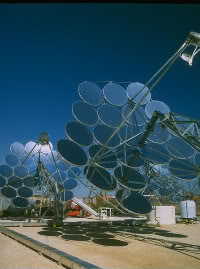
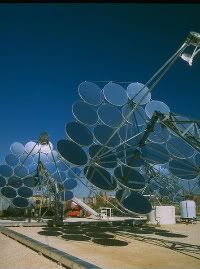 A reader points out that in talking about utility scale solar, only mature technologies are used — usually 20 to 30 years mature or more. He observes how long it’s taken PV to be seriously considered for plants over 10mW. But he goes on to talk about the Stirling Dish System, noticing that the system holds the efficiency world record for sun to grid electricity at 31.5%, and has minimal water use and half the land area and prep requirements of PV.
 I’m trying to develop solid ideas for a path to pursue this upcoming book on Renewable Energy Job Creation. I woke up this morning with what I think is a good one: Why not head back to alma mater Georgetown with a plea from an alumnus? Please let me interview a few economics professors. The idea makes sense, but it makes me wish I’d been more generous in my donations.
 The world’s oceans are a new frontier in the renewable energy world. Ocean energy is emerging and will be ‘make or break’ in the next five years, says the firm Pike Research that focuses on research and analysis of renewable energies. “The ocean energy business is right on the cusp,” says Pike’s managing director Clint Wheelock. He says more than 300 projects and tests are in the works around the world. (Press release, Pike Research. “Ocean Energy Could Reach up to 200 Gigawatts of Power Generation by 2025.” January 19, 2010.)


