I just spoke with Omar Passons — a terrific young man with a novel idea aimed at sustainability — a shuttle bus that would connect parts of cities that contain two or more islands with great deal of foot traffic, but whose islands are sufficiently far apart that people would not walk between them. The first such instance of this is San Diego, as described on his website: Park-2-Park. He describes the shuttle as a fun, new, convenient way to see and do more when you’re in North Park, South Park, Normal Heights or University Heights. The “Park-2-Park” connects these communities with 9 shuttle stops at local restaurants, bars, studios, and music venues.
“…Yesterday I listed a few of the hottest new innovations coming our way in clean tech. Here are a few more.
DuPont and Bio Architecture Lab are developing a process to produce bio-butanol from seaweed. This project is funded through ARPA-E. (Geology. “Renewable Natural Gas from Algae”. May 2009).
CalStar Products plans to build a factory that would make bricks from a by-product of coal burning (fly-ash). This may help reduce carbon-dioxide emissions.
The Bloom Box from Bloom Energy has received much press since they revealed themselves publicly in February 2010. The chief officer K.R. Sridhar used sand to create wafers similar to floppy disks that serve as electrolytes. Says the New York Times, as fuel passes over the cells and mixes with oxygen ions, the reaction is electricity. Each cell generates 25 watts, and a 100 KW Bloom Server fits into the size of a parking space. A box of fuel cells could allow homes and businesses to generate their own electricity. Bloom spent about a decade working on its fuel-cell tech, and on a proprietary low-cost seal to prevent cracks and seals. About a year and a half ago, they installed 100 KW Bloom Boxes at several corporate giants for testing: eBay, Google, Wal-Mart, Bank of America, etc. These boxes apparently cost between $700,000 – $800,000 each, and a great deal of work will be needed to bring pricing down though Sridhar says the actual cost to generate electricity is low. Sridhar believes his application could power homes in five to ten years. (New York Times. “A Secretive Start-Up Raises the Curtain.” By Todd Woody. February 24, 2010).
The world’s largest independent rotor blade manufacturer, LM Glasfiber, and several partners are developing a new laser-based wind sensing system. This is a three-year research project in Denmark that started in 2009 with financial support from the Danish National Advanced Technology Foundation. They believe the system, called ‘wind Lidar’, can predict wind direction, gusts and turbulence and the application will improve overall reliability and efficiency. Instead of measuring wind load after the fact, they will be able to measure wind in real-time and have the blade or turbine react instantly. This would not only create more efficiency but better energy yield, they say.
A Virginia-based company, Catch the Wind, is working on a similar onshore system that will sense wind direction, speed and variations, called the Vindicator Laser Wind Sensor. The technology is a spin-off of the U.S.–based Optical Air Data Systems (OADS), an optical remote sensing technology founded in 1990. The OADS system is covered by 27 patents, and was created to improve flight safety. Catch the Wind acquired a technology license from OADS for non-aviation applications in 2008. By September 2009, Catch the Wind announced it had a manufacturing agreement with Canadian BreconRidge Corp, a fiber- optics specialist, who will provide design, technical, engineering and other services for manufacture of the Vindicator. Subsequently, Catch the Wind and the Nebraska Public Power District collaborated on a joint trial. The successful trial confirmed the Vindicator’s capabilities, says the company President. The system can see approaching winds 300 yards out, and allows the turbine to make changes immediately – for more efficiency. The company is also testing an offshore application. (Renewable Energy World. “Eye on the Wind: Innovations Designed to “See” and Track Gusts”, by Eize de Vries. March 16, 2010).
Dr. Yet-Ming Chiang of MIT is working to improve the chemistry of lithium ion batteries that could be used for solar residential power and for hybrid vehicles. The current generation of these batteries, when used for large-scale storage, tends to burst into flames. Finding a safe way to store the sun’s unlimited sunlight is necessary to advance solar power and use of stronger batteries in cars.
I would like to highlight Daniel Nocera and his breakthrough work:
Daniel Nocera, a chemist and Dreyfus Professor of Energy at Massachusetts Institute of Technology (MIT) also runs the SunCatalytix company. He and fellow Matthew Kanan discovered an inexpensive and easy way to store energy which could change energy around the world. In a nutshell, he developed a technology that splits water into hydrogen and oxygen to enable storage of solar and wind energy for 24-hour use. The idea is that when the sun isn’t shining (at night, rainy days), you will have already collected and stored the solar power. Nocera says energy stored in the size of a water bottle could power an average U.S. home. The technology could be groundbreaking for areas where there is no power or power grid (countryside, third world countries, islands) but could also allow typical households to power themselves.
This project received some funding from ARPA. Nocera thinks this process will bring solar mainstream, stating that we can’t hope to have a solar economy unless it can be produced 24/7. The discovery was made in mid 2008 and the team has been working at improving, testing and finding the right way for all to use. His goal is a robust system that is low maintenance.
“Solar power has always been a limited, far-off solution. Now we can seriously think about solar power as unlimited and soon,” he said in Science on July 31, 2008. He is confident and hopes that within 10 years
U.S. homeowners will be able to power their homes in daylight through solar photovoltaic cells and power their own household fuel cell at other times with the excess stored energy.
Nocera asks on the MIT website – what will be the oil of the future? He hopes it is as simple as water plus sun.
There are many more technological advances in the works in many places and exciting technologies seem to be bubbling up. Turning a bottle of water into energy storage for a home is just one example. These advances will help green tech advance to become more efficient and more financially viable.
“…Because energy has become a focus for innovation, things will start to move faster…The most important thing we did is make energy an interesting area for Ph.D. students over the last five years,” said Vinod Khosla at the inaugural ARPA-E (Advanced Research Projects Agency – Energy) conference in March 2010. And, as one of the most influential men in Silicon Valley – the co-founder of Sun Microsystems, Mr. Khosla should know. Khosla has raised more than $1 billion for a green-tech fund is based on following – and setting – cutting-edge trends.
Those of us who follow the renewable energy world focus on the market applications of solar, wind, hydro and biomass — the politics and financial issues – and the statistics on what is being installed. But here, in a lesser-known world of R&D. scientists and researchers are working tirelessly on the next great discovery that could change the entire landscape. It’s a fascinating world – and one that is ramping up fast.
Science Will Move Renewable Energy Forward
ARPA-E, or Advanced Research Projects Agency-Energy is a fairly recent US government agency, established to drive R&D within the energy sector, and was formed in response to the U.S. losing its tech lead. The director, Arun Majumdar, said “We have a Sputnik moment right now. We are losing our technology leadership and we are falling behind. Our role is to take the high-risk, high-payoff approach to developing technologies… Business as usual and the pace of innovation is just not fast enough.” (Scientific American podcast. “Seeking Transformational Energy Technologies”, by David Biello. March 2010).
Massachusetts Institute of Technology (MIT) and a host of university researchers here and abroad are also busy on clean tech — and so are corporations. The National Energy Research Lab (NERL) plays a part, too. Some of the research comes from stimulus funding or separate ARPA-E funding, while some funding is from private sources and venture funds.
Just a few recent discoveries and innovative work in solar, wind and biomass include:
A research team led by Australia’s Monash University announced in December 2009 a breakthrough in developing more efficient and viable solar cells. The have developed and produced dye-sensitized solar cells which increase energy generation performance threefold. Still in its infancy, the discovery may lead to a lower-costs and more efficient use of solar. (Asian News International, January 10, 2010).
California Institute of Technology and the team of Harry Atwater have developed a flexible solar cell that can be built into clothing using an array of microwires embedded in clear flexible polymer. The wearable cells could charge gadgets while on the move, reported Asian News International on February 22, 2010. The application won’t be used only in clothing, either. Its tiny silicon wire uses one hundredth of the current silicon technology on the market. These tiny wires or whiskers of silicon are lined up and sprinkled with aluminum oxide particles, which help scatter incoming light so it moves around inside the array of whiskers. Atwater says up to 85 percent of usable sunlight is absorbed with this technique. “We’ve broken through what people thought was the absorption limit,” Atwater said. (Asian News International. “Carpet of silicon whiskers could make solar cells cheaper”. February 15, 2010).
University of Texas researchers are using nanoparticle “inks” of tiny photovolatics to spray solar cells onto any surface. Currently this ink only converts 1% of sunlight to electricity, but researchers expect improvements with continued research and it may be efficient enough for market applications in three to five years.
Professors at Tel Aviv University have found a new energy source from the common pea. As we know, plants generate useful energy with their own nanotechnology using light as the energy source. “My research aims to come close to achieving the energy production that plants can obtain when converting sun to sugars…”, says Professor Nelson of his project. They isolated the minute crystals of the PSI super complex from the pea plant, can illuminate the crystals and use them as small battery chargers or use them to form the core of a more efficient solar cell. (ScienceDaily. “New Energy Source for the Common Pea…March 4,2010).
Professors at the University of Milan, University of Piedmonte-Orientale and Ludwig Maximilian University in Munich collaborated to identify a plant protein that optimizes light absorption during photosynthesis. This has relevance in capturing solar radiation as a renewable energy source. (Science Business. “Business Leads”, 24 Feb 2010).
A flashlight-sized device that generates electricity has been developed by engineer Aaron LeMieux and will be coming to market at some time in the near future. He wanted to develop a small personal generator sourcing kinetic energy. He is working on a larger product with the same engineering that could turn waves from a body of water into electricity. (Forbes. “Green Tech, Green Jobs: The New Face of Cleveland”. March 2, 2010)
Researchers at the University of Minnesota recently reported a breakthrough on improving electricity efficiency. They have created a system that moves electrons between proteins in cells. This gives insights on minimizing energy loss and improving energy efficiency. (University of Minnesota, March 2010).
Chemists at the University of New Hampshire successfully synthesized the first-ever stable derivative of nonacene. Nonacene belongs to a class of organic semi-conductors called acenes, widely recognized as the best semi-conductors for electricity – but the technology has been unstable until now. This advance could help applications such as solar cells and could cut costs. (Asian News International. February 14, 2010).
Dow Solar recently announced a new generation of solar panel rooftop shingles. Called building-integrated photovoltaic (BIPV) roof shingles, they wanted to address homeowner concerns on the aesthetic issue… some homeowners think rooftop solar panels are too ugly, they say. SRS Energy has created solar panels that look like standard clay roof tiles.
The Indo-Asian News Service reported that solar rooftop storage batteries may soon power homes in India. The government is in talks with MIT (Massachusetts Institute of Technology) to use their 1 MW-capacity prototype. The storage battery can also be charged with wind power. Both sun and wind are abundant in many parts of India. India will fund the pilot program.
Scientists at Stanford and IBM announced in early March 2010 a breakthrough on plastics and plastic recycling. IBM says that many plastic bottles are being recycled now but can only be recycled once. Most bottles made from second-generation recycled plastic have to be sent to landfills. However, their team found a way for plastics to become endlessly recyclable. The team used organic catalysts for a new way to produce but also breakdown plastic polymers.
IBM is expanding into alternative energy by unveiling a solar cell that is apparently 40 percent more efficient than others. They use common elements rather than rare ones to keep costs down. (Popular Science. February 11, 2010).
A team in London at Imperial College introduced a degradable plastic polymer made from sugars in February 2010.
Wood waste can be used in making biofuels but until now, complex sugars found in wood are not naturally digestible by micro-organisms that convert the waste, and the process has given rise to harmful by-products. Delft University researchers in The Netherlands discovered that a specific bacteria breaks down these harmful by-products produced when sugars are released from wood waste. This discovery could change all that. (Delft University of Technology, March 12, 2010. Reviewed in ScienceDaily. “Production of Chemicals from Wood Waste Made More Environmentally-Friendly and Cheaper”.
Natural gas created from algae is another new invention. The Department of Energy’s Pacific Northwest National Laboratory is bringing to market a method for converting algae to renewable natural gas under a license between Genifuel and Battelle. The process is called catalystic hydrothermal gasification. Apparently 99 percent of the biomass is gasified, and existing natural gas pipelines can deliver the fuel. This could be a future boost for producing electricity from renewable sources.
Craig Shields, former Libertarian, speaks on the role of government should play in energy policy, citing the need for a level playing field for renewable energy.
Transportation is a major cause of carbon emissions, so much so that it accounts to the north of 20 percent. The US, being at the forefront of industrial development, has its fair share in overall emissions. But the federal government in the states is pushing vehicle electrification in its bid to reduce dependence on foreign oil. President Obama has set a target of one million electric and plug-in hybrid vehicles on the road in the United States by 2015.
Steven Chu, Secretary of the US Department of Energy (DOE) claims, “Plug-in hybrid electric vehicles could revolutionize personal transportation and cut our dependence on foreign oil, not to mention give us cleaner air and less carbon pollution.” (more…)
On behalf of 2GreenEnergy, Craig Shields speaks on the Energy Industry, and the changes in perspective that are required if we’re to have a sustainable energy policy.
A number of people have commented on the post of frequent blogger Dan C. writes:
The problem IS the money. As long as your solution involves selling and buying something, then you are dependent on the System of systems and centralized currency. Ask yourself if your ‘green’ solution can be implemented locally with local materials and without money from outside interests. If not, it isn’t truly sustainable, it’s just Marketing. Marketing is a religion, fostered by belief in perpetual growth and owned by centralized authority.
It’s certainly true that we’re trained to be super-consumers. As always, Dan makes some excellent points about the underlying nature of the problem we’re all trying to solve. But two things:
1) I’m not so sure that the world would be a better place with seven billion Henry David Thoreaus living solitary, introspective, and misanthropic lives in crude huts.
2) Even if that simplicity would, in fact, be better, it seems quite impossible to turn back the clock and try to get there. From the end of World War II coming forward, Western Culture has aggressively taught us that we’re pathetic losers if we don’t have the right hair, the right car, vacation in the right countries, and, if we’re guys, sleep with women who look like Scarlett Johansson. It’s asinine, and it’s unsustainable, but it seems to sum up human civilization right now.
Yesterday’s announcement by Obama that he’s opening up East and Gulf coasts to offshore drilling is very good news, insofar as it will drive increased visibility of the imperatives for renewable energy. Coming on the heels of Obama’s announcement of federal loan guarantees for new nuclear power units, this now sets the stage for a strong administration push for climate change legislation by the fall — not that it will be called that, given how politically-charged that phrase has become. Obama is giving more moderate Republicans, especially SC Sen. Lindsey Graham, what they want and need to support a bill that is expected to include, for the first time ever, some sort of cap on carbon dioxide emissions. Exactly what that cap will look like and which companies and industries it will impact most will be the source of a lot of political haggling in the weeks and months to come.
In short, what everyone thought was dead, at least for this year, now seems very much alive. With healthcare out of the way, climate change legislation (which they’ll probably call energy legislation) should become the new buzz in Washington. On Wall Street, everyone’s going to wonder how this will affect different companies and industries, which is where we come in.
Separately, take a look at this recent Reuters story, specifically in the 3rd paragraph the mention of growing “institutional interest” in alternative energy. This too is good news.
I notice – with no particular level of surprise – that many of the comments we get on business blog posts suggest fairly radical ideas in terms of social reform. I am by no means an expert on this, though I do try to keep an open mind to ideas other than garden-variety capitalism.
In fact, I often ask myself: What would have happened in Cuba over the past 50 years if the US hadn’t done everything in its power to ensure the most miserable lives possible for those people? Are there valid alternatives to our way of life?
But, looking at these ideas in a cold and pragmatic light, it seems that these alternative social and economic construct only replace one set of horrors with another – in many case, horrors that are far greater. If market conditions do not set levels of production and consumption of goods and services, who or what does? Can anyone reasonably believe that a centralized government will do a better job than free-market capitalism?
Danish company Vestas, world wind turbine leader, has been expanding its production base in the U.S. where it says it created more than 1,200 skilled jobs, and expects that number to climb to 4,000 or more by the end of 2010. Vestas was encouraged by the Obama administration’s commitment to develop renewable energy; they say it hopes Congress will pass a national renewable energy standard to stabilize the U.S. market in the long term.
This key point, much discussed and highlighted lately, needs to be understood. The renewable markets, including wind, have been relatively unstable because tax credits and other policies are short-term and lapse with no assurance of continued support. Further, there is no policy enabled by a Renewable Electricity Standard, ensuring purchase of renewable energy by utilities.
Where China provides the wind industry assurance of growth with a $440 – $660 billion clean energy bill and requirement to buy renewable energy generated power, there is no corollary in the US
Europe is the undisputed leader in wind energy. 60% of world capacity was installed in Europe by the end of 2007, says the European Wind Energy Association (EWEA. “Wind Energy – The Facts”, February 2009) — and political support continues for growth. The European Union adopted a 20% renewable target by 2020 and followed with legislation in 2008 to support expansion. EWEA projects 80,000 MW installed by end of 2020. Denmark has already reached 21% of electricity supplied by renewables, and Spain sits at about 12%. The following chart, courtesy of the Energy Information Agency, illustrates the place that wind holds for electricity generation in Europe:
Underlying key factors in supporting U.S. legislation and policies for the renewable energy industry include:
job growth and economic opportunities abound;
clean energy is good for the environment and our health;
renewables are necessary long-term to wean us away from foreign dependence on fossil fuels
Key legislation, policies and credits are key factors for any country – the U.S or foreign – to invest. While The American Recovery and Reinvestment Plan (known as the stimulus funding) is a great boon to the new industries, it too is temporary and expires in 2012. Support will be needed from every quarter to continue the growth.



 I just spoke with Omar Passons — a terrific young man with a novel idea aimed at sustainability — a shuttle bus that would connect parts of cities that contain two or more islands with great deal of foot traffic, but whose islands are sufficiently far apart that people would not walk between them. The first such instance of this is San Diego, as described on his website: Park-2-Park. He describes the shuttle as a fun, new, convenient way to see and do more when you’re in North Park, South Park, Normal Heights or University Heights. The “Park-2-Park” connects these communities with 9 shuttle stops at local restaurants, bars, studios, and music venues.
 “…Yesterday I listed a few of the hottest new innovations coming our way in clean tech. Here are a few more.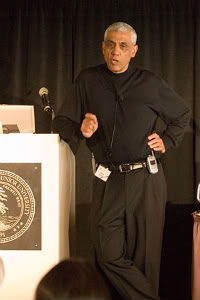
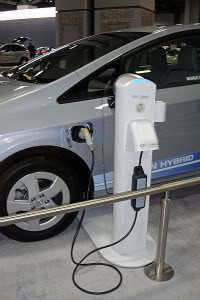
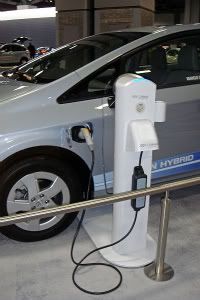 Transportation is a major cause of carbon emissions, so much so that it accounts to the north of 20 percent. The US, being at the forefront of industrial development, has its fair share in overall emissions. But the federal government in the states is pushing vehicle electrification in its bid to reduce dependence on foreign oil. President Obama has set a target of one million electric and plug-in hybrid vehicles on the road in the United States by 2015.
 A number of people have commented on the post of frequent blogger Dan C. writes:
 Yesterday’s announcement by Obama that he’s opening up East and Gulf coasts to offshore drilling is very good news, insofar as it will drive increased visibility of the imperatives for renewable energy. Coming on the heels of Obama’s announcement of federal loan guarantees for new nuclear power units, this now sets the stage for a strong administration push for climate change legislation by the fall — not that it will be called that, given how politically-charged that phrase has become. Obama is giving more moderate Republicans, especially SC Sen. Lindsey Graham, what they want and need to support a bill that is expected to include, for the first time ever, some sort of cap on carbon dioxide emissions. Exactly what that cap will look like and which companies and industries it will impact most will be the source of a lot of political haggling in the weeks and months to come.
 As suggested yesterday, here is a continuation.


