
Wind Power


 I recently had the pleasure of speaking with Dr. Amir Mikhail, Senior Vice President of Engineering for Clipper Windpower, in an effort to develop my chapter on wind for my upcoming book on renewable energy. This talk was full of interesting nuances about the physics and engineering aspects of cutting-edge the technology for extracting energy from the wind and converting it to mechanical – and ultimately to electrical energy. And, as suggested by today’s photo, we began with some fascinating history on the subject.
But Dr. Mikhail raised a few basic points about the renewables industry in general that I thought I would share in this post:
The issue of energy storage is – for the US at this point at least – something of a red herring. With 2% overall penetration of clean energy (across all forms of renewables) the fluctuation associated with the intensity of the wind – even locally — is of essentially no consequence to overall energy availability levels whatsoever. Moreover, by the time the penetration rate increases to anywhere resembling that of Europe, we will have developed smart grid technologies that will enable far better real-time control of large sections of the grid. E.g., if the wind is not blowing strong in area A, let’s see what it’s doing in area B, C, or D.
We also discussed the tough choices forced upon us a we migration to renewables. The wind industry takes seriously the issue of environmental damage associated with its farms, and conducts ongoing research to ensure that the size of turbine rotors and the hours of operation are creating a minimum of negative impact. In the early days of commercial wind, the primary issue was large raptors; now, decades later, the focus is on bats, whose tiny lungs cannot handle the differential in air pressure around the turbines. The industry also is making an effort to build farms in areas that already have a significant human footprint, recognizing the imperative to preserve the true wilderness wherever possible.
However, Dr. Mikhail points out that there are no existing clean energy technologies that come with zero environmental impact. We do have to make choices, and each of these choices will represent some level of sacrifice. “The people in a coal mining state back east were offered a choice of either putting wind turbines on a local mountain, or chopping off the top of the mountain, pulling the coal out of it, and burning it. Craig, do you realize that they chose the latter? There are choices. We simply have to make the best ones.”
Again, Dr. Mikhail, thanks for the insights.

 Reader Jacob Silver writes:
 I have to say that I’m quite happy to be part of the
 Not to harp on the obvious, but without vigorous grassroots efforts to the contrary, the migration to renewable energy and clean transportation will be slow and arduous. In news that underscores this point, Toyota unveiled its new plug-in hybrid, promising sales in 2011 at an “affordable” price. Executive vice president Takeshi Uchiyamada told an eager audience that Toyota’s plug-in travels 14.5 miles as an electric vehicle on a single charge.
 I don’t think too many of us had high hopes for definitive negotiations emanating from Copenhagen. Today we learned of China’s announcement that the developing world won’t commit to greenhouse gas emissions reductions until the developed world leads the way – a stalemate that is regrettable but hardly surprising.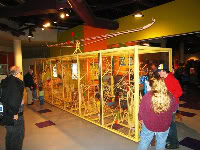
 In a typical week, I receive half a dozen or so business plans with requests for funding. I find all of these intriguing in one way or another — even the ones that I can see instantly have no chance.
 I don’t know the extent to which most readers are aware of the frequent comments of Dan Conine, whom I would characterize as irreverent but incredibly bright. Here, in response to my piece on
 I want my


The Five Most-Commented Posts of 2009
The True Cost of Fossil Fuels
Big Energy and Campaign Finance Reform
Renewables and Cutting-Edge Physics
The True Cost of Electric Power
The “Business of Plugging In” Conference