Being Trusted

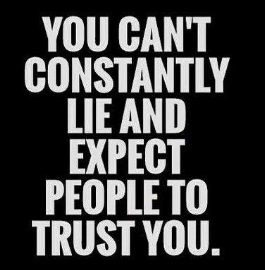 The meme here was an accepted fact of life until Donald Trump came along.
Lying may be the only thing he’s good at, but give him credit, he’s intensely good at it.

The meme here was an accepted fact of life until Donald Trump came along.
Lying may be the only thing he’s good at, but give him credit, he’s intensely good at it.
 A reader asks: Re: the phrase “where we’re at”. Is it grammatically incorrect and should be “where we are”? And did I get the period and question mark right?
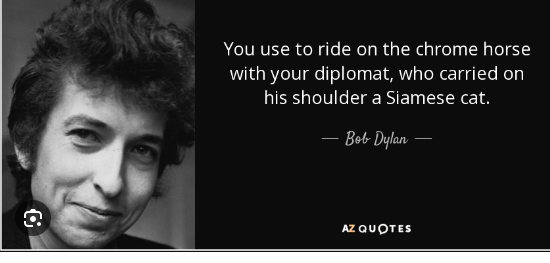
The phrases “where we’re at, where it’s at,” etc. are all incorrect in formal English. But personally, I think people make a bigger deal out of this than they should, especially given that this whole construction arose in the 1960, especially in song lyrics, some of which remain immensely popular today, e.g., Bob Dylan’s “Like a Rolling Stone, an excerpt from which is:
You used to ride on a chrome horse with your diplomatWho carried on his shoulder a Siamese catAin’t it hard when you discovered thatHe really wasn’t where it’s atAfter he took from you everything he could steal
I can imagine sitting with a cold martini watching a fantastic sunset and telling my friends, “Ya know? This is really where it’s at” — knowing that they all would understand that I would not write like that in a business proposal.
To answer your other question, most pieces of punctuation, i,e., commas, question marks, and periods, come before quotation marks, where colons and semicolons come after. Thus, the following are correct:
“Vote your conscience,” I told him.
“Do you really mean it?”
“Absolutely.”
Here’s a “rule of thumb”: don’t eat before bed.
He told me not to call him “Shirley”; he said he’d punch me if I did.
 A reader asks: In today’s fast paced world, the idea is to get to the point (as quickly) as possible. Is it wrong to cut words out of a sentence as long as the message is clear and understood?
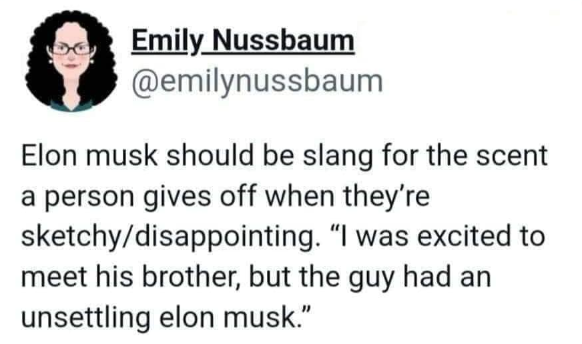 The meme here is funny, but its use of the word “disappointing” is especially apt in describing Musk.
Along comes a guy with hundreds of billions of dollars. Who is he? What is he like? Is he going to end world hunger? Disease? Climate change?
No! A few years later, we learn the horrible truth. He’s an asshole! He’s going to try to destroy wokeness and empathy for others.
That’s a serious effing disappointment.
 Followers of social media may have noticed a significant backlash against the trend towards electrifying our energy and transportation sectors. Perhaps this is part of some disinformation campaign created and implemented by Big Oil; I have no proof that this is the case, but it is in line with other similar PR campaigns from their past.
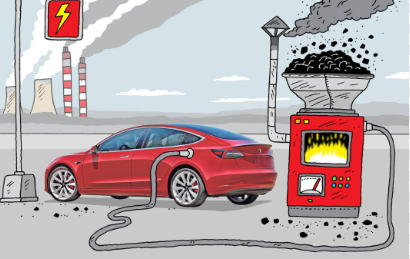
In any case, for at least half a century, political conservatives have been trying to make the case that EVs simply move the noxious emissions associated with transportation from the tailpipe to the power generation plant, essentially replacing petroleum with coal. See graphic below.
The people who have studied this subject honestly and objectively have consistently found that claim is largely untrue, if only due to the technology that removes the greenhouse gases, heavy metals, and radioactive isotope at the power plant. But at this point, however that argument is becoming increasingly difficult to accept, even on the part of people who are, for whatever reason, desperate to do so, because coal is disappearing.
 From ABC News:
In his State of the Union address this month, President Joe Biden boasted that the nation reported a historically low murder rate in 2023 and violent crime had plummeted to one of the lowest levels in 50 years.
For some Americans, however, the perception of crime is clashing with the statistics.
“I don’t believe it, plain and simple. I don’t believe it because we’re experiencing different results,” Auriol Sonia Morris — a South Carolina education, finance and legal consultant who describes herself as a Black conservative Republican and a supporter of former President Donald Trump — told ABC News.
This sure rings true to me. I know quite a few Trump supporters, and one thing they have in common is the belief that nothing good happens under a Democratic administration.
In most cases, and this issue with crime statistics is a great example, this overall mode of viewing the world is extremely clunky, because it involves the belief that huge classes of people, in this case, the FBI, are lying.
Perhaps even tougher to support is the notion that the stats surrounding COVID-19 are falsified. To believe this, you have to accept that the doctors who went through a decade of medical training and seem to do a pretty good job with our illnesses and other diseases have become completely dishonest, almost overnight, and are now deliberately lying about their patients’ causes of death.
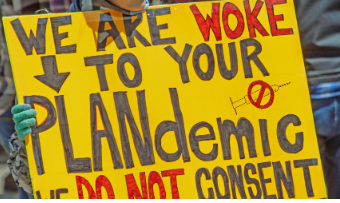
An old friend of mine believes in the “plandemic,” the notion that the COVID epidemic is planned and orchestrated by the U.S. government. Of course, he faces an even more difficult challenge, i.e., the fact that there are more than 200 countries on Earth, and each one of which have their own responses to the disease. Is he suggesting that the governments of Uruguay, Romania, and Nepal are all colluding with our CDC? Or that they are implementing their own independent conspiracies to murder their citizens?
If this seems hard for you to accept, perhaps it’s because somehow, through all the disinformation floating around you every minute of every day, you have miraculously retained the ability to think. Well done.
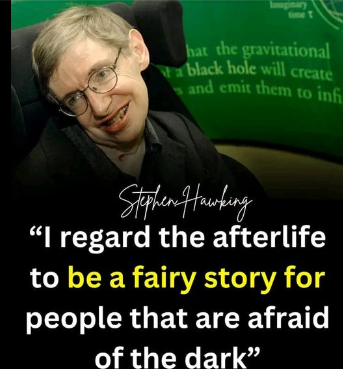 In the human population, at least in the Western World, we find a strong correlation between intelligence and atheism. What Stephen Hawking said here hits home to me.
Having said this, the correlation is nowhere near absolute; there are huge and notable exceptions in most of our lives.
So interesting.
 Here’s a very short video that reveals why it’s so difficult to remove chemical pesticides from our production of vegetables. It offers a glimpse into how the potatoes are selected to become the French fries that McDonald’s offers its customers.
There may be, somewhere in our culture, an example of huge corporate profitmaking that doesn’t rely on either a) the natural ignorance of the consumer, or b) deliberate deception on the part of the purveyor, but I can’t think of a single one.
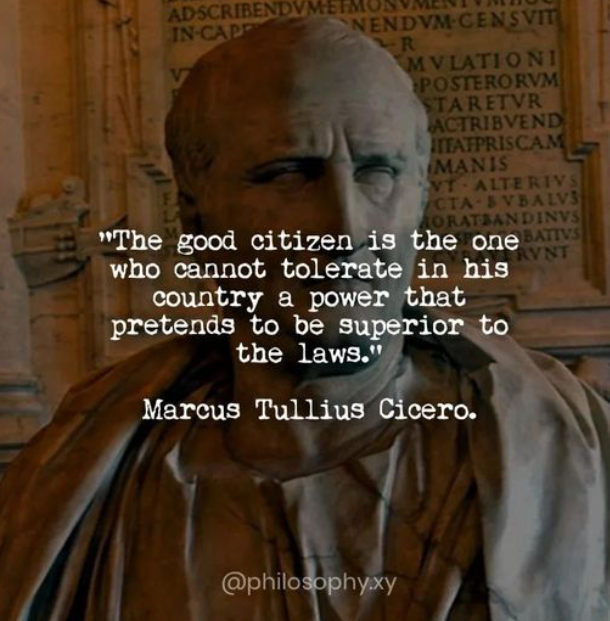 The concept that rule of law sits at the core of all civilized societies has been around a long time–at least 2100 years.
Until the advent of Donald Trump on the U.S. political scene, it was certainly central to our lives as Americans.
From Cicero’s Wikipedia page: An accomplished poet, philosopher, rhetorician, and humorist, Marcus Tullius Cicero (106 BC-43 BC) was also the greatest forensic orator Rome ever produced. But to Cicero, service to the res publica (literally, “the public affair”) was a Roman citizen’s highest duty.
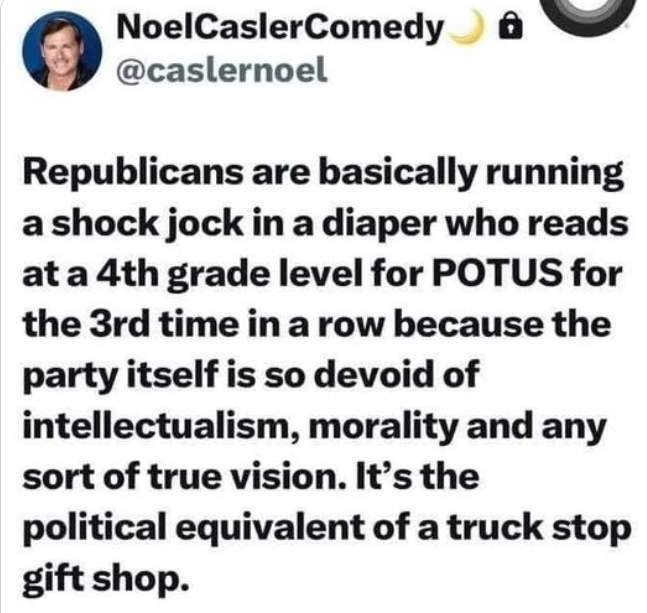 I’m not familiar with Noel Casler, but he’s both funny and insightful.
I wouldn’t say that Republicans have no true vision for the U.S. From here, it looks like they’re modeling their thinking after modern-day Hungary: authoritarian, hyper-nationalist, amoral, no compassion for the common person, and anti-science.


