
The Warming North

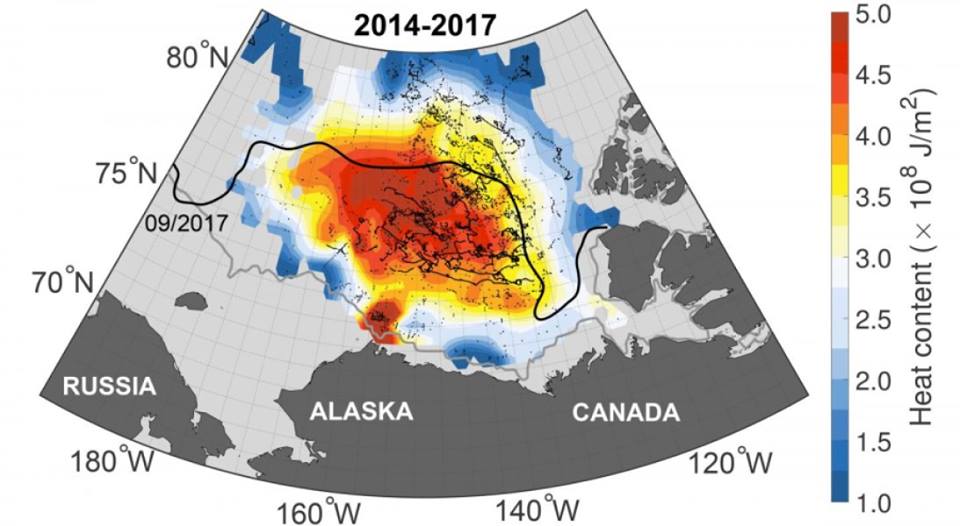 You might think that all the new heat that’s melting the arctic is distributed more or less evenly across the region. As shown here, you’d be wrong; for reasons no one seems to be able to understand, it’s actually concentrated in a fairly small patch of previously frozen ocean water between Alaska and the North Pole. The rate of warming up there is more than three times the planetary average.


In the Atlantic Oceans cold patches have either been discovered or sprung into existence.
It’s not easy to determine why these anomalies exist, nor is there any real knowledge of the length of their existence or what, if anything they portend.
Theories range from concealed radio active or volcanic activity, to the slowing of ocean currents, Luna, Solar, activity, etc.
Research hasn’t been aided by an insistence by many academics and the plethora of climate change institutions that have sprung into existence over the last two decades that all research should only produce findings in step with current climate change orthodoxy.
The Atlantic Meridional Overturning Circulation, or AMOC, conveyor-like current system influences Europe and eastern North America weather patterns, while transporting heat and cold all over the Atlantic.
A good deal of the scientific modelling focusing on AMOC have been deeply flawed through misinterpretation. lack of data, assumptions and an unwillingness to include inconvenient anomalies.
One of the problems has been as the science advances, is how little we know and how wrong many previous assumptions have been. This hasn’t been well received by folk who have built careers and reputations (and incomes) from climate change orthodoxy.
The more we learn, the more we realize how much more there is to learn. In some ways, the problems of Climate Change and simple pollution and bad environmental practices have become more urgent than ever to correct, while in other aspects we may simply be witnessing yet another set of natural phenomena to which we must adapt.
Like many natural phenomena, it’s not a matter of ‘either/or’ but a highly complex, analogous, dynamic,jigsaw with many of the pieces yet to be identified and correctly interpreted.
Craig,
A quick note on the “why” of the warming poles…
If you think of the Earth and it’s atmosphere as a single blackbody emitter, then you can get a sense of why the warming is so disproportional.
The radiation curve for a blackbody emitter at 250 K has a much lower integral (total radiant emittance) than the radiation curve for a 300 K blackbody emitter. In other words, cold objects emit FAR less radiation than hot objects – something that is pretty well known by any child who has sat around a campfire, but still salient.
What the child does not know, and indeed most people who haven’t taken several years in physics don’t know, is that the radiant emittance for any given emitter is going to have a 4th power relationship to the temperature. So if something was twice as warm (in Kelvin), it would radiate ~16 times as much energy.
When we’re talking about climate forcing, the planet/atmosphere is absorbing an additional ~2-4 W/m2. That’s not much. If the Equator is ~310 K, and the poles are ~250 K, then the equator is emitting nearly 2.4 times as much energy as the poles, and it would also take nearly 2.4 times the energy influx to increase the energy state of the equator by 1 K as it would to increase the energy state of the poles by 1 K, because the emission curve at those lower temperatures is so much less, and progressing so much slower.
It makes sense when you know the physics. The atmosphere is shared, so the climate forcing from GHG concentrations is more or less evenly distributed, but it takes less energy to warm the poles than it takes to warm the tropics.
Glenn,
Perhaps I missed something in your explanation, but the original question posed by Craig had nothing to do with poles v equator but anomalies in polar (and other) regions.
Surely, it’s more logical to seek an alternate explanation? The question being why one patch of Ice or Ocean is hotter or colder than a neighboring patch would seem to have more to do with a localized dynamic than a generalized scale of heat emission gradients.
You’re right; I was talking about regional differences, though I learned a lot from Glenn’s more general response.
Craig,
Thanks for that, yes Glenn’s response was informative, even if not particularly pertinent.
It’s the anomalies in climate change events I find interesting. Until very recently, “climate change scientists” treated the oceans as dry terrain, just covered with water.
Studies of oceanic topography reveal a very different, completely separate ‘climate’ dynamic.
The interconnection between the oceanic ‘climate’ with the dynamics of climate change on terra firma, and how this affects the entire biosphere, has been the subject ‘scientific’ speculation, but very little practical research has occurred.
Volcanic eruptions on terra firma, quickly become the object for frenzied media coverage as people watch fascinated by the frighteningly awesome power of the natural world. Cyclones, hurricanes and similar events also become the subject of intense media speculation.
Since the dawn of civilization, humans have always regarded such spectacular weather events as omens, portending catastrophe and massive change.
Yet, each day, unbeknownst to surface dwelling creatures, in the depths of the worlds oceans cataclysmic volcanic activity is occurring on a scale that hasn’t existed on land since the age of dinosaurs!
More than 90% of the planet’s volcanic eruptions are oceanic. At depths of nearly forty thousand feet in places, the ocean hides mountains and volcanoes taller than Mount Everest !
6000 feet below the surface of the Pacific Ocean, a volcanic eruption is currently occurring that dwarfs all the volcanic events that have occurred on land throughout the entire period of human existence !
This volcano is producing intense Boninite lavas, maybe the hottest in millions of years, not since T-Rex roamed the Earth. .
Curiously, an environment of molten lava and water with the acidic quality of a cross between battery and stomach acid, is home to a thriving variety of spotted shrimp evolved to live in such a hostile environment!
The ocean experiences a plethora of weird “climatic” events. These range from immense storms, cyclones, hurricanes etc to phenomena like vortexes, maelstroms and vast undersea rivers.
In addition, measurement of the movements of the North American and Eurasian tectonic plates at Iceland seem to be gathering pace. Very little research has been done on the planet’s tectonic plates although these would seem to be important when attempting to understand and measure sea levels.
As the Gap widens, a huge area of faults, valleys, volcanoes and hot springs, is exposed contributing to higher oceanic temperatures.
The influence oceanic climatic conditions on land atmosphere and general biosphere remains poorly understood and seldom adequately taken into consideration by Climate Change modelling.