A friend just sent me a note on this compact, consumer-oriented energy storage device from Toshiba. I’m wondering if it’s a hoax. It delivers 3 kW of stored electricity for 12 hours? If it’s using lithium ion and combines the very best characteristics, it will weigh about 300 pounds, occupy about 15 gallons of space, and cost about $15,000, plus whatever profit Toshiba wants to make on it. If its purpose, as mentioned in the article, is to enable its user to buy power at off-peak rates and use it on peak, in most parts of the U.S., it would take about 12000 cycles (33 years) to pay for itself. Of course, if the power in your area is horrifically unreliable and you want an uninterruptable power supply on steroids, maybe you’ll find this attractive.
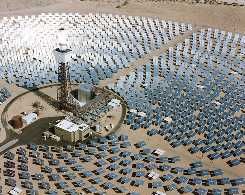
Whilst Spain has been a strong driving force for the CSP industry worldwide with more than 20 years’ experience in research and technology developments, the government support is what have made the development of this technology extremely lucrative in the country. But the approval in 2011 of a royal decree temporarily suspending all economic incentives for renewable sources, has shaken the CSP industry to the core.
Furthermore, the global economic downturn and the lower prices of PV and natural gas have not made 2012 an easy year for the Concentrated Solar Thermal industry worldwide. But despite the challenging times and the need for the sector to re-define its strategy to become a true contender in the global energy generation mix, the opportunities continue to flourish around the globe.
I’d like to think that last sentence is true, i.e., that CSP opportunities are, in fact, flourishing around the globe. The first part of the blurb is most certainly true: these last years have been tough for the industry. Unfortunately, the unchallenged leader in CSP development is Spain, and the European financial mess has hit them hard.
In my estimation, it will be a terrific tragedy for our civilization if CSP does not receive the opportunity that solar PV and wind did: several decades of R&D that resulted in terrific breakthroughs – particularly in cost.
At a party yesterday, I ran into a top-flight businessman who sells advanced sonar systems to the world’s navies. I happen to know that he spends a huge amount of time in India, and I wanted to ask him about tips to avoid getting sick – a plight that befalls a great number of Americans travelling there.
I took the occasion to ask about India’s intent in building up its navy. “Oh, they’ll tell you it’s about Pakistan, but long-term it’s clearly about China.”
“But China and India aren’t enemies, are they?” I asked. (more…)
I just came back from an annual chili cook-off at a home of a dear friend. My recipe, which my kids and their friends adore, came in second place in the popular vote two years ago, but hasn’t been able to place since. Next year, I have a totally different approach that I’m looking forward to trying. More on this later, as if you could possibly care. 🙂 In any case, great people, fantastic food, and a ton of interesting ideas thrown around all afternoon and evening.
I always enjoy the opportunity to talk with college students about their aspirations and their observations from the perspective of their young lives. Last night I stayed at the home of one of my best friends from my boyhood, which gave me the chance to speak with his highly accomplished elder daughter, who just entered UCLA (University of California at Los Angeles) as a freshman. In the course of the talk, she mentioned that all incoming students receive a heavy indoctrination that their school’s cross-town rival, USC (University of Southern California), is “the enemy”; all freshmen take a pledge that they will forever regard USC and its people as such. I suggested that this must be a kind of joke that no one takes seriously, but she assured me that the entire ritual is completely serious.
I’m sure most people regard these hijinks as good, clean collegiate fun, and so I’m sorry to sound like a kill-joy, but I find it sickening. Taking an innocent kid and teaching her that some other equally innocent kid is some sort of “enemy” merely by virtue of the school she’s chosen is deplorable. That the urban gangs do garbage like this is regrettable, but at least their members have the excuse of having been deprived of the privileges of a normal upbringing. Seeing this played out in our great academic institutions shows a revolting lack of grace and class.
The Earth is populated with races, religious sects, and nation-states that are in a perpetual state of hostility. Is it really so hard to understand why?
I took most of the day off yesterday to be a part of a family outing at the Los Angeles County Fair. While the kids were on the rides, I wandered off on my own to check out as many eco-friendly solutions as I could find in the “home and garden” area, including a clever new approach to solar water heating for swimming pools.
There was also a marvelous exhibit heralding some of the great American inventors: Franklin, Edison, The Wright Brothers, Carver, Ford, as well as dozens of others: the guy who invented the yoyo, another who gave us Post-it notes, etc. I felt a bit sad that the designers felt the need to limit the focus to Americans, but outside of that, they did a good job.
Now I’m on the train back from Los Angeles, sitting next to a very affable lady of Indian descent who works as an environmental engineer, whose job functions include a great deal of permitting and regulation. So far, the conversation’s been quite thought-provoking. “We regulate businesses, but we educate people,” she says. “As a society, we expect people to make the right decisions with respect to the environment, but not to the extent that they cease to enjoy their lives. I’m not an eco-Nazi,” she smiles.
Here’s an article on biofuels, the first part of which everyone should read, as it frames the world energy situation very nicely. Yes, we face a situation in which our planet’s energy demand will double in the next 40 years, and fossil fuels will soon prove insufficient (not to mention their externalities in terms of ecological and health-related consequences). The author points out the silliness of the debate about drilling for oil on federal lands in the Arctic National Wildlife Refuge (ANWR). “If you drilled the provable oil reserve in the entire federal ANWR and flooded the world market with it – the reserve would be used up in 9 days, at 2050 consumption rates.”
So it appears that we’re off to a good start here; the premise seems solid. I’m not sure how you get from there to the conclusion, however. The point of the article is that our focus on renewables and energy storage is misguided and that any or all of the 15 biofuels companies it names are here to save the day. The first four are “headed for commercialization now” and the other 11 are “farther down the road.”
I’m rooting for you guys, but I’m skeptical.
Life forms evolved over four billion years to convert sunlight into chemical energy that would support the organisms’ survival, growth and reproduction, not to store it in great abundance beyond the foreseeable need, so that we could come along and put it in our gas tanks. Converting solar energy in the form of biomass to chemical energy in liquid fuels can be done, as we’ve all seen, but by its very nature, it’s extremely inefficient, and thus, resource-intensive. I believe this is the reason that, after decades and billions of dollars in R&D, there are no demonstrations of commercially viable approaches in this space. Are there really some that are “headed for commercialization now?” Could be. But I’ve been hearing that for a long, long time.
Of all the byproducts of our gross extravagance in energy consumption over the last half century, the one that could be most toxic to all of us is the way it has turned brother against brother with regard to environmentalism. Here’s the website of the Agricultural Defense Coalition, whose authors, I’m quite confident, are fine people. But their mission is essentially to block experimentation whose purpose is to ameliorate climate change, if such tests could affect the purity of agriculture.
For what it’s worth, this is why Bill McKibben’s recent book is called “Eaarth.” It’s a one-word reminder that we will never again live on a planet that is unadulterated by human activity. There are PCBs in the arctic. Our blood systems contain over 140 different synthetic chemicals. To the Agricultural Defense Coalition, and anyone else who wishes for a return to anything remotely resembling “purity,” I point out that train left the station 50 – 75 years ago.
We are in a world of hurt if we can’t realize, as a civilization, that we’re going to have to make certain sacrifices. Let’s get to that realization as a culture, then work together to make the right ones.
A reader from Nigeria sent me a business plan on an ethanol plant that would provide a far cleaner way for West Africans to cook their food than their current approach, which is a combination of kerosene and wood gathered from rapidly disappearing forests.
There is no doubt that Nigeria, where 98% of the people are incredibly poor, and do, in fact, cook this way, represents a huge opportunity to improve the eco-friendliness of the average kilowatt-hour of energy generated and consumed. Currently, their energy comes almost exclusively from burning hydrocarbons, with no emission controls whatsoever. In fact, this is one of the points I made in my concept of “hitting the broad side of the energy barn.”
But, as I told him, I’m not a big fan of biofuel. It’s one thing to put numbers on paper and make certain projections; in the real world, however, it becomes far more expensive than most people realize, and it tends to have horrific unintended environmental consequences. I went on to say that I’m hoping to see Africa develop renewable energy in distributed, off-grid/micro-grid settings.
But I’m wondering if this is the equivalent of saying, “Let them eat cake.” Am I being short-sighted here?
Late last night I was on a Skype call with a friend, a clean energy aficionado based in Central France. He went on at length about some of the projects he’s pursuing, several of which are various types of pyrolysis plants that will invoke some extremely specific equipment that I never knew existed. I learned about machines that process corn and miscanthus, as well as:
• Plastic bottles, includes delabeling and unscrewing the caps (which have more calorific value per gram than the rest of the bottle). Who knew?
• Food waste, especially the byproducts from making chocolate that are particularly energy-rich. Again, news to me.
• Dying pines trees my friend believes were victims of climate change, many of which were planted by Napoleon’s people who wanted to ensure France would always have enough wood to build war ships. Wow, a free lesson in European history!
We also talked about equipment to chill solar panels to create better efficiency and longer life. Can this be cost-effective? Apparently he thinks so.


 A friend just sent me a note on this compact, consumer-oriented energy storage device from Toshiba. I’m wondering if it’s a hoax. It delivers 3 kW of stored electricity for 12 hours? If it’s using lithium ion and combines the very best characteristics, it will weigh about 300 pounds, occupy about 15 gallons of space, and cost about $15,000, plus whatever profit Toshiba wants to make on it. If its purpose, as mentioned in the article, is to enable its user to buy power at off-peak rates and use it on peak, in most parts of the U.S., it would take about 12000 cycles (33 years) to pay for itself. Of course, if the power in your area is horrifically unreliable and you want an uninterruptable power supply on steroids, maybe you’ll find this attractive.
  Here’s part of an invitation to one of the most important
  At a party yesterday, I ran into a top-flight businessman who sells advanced sonar systems to the world’s navies. I happen to know that he spends a huge amount of time in India, and I wanted to ask him about tips to avoid getting sick – a plight that befalls a great number of Americans travelling there.
  I just came back from an annual chili cook-off at a home of a dear friend. My recipe, which my kids and their friends adore, came in second place in the popular vote two years ago, but hasn’t been able to place since. Next year, I have a totally different approach that I’m looking forward to trying. More on this later, as if you could possibly care. 🙂 In any case, great people, fantastic food, and a ton of interesting ideas thrown around all afternoon and evening.
 I always enjoy the opportunity to talk with college students about their aspirations and their observations from the perspective of their young lives. Last night I stayed at the home of one of my best friends from my boyhood, which gave me the chance to speak with his highly accomplished elder daughter, who just entered UCLA (University of California at Los Angeles) as a freshman. In the course of the talk, she mentioned that all incoming students receive a heavy indoctrination that their school’s cross-town rival, USC (University of Southern California), is “the enemy”; all freshmen take a pledge that they will forever regard USC and its people as such. I suggested that this must be a kind of joke that no one takes seriously, but she assured me that the entire ritual is completely serious.
 I took most of the day off yesterday to be a part of a family outing at the Los Angeles County Fair. While the kids were on the rides, I wandered off on my own to check out as many eco-friendly solutions as I could find in the “home and garden” area, including a clever new approach to
  Here’s an
  Of all the byproducts of our gross extravagance in energy consumption over the last half century, the one that could be most toxic to all of us is the way it has turned brother against brother with regard to environmentalism. Here’s the website of the
  A reader from Nigeria sent me a business plan on an ethanol plant that would provide a far cleaner way for West Africans to cook their food than their current approach, which is a combination of kerosene and wood gathered from rapidly disappearing forests.
 Late last night I was on a Skype call with a friend, a clean energy aficionado based in Central France. He went on at length about some of the projects he’s pursuing, several of which are various types of pyrolysis plants that will invoke some extremely specific equipment that I never knew existed. I learned about machines that process corn and miscanthus, as well as:


