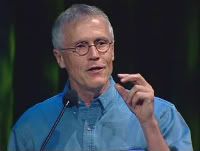
Woody Clark is another of these supremely visible figures who is impossible to miss when one attends industry conferences. He has a warm, approachable – and often hilariously funny speaking style that belies the depth of his understanding of complex, multi-disciplinary issues.

Woody is an applied academician, a long-time advocate for the environment and renewable energy, and an internationally recognized author, lecturer and advisor on sustainable communities. He was a contributing scientist on the United Nations Intergovernmental Panel on Climate Change (UNIPCC) that won the Nobel Peace Prize in December, 2007.

I am very grateful to Dr. Clark for his help with the project, and I know readers will find his insights quite enlightening.

Tagged with: , , ,

Is Renewable Really Doable, by Craig ShieldsIt’s time to launch my second book, Is Renewable Really Doable? on Amazon.com. The big day: March 15, 2012. I hope you will mark your calendar, and buy the book on that date.

To help generate interest in the subject, we have a giveaway: a hot new report called “Insights in LCOE – The Levelized Cost of Energy,” by industry analyst Mike Hess.

Before our society can decide on a certain course for its energy policy, we need to ask ourselves a central question: What Does It Cost?

Here’s a 32-page study, dealing with tough questions about land use, externalities, the safety of fracking, food and water shortages, climate change, transmission rights, smart-grid, efficiency, conservation, consumer incentives, carbon taxes, energy storage, health hazards, feed-in tariffs, subsidies – you name it. (more…)

Tagged with: , , , , , , , , , , , , , , , , , , , , , , , , ,

A reader asks my opinion of Envia Systems‘ lithium-ion battery. I reply:

If these claims are true, it’s a really important breakthrough — potentially even more significant than that of my friends at Eos Energy Storage.

The number one issue that electric vehicle nay-sayers throw in the face of us advocates is resistance of battery technology to rapid change: both in terms of cost and energy density. In particular, they say that where Moore’s Law (the idea that the functionality of technology increases exponentially over time) applies to things like integrated circuits, it absolutely does not apply to power systems like motors and batteries. I believe the truth is probably somewhere in the middle, and perhaps this is evidence of that. We’ll see.


Tagged with: , , , , , , ,

It pains me to hear people moan about how frightening and horrible these times are, while they actively dismiss their role in the outcome. When I hear people say, for instance, that our government is out of control, I immediately wonder whom they count on to bring it back to the way they think it ought to be. Perhaps they believe in miracles.

I happen not to believe in miracles; to the contrary, I assert that we hold our fates in our own hands.  United in our common humanity, we and we alone will determine whether the 21st Century will be the end of civilization, or the mere rounding of a scary corner. (more…)

Tagged with: , , , , ,

The investment opportunities we endorse on 2GreenEnergy are all “socially responsible” in the sense that each of them holds the promise to make the world a better place. But there is something about the business concept embodied in the aeroponics project I’ve been talking up recently that I believe is unique. This is an innovation in agriculture that has the potential to deal effectively with the shortages of water and food, while providing meaningful work for large numbers of unskilled people. (more…)

Tagged with: , , , , , , , , ,

I was lucky to happen across Dr. Jason Scorse in my quest to interview an economist who could shed light on the migration to renewables.

Jason is currently Associate Professor and Chair of the International Environmental Policy Program at The Monterey Institute of International Studies, a graduate school of Middlebury College. He has consulted for numerous environmental organizations, including the Natural Resources Defense Council and the Sierra Club. (more…)

Tagged with: , , , , , , ,

As suggested in this article, the U.S. military is leading the way in the migration to renewable energy and electric transportation.

Obviously, there’s a certain irony here, as the role of the American military is, in large measure, to ensure our access to oil on an ongoing basis.  But anyone can see the rationale: depending on gasoline and diesel while you’re actively in battle or defending a military position is a potentially lethal place to be. According to my understanding, more of our soldiers are killed defending the supply line of oil to military bases and outposts in the Middle East than in any other single activity.

Thus the interest in clean energy here is rooted in self-preservation – which is more than fine by me; whatever gets the job done. I’m like anyone; I hate to see young people killed or wounded – for any reason.


Tagged with: , ,

I’m working on a project to popularize the concept of aeroponics, the science of growing plants in areas where land is scarce, using a mixture of air, water, and nutrients. Imagine robust, organic produce grown indoors, on rooftops, etc. Now realize a potential downside: you need containers, most of which are made out of plastics that come from petroleum and do not biodegrade.

OK, what about bioplastics, derived from the cellulose in plants? I’m willing to learn a bit more. How about you? I hope you’ll check out the article linked above.


Tagged with: , ,

I’ve had the pleasure of bumping into Ray Lane at numerous industry conferences, and have been lucky enough to hear him speak on subjects that include the financing of renewables and electric transportation. I was thrilled when he accepted my invitation for an interview, as I knew it would add a much-needed perspective of the real-world, no-nonsense exigencies of big money. After all, we can talk about the theory of money—but we can also look at the way in which billions of dollars actually change hands. (more…)

Tagged with: , , , , , , , ,

A friend in Australia just sent me a claim for a regenerative braking system that recaptures so much energy that the car has unlimited range.  He became dubious, however, when the company, based in Canada, would not pay his way to see the demonstration.

I reply:

Yes, I would be dubious too.  I come across claims like this, i.e., those that violate the first and second laws of thermodynamics, about once a week.  In many cases, they are made by people I would call “crackpots,” i.e., people who actually believe their story, and just don’t know enough about physics to know that they’re speaking gibberish.  Others are made by what I call “charlatans,” people who (according to my perception) do not believe their story, but are attempting to defraud investors.  I tell them: “I don’t know about the securities laws in your country.  But if you raise capital from investors in the U.S. to build a prototype of something that is theoretically impossible (like what you’re describing here), there’s an excellent chance you’ll go to prison.”  It makes for a mercifully short conversation.


Tagged with: , , , , , , ,