Renewables Are Cool, But Using Less Energy Is Far Better


Frequent Commenter John F. Robbins writes this marvelous response to the 2GreenEnergy survey on renewables:
The most missing question or comment in your survey and most of this blog is how to move away from the current energy-guzzling nature of our culture. Almost all the old-wave renewable energy discussion (prior to 2000) was heavy and serious on how to use less prior to or while trying to convert to renewables. Yet now, under the mantra of “creating jobs” or “increasing profits and tax collection” or just “new-wave RE advocacy”, RE is being pushed with almost no inclusion or demand that energy guzzling be actually reduced.
If we cut energy use first, that would be the most cost-effective solution ranked according to $/energy. That first step would also reduce how much and what scale of RE and storage are needed, thereby lowering those costs substantially.
As long as we allow, tolerate or are part of a culture of ever-increasing energy demand and use, both the futures of conventional and renewable energy are diminished, even bleak. The current energy model cannot exist ad infinitum, simply because it is based on infinite supplies at perpetually low prices.
Even if we didn’t move more quickly to RE, the price of future conventional will certainly be erratic and inflationary, especially as certain sources like oil become more depleted sooner. Natural gas will likely be second to deplete or become super-expensive to deliver in the current scale of demand.
Deceased thinker Donella Meadows often wrote about how our culture was operating beyond its physical limits. We need solutions which go beyond specific technologies and deal with our culture, how to change it so we can use and demand far less energy. Then the prognosis for energy futures gets better faster.
Thanks, John. All this is completely true, and you’re right; I most definitely fall into a faulty manner of thinking re: conservation and efficiency. There is no doubt that, as a culture, we simply hog far too much energy.
This is why Vaclav Smil says, as he contemplates the effect that two billion more people will have on the Earth, “It depends. Will they use energy at the rate of the North Americans, or the Japanese?”
What I’ve noticed living here in the good ol’ USA is that virtually no one does anything that doesn’t benefit himself or his immediate friends and family. We’ve been programmed to ignore the needs of others, and that programming has been enormously effective. (It wasn’t always like this, btw. When we really became a consumer society after World War II, the idea that economics was an indifferent and often cruel taskmaster controlling all of us was vigorously drummed into our heads.)
Be this as it may, we live in a society in which the vast majority of people will not even consider sacrificing a pleasure for the good of someone else – regardless of how trivial the sacrifice or how enormous the benefit to the other. In the main, we turn off our lights, replace our incandescent light bulbs, and install low-flow showerheads (when we do), because of our utility bills. We buy more fuel-efficient cars because of the objectionable price of gasoline.
At the end of the day, if you want to save energy, you have to make it expensive. However, here in the US, we make it artificially cheap. If we had any sincerity about weaning ourselves off coal and oil (which we don’t) we would simply begin to force the producers and consumers of energy from those sources to pay the true and comprehensive costs. If we were to do that, you’d see an enormous change in people’s behavior – not next year, but this afternoon.
Here’s a start. Just take this list of subsidies we give the big oil companies and make them go away.
- Construction bonds at low interest rates or tax-free
- Research-and-development programs at low or no cost
- Assuming the legal risks of exploration and development in a company’s stead
- Below-cost loans with lenient repayment conditions
- Income tax breaks, especially featuring obscure provisions in tax laws designed to receive little congressional oversight when they expire
- Sales tax breaks – taxes on petroleum products are lower than average sales tax rates for other goods
- Giving money to international financial institutions (the U.S. has given tens of billions of dollars to the World Bank and U.S. Export-Import Bank to encourage oil production internationally, according to Friends of the Earth)
- The U.S. Strategic Petroleum Reserve
- Construction and protection of the nation’s highway system
- Relaxing the amount of royalties to be paid – apparently, we get about 40% of revenues from oil on public land vs. 60% – 65% in most other countries
Then get the oil and coal companies to pay the increases in healthcare costs caused by aromatics, absorb the cost of the long-term environmental damage. All of this garbage would be gone in a heartbeat.
Again, thanks for your comment.
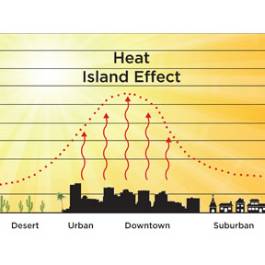
 “Changing surface colors in 100 of the world’s largest cities could save the equivalent of 44 billion tonnes of carbon dioxide – about as much as global carbon emissions are expected to rise by over the next decade,” said U.S. Secretary of Energy, Steven Chu in 2009.In fact, pale surfaces reflect up to 80 percent of the sunlight that falls on them, compared with about 20 percent for dark ones, which is why roofs and walls in hot countries are often whitewashed. An increase in pale surfaces in our urban locations could both reflect more solar radiation away and reduce the amount of energy needed to cool buildings.Professor Chu explains he has been influenced by Art Rosenfeld, a member of the California Energy Commission, who pushed for some new building codes. Since 2005, California has required all flat roofs on commercial buildings to be white. Florida and Georgia are among states that have adopted building codes for white roof installations and more than 75 percent of Wal-Mart stores in the U.S. have them. Dr. Rosenfeld, also a physicist at the Lawrence Berkeley National Laboratory, and two of his colleagues from the laboratory, Hashem Akbari and Surabi Menon, made the calculations found in Steven Chu’s quote above and believe light surfaces can help chip away at energy conservation and global warming issues.Using this very concept, some cities (including those in California) are painting roofs white to reflect heat, conserve energy and reduce the carbon footprint. Another company, Emerald Cities, successfully developed a high performance solar reflective coating for asphalt and cement for the same purpose. The special coating can cool down the surface by up to 50 degrees and reduce smog by 15%, and it also preserves deteriorating asphalt. The product is called Emerald Cities (EC) Solar Reflective Cool Pavement, coined Cool Pavement.
 I just spoke with the proprietor of a very well-established and well-diversified energy solutions company in New York, focusing on a range of residential, commercial, and industrial customers. He happened to have seen my piece on Joe Biden’s speech, and told me: “If you want real malarkey, you have to come to New York. We take the cake.”