
Electric Vehicles on Display at the Department of Energy

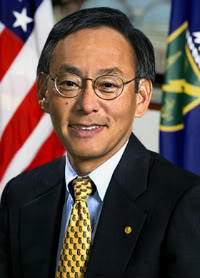
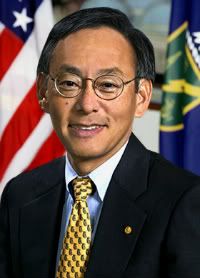 This week I’m taking a break from the ideal Southern California weather, and traveling on one of my regular East Coast tours. Today, I’m in Washington DC for the Electric Drive Transportation Association’s annual conference, where one of the day’s events was a press conference in which a few dozen of the currently- and soon-to-be-available EVs were displayed outside the Department of Energy Building. Energy Secretary Steven Chu, Rep. Edward Markey (D-Mass.) and a few others spoke to an enthusiastic audience. I was in the front row.
Markey is obviously very bright, and has the quick wit one expects of a Congressman who thinks of himself as progressive. “Many people have a theological belief in our abundance of oil. The problem is that oil isn’t about THEology; it’s about GEology. We have less than 2% of the world’s oil, while consuming about 25% of it.”
He also reminded us of the trip that George W. Bush and Condoleezza Rice made to Saudi Arabia a few years ago, the purpose of which was to make a request for an increase in oil production, thus a reduction in price on the world markets. In exchange for the Saudis’ agreement to consider the idea, we agreed to sell them nuclear energy generation equipment (as if they need it, sitting on all that oil, with their own gasoline at 9 cents a gallon).
“This was one of the low points in US history,” Markey told us, looking at his feet solemnly. “When Kennedy was president, he told Khrushchev, ‘We will use technology to dominate you in the Space Race.’ Why couldn’t Bush have done something like that? Why can’t we simply commit to innovating and developing technology that will establish US leadership in the field of energy? So much of this is right here, in our hands right now. The electric vehicles you see here today are a lethal weapon in our fight to end our oil addiction.”
Something to think about.


 In yesterday’s webinar on electric vehicles (EVs) I used the same metaphor that the author of
 ![[The Vector] Consumer Attitudes Revealed in Latest Solar Survey](https://www.2greenenergy.com/wp-content/uploads/2011/04/electric-from-renewables.jpg)
 San Jose State University and SolarTech conducted a study recently in Silicon Valley to understand consumer attitudes toward solar energy and solar power for home use. Silicon Valley (Santa Clara County) is considered a bell-weather county in a state that is more aware of solar and alternative energy than the typical American.


