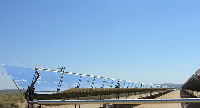
I had a wonderful chance encounter the other day with Melinda Keller, a professor of engineering at California Polytechnic at the Santa Barbara Summit on Energy Efficiency. It seems that she specializes in CSP (concentrated solar power) – and is tackling what is arguably its thorniest problem: cooling. CSP does best in the desert, but that’s where cooling is the toughest. How efficiently can you cool a fluid by blowing 115-degree air past it?

Unfortunately, she couldn’t tell me the exact nature of her project, as it’s funded with private money by a group that wants to keep the work under wraps at this point. But she asked, “Just ask yourself: What’s cold in the desert?”

How intriguing! “The air at night? Underground?” I probed.

She smiled mysteriously. Looks like I’ll have to wait to get my answer.

Tagged with: , , , , , , , , , ,

Maybe “you had to be there” for this one, but I was personally amused by the following dialog in which a presenter at this year’s Santa Barbara Summit on Energy Efficiency fielded a question from an audience member: 

Audience member:  It’s clear that we need to build out our grid, in a way not too different from what we did in the 1950s with the national highway system.  Why can’t we do that?

Presenter:  Oh, that would require help and guidance from the federal government.

Now, if you didn’t chuckle, maybe the story is too sad to be funny.  Of course we need federal help in executing a project that involves every one of the 50 states.  That’s what the federal government does.   But apparently, we’ve gotten to the point that this is really out of the question, and all we can expect of Washington is partisan bickering and political posturing. 

And that is sad indeed; I’ll understand if you’re not snorting with laughter.


Tagged with: , ,

I spent a few happy hours at the Santa Barbara Summit on Energy Efficiency over the last couple of days. Most (though not all) of the presentations were really good, and totally relevant to the audience.

I was really pleasantly surprised, because I’ve noticed that sometimes speakers have one PowerPoint deck, and make the same talk, regardless of the audience. None of us could believe that the lady presenting from the Office of Naval Research would spend 15 minutes on a slide, taking us through the names and ranks of dozens of people we couldn’t have cared less about.

Also, I’m amused at the way some speakers present ideas that leave the audience with gaping, obvious questions. Here’s a good example. The spokesperson from Southern California Edison, whose talk was otherwise excellent, talked about an energy storage project that her organization has underway in the Tehachapi Mountains, northeast of Los Angeles. It’s a whole bunch of lithium-ion battery packs that can provide 8 megawatts for 4 hours.

At the conclusion of her talk, I approached her, and we the following dialogue:

Craig: I’m amazed every time I hear about lithium-ion – or any other battery chemistry – proposed for utility-scale storage. If we’re struggling with the price of a 30 kilowatt-hour pack for an EV, is there really any trajectory for what you folks would need?

Linda: It sure would be expensive, wouldn’t it?

Craig: To be sure. Well given that, why build this 32 megawatt-hour project, which is obviously a drop in the bucket?

Linda: To be honest, I’m not sure.

Craig: Hmmm. Though I’ve heard good arguments for other ideas, to me, pumped hydro seems to be the only good storage technology — and especially if you’re in the mountains anyway, with the natural changes in elevation.

Linda: Yes, you’re probably right.

Craig: OK, thanks very much. Good presentation!

Linda: Thanks!

See? Nice, cordial conversation, but one that left me wondering what’s going on there. It’s a strange world sometimes.

Tagged with: , , ,

For those who missed April’s webinar on electric vehicles, here’s a press release that hits a few of the highlights.

In a webinar attended by interested participants all over the world, Craig Shields presented his views on the business aspects of electric transportation. Shields began by noting the importance of the transition from a purely practical standpoint. “Energy consumption is closely tied to GDP,” he told listeners. “So, as long as we’re concerned about economic growth and stability – as long as we’re not returning to our roots as an agrarian or hunter/gatherer society, we’ll need to generate and consume more energy. This creates the imperative to do so wisely, and EVs will play a huge role here.”

Shields went on to discuss the other aspects of electric transportation that make it so attractive, especially national security and health issues.

Of course, consumers normally make purchases for selfish reasons, and so predicting a bullish EV adoption curve means believing that the EV industry will develop an attractive value proposition. Craig sees that as a reality. “I predict 10% penetration by 2020 – a $250 billion market. I know there are people who disagree. But 78% of Americans commute less than 40 miles a day. As oil prices rise – and remain obscenely high — the common man is going to be highly motivated to own a car that will never take a drop of gas.”

Craig acknowledged that predictions in this area are all over the map, but he pointed out that shifts like this happen very quickly in our society nowadays. “When was the last time you rented a video? Bought a CD? Technology has almost completely obsoleted these industries that were huge just a few years ago.”

When the audience was asked to submit questions, they came in torrents. Shields addressed as many as he could squeeze into the hour-long session.

Shields admits that there are a few interesting open issues that remain. Sure, we’re witnessing a huge, messy divorce between Big Auto and Big Oil, but don’t think that ExxonMobil, Shell, Chevron, and so forth are going down without a fight. They’ll be around for many decades regardless of what happens. But they’re fighting hard to forestall the advent of EVs – and the renewable energy that will fuel them — to an ever-growing extent. “California’s Prop 23, which was funded almost exclusively by a few big oil companies, would have set the environmental movement back 30 years. Big Oil spent tens of millions of dollars promoting it, and it got about 47% of the popular vote. We came very close to extinguishing the entire push for clean air in this all-important state,” Shields said.

A key take-away from the webinar was the myriad types of businesses that will flourish as a result of the migration to electric transportation, including clean power generation, “telematics” (information services), smart-grid components, and billing services.

Of course, batteries are critically important. Shields continued: “As we achieve scale here, as we experience ongoing technology innovation, establish design standards, and remove cost from the supply chain, we’ll have battery costs at $300/kWh, which will enable EVs to be offered at terrifically attractive prices. Consumers will also see that corporate America is deploying EVs in bulk; I have to think people will be pretty impressed when they see large fleets owned by FedEx, Verizon, and Frito Lay and a dozen or so others. Sure, there are just so many early adopters. But soon you’ll see the pragmatists getting onboard.”

Craig closed with a few remarks about American Interest in Renewable Energy. “We feign concern about the national debt we’re leaving to our children, while borrowing an incremental $1 billion per day to buy foreign oil and sending it to regimes that are openly hostile of the US and its interests. We act like we’re concerned about unemployment, while ignoring the fact that the migration to clean energy will create three new jobs for every one that is lost. Expect to see this as a huge factor in the 2012 presidential election; Every credible candidate will have well-articulated (even if disingenuous) positions on the subject.”

Those wishing to view the archived webinar can do so here.   


— Craig Shields is editor of 2GreenEnergy.com, and author of Renewable Energy – Facts and Fantasies (published by Clean Energy Press, 2010)

Tagged with: , ,

The U.S. Department of Energy (DOE) released a FACT SHEET on March 30th in concert with the President’s speech.

First, the good news (in my opinion.) I tend to agree with the statements of the FACT SHEET in the section entitled “Innovating our way to a Clean Energy Future:”

Creating Markets for Clean Energy. The FACT SHEET concludes that in order to move capital off the sidelines and into the clean energy industry (which creates jobs), we need to give businesses and entrepreneurs certainty and a clear signal. The Clean Energy Standard (CES) aims to achieve 80% of our electricity from clean sources by 2034.  Bravo. Recognizing that businesses will not act in uncertainty, and setting a clear goal is commendable.

Cutting Energy Bills through Efficiency. Increasing efficiency is a given – conserve and use wisely what you do have.

Staying on the Cutting Edge through Clean Energy Research & Development.  The Department of Energy tells us that (more…)

Tagged with:

[youtube http://www.youtube.com/watch?v=uoS8oCMeNMs&w=480&h=390]

In this episode of the 2GreenEnergy Video Report, I discuss a unique business opportunity: paper made not from trees, but from sugarcane waste. I’m referring, of course, about our relationship with our client Canefields USA, based in upstate NY.

Tagged with: , , ,

I just got off the phone with John Aker, CEO of Aker-Wade Inc. in Charlottesville, VA, a leader in Level Three (fast-charging) solutions for electric vehicles. Obviously, the establishment of a solution for charging away from the home and workplace is a necessary condition to the widespread adoption of EVs. Until we can get a charge in about 15 minutes (preferably 10) that provides a range of a couple of hundred miles, there will always be a need for gas and diesel.

John’s solution, fast-charging (400 volts and 125 amps, or about 50 kilowatts) enables a Nissan Leaf owner to go from 20% state of charge to 80% in about 20 minutes. This is good, but he sees a day in the not-too-distant future in which batteries will improve and become larger, eliminating any need for gasoline-powered passenger cars.

From your lips to God’s ears, my friend.

Tagged with:

No one believes that we’ll be driving Hummers in 100 years. Without a doubt, the world will eventually electrify transportation and replace gas and diesel as its fuel source. But exactly how will this process unfold?

By the way, this is not an academic question. Along the way, there are going to be plenty of hot business opportunities. But where exactly do they lie?

Each week we see the product announcements, the wild claims, and the editorials. We read the speculation on the EV adoption curve, a lot of which directly contradicts itself; some reports are euphoric, some cautious, others dismal. At the same time, we hear the rumors. Warren Buffet is heavily involved. And Bill Gates….

So what does all this mean? And again, even more important, where are the profit opportunities for people like you and me?

Let me call your attention to a special 68-page report that the editor-in-chief of EVWorld.com, Bill Moore just wrote. For the first time in the 13 years he’s been covering the industry, he’s offering bold predictions about specifically what will happen during the rest of 2011 and beyond from a financial perspective.

Bill traverses the globe, going to conferences, interviewing the top players in the industry. From his travels, he’s been able to piece together the most likely, critically important events that will shape the immediate EV future – and pave the way for you, if you’re interested, to profit handsomely from involvement with the right parties and the right times.

Bill’s report “The Top Trends Shaping The World Of Electric Vehicles in 2011 and Beyond” normally costs $395.00. But if you buy it before May 10, 2011, it’s yours for only $195 – a savings of more than 50%. And, if you’re not 100% satisfied with the level of scope and insight, we’ll provide you a complete, no-questions-asked refund. Click here to get the report:

The Top Trends Shaping The World Of Electric Vehicles in 2011 and Beyond

In “Top Trends Shaping The World Of Electric Vehicles in 2011 and Beyond,” Bill presents his take on the most probable winners (and losers). He does what he can to separate the truth from the fiction, and points to the few meaningful facts in a sea of trivialities and outright bull.

Here’s that link again:

The Top Trends Shaping The World Of Electric Vehicles in 2011 and Beyond

Tagged with: , , , ,

[youtube http://www.youtube.com/watch?v=VY4p4x34Br4]

In this segment of the 2GreenEnergy Video Report, I cover concentrated solar power (CSP), aka solar thermal. It appears that one of our clients has made a real breakthrough in lowering costs and improving efficiencies.

Tagged with: , , , , , , , , , , , , ,

If you’re involved in clean energy as a business, if you’d like to be a part of the multi-trillion dollar renewables industry, let me ask you this:  Do you ever wish you could establish win-win relationships with key business partners?  Your venture does not exist in a vacuum.  Wouldn’t it be great to develop the basic relationships you’ll ultimately need to succeed, teaming up with those who can provide a more complete, market-ready solution, product distribution — and perhaps additional investment capital?

Introducing Lindsay Oliver

Lindsay Oliver, a gentleman I came across late last year, has recently come onboard as a 2GreenEnergy associate.  Here’s a guy who’s made his life’s work establishing strategic business partnerships and joint ventures.  In his long and well-decorated career (more…)

Tagged with: , , ,