Oakland, CA-based BrightSource will soon be raising $250 million in an IPO to complete a 393-megawatt solar thermal project in the Mojave Desert. The project is under attack, however, as the land involved in the deal is home to the desert tortoise. In fact, BrightSource has already shaved 500 acres (and about 50 megawatts) off of its original blueprints to accommodate concerns from environmentalists.
But don’t we need to weigh the environmental impact of the project – equivalent to taking 90,000 gas-powered cars off the road, against the plight of a certain number of desert tortoises? It seems ironic that we’re so compassionate towards our reptiles when we don’t seem as adamant in our dealings with coal-fired power plants, the noxious output of which causes the premature death of tens of thousands of human beings every year.
EV buff Dick Schoen argues: “EVs, the 110 models coming into the US from forty or so manufacturers worldwide, cannot successfully commercialize without free public solar charging.”
I reply:
Dick: Thanks for writing. I have a great deal of respect for you and your thinking, and I would love to live in a world in which EVs are commercialized with free public solar charging. But personally, I don’t see it. In fact, though I’m not happy about this, I see the grid-mix as being pretty much incidental to the success of EVs in the marketplace. I’m betting that we’ll see something like this:
2020: 10% penetration of EVs
Early adopters, corporate fleets
Charging mainly at private or semi-private locations: home, workplace, corporate facilities
A few “opportunity-charging” locations, mostly Level 2, and even fewer (far from ubiquitous) fast-charging (Level 3) locations
Slightly cleaner grid-mix brought about largely by state RPSs (renewable portfolio standards).
2050 – near 100% penetration of EVs in every class of land vehicle except the largest trucks
Battery packs completely affordable, as we experience scale and incremental improvement in performance over a 50-year period (currently 8% per year, compounded; this adds up mightily of 50 years)
Design standards for batteries that are optimized for fast (Level 3) charging
Thousands of such stations deployed in all “developed” countries
A much cleaner grid-mix, as old coal plants are decommissioned and the cost of renewable energy continues to fall
As I’m fond of saying, the issue isn’t “Will it happen?” It’s “Who’s going to make a buck in the process?” I aspire to be one of them, and I’m rooting for you too! Thanks for writing.
In this week’s 2GreenEnergy Video Report, I discuss a potential trap for investors and business people more generally — the gap in funding necessary to achieve momentum and successful commercialization of a new electric vehicle product.
A reader writes in about my blog post on John Hofmeister’s “Why We Hate The Oil Companies.” In it, I point out that the author, the ex-CEO of Shell Oil, though hardly a radical, calls upon the oil industry to act in better conformity with the needs of “grass-roots Americans.” The inquiry reads:
He (Hofmeister) questions why oil companies act only with self-interest. Isn’t it because their role is to make money? Does he think that selfishness is going to be eliminated? It seems to me that selfishness is the driving force in everything I can think of (unfortunately). Please enlighten me.
I respond:
You bring up an interesting point. It seems to me that the history of our society is really about finding a balance between selfishness and its ultimate catastrophic effects. At any time until the signing of the Magna Carta in 1215, the king/pharaoh/you-name-it could imprison, torture, and kill anyone he wanted, for any reason. Before the Emancipation Proclamation in 1863, Americans could legally own slaves. Until the US Civil Rights Act of 1964, we had laws that cut across the rights of US citizens to vote and take part in many other activities that we all take for granted today. Clearly, the last few thousand years have taught us that selfishness needs the moderation that is brought along by the forces of reason and decency, and that this moderation cannot be an option taken only by the enlightened; it needs to be made a part of our laws.
Now there is no doubt that the self-interest that lies at the base of free-market capitalism does certain things very well. It sets prices and supply/demand curves, and, in most cases, rewards people who work hard. All of these are good. But we need to recognize that there are things that capitalism doesn’t do at all well – some of which we’ve seen emphasized in the recent financial meltdowns. Witness Enron, Bernie Madoff, and the devastation wreaked by the present-day Wall Street bandits, which has ruined the lives of countless millions of Americans and turned our financial markets upside down. Perhaps most horrifying in all this is the realization that it’s only a matter of time until this exact same stream of events recurs.
As much as we love the efficiency with which capitalism creates the markets that set our prices and determine the range of products and services we offer, we need to accept that it fails to deal well with at least two main issues:
1) Sustainable Wealth Distribution. As we observe every day, unbridled capitalism ensures that the rich get richer while the poor get poorer. And, as much as some people may think this is just fine, this eventual dissolution of the middle class will ultimately lead to collapse. We actually had this a few centuries ago; it’s called “feudalism,” and it really wasn’t all that good.
2) Environmental Protection. The economic self-interest of our day has led us to a point where our planet is in real danger. It is a sad truth that leaving each of us more or less on our own to self-regulate the level of toxins we dump into our environment has brought us to the brink of disaster. Not everyone agrees with me here, but it is, according to my research, alarmingly true.
There is more at stake now than an inequitable distribution of wealth that causes miserable lives for the impoverished majority of Earth’s seven billion current inhabitants. We’ve reached the point at which we’re sentencing huge levels of suffering on even more of us to come.
It is for this reason that I believe we need enlightened government — one that will force compliance with critical environmental issues — an important one of which is our renewable energy portfolio. But goodness knows from where this government may derive; we certainly seem to be a million miles from it in what we have in Washington DC today.
I hope that you’ll support us in our search for solutions. Thanks so much for writing.
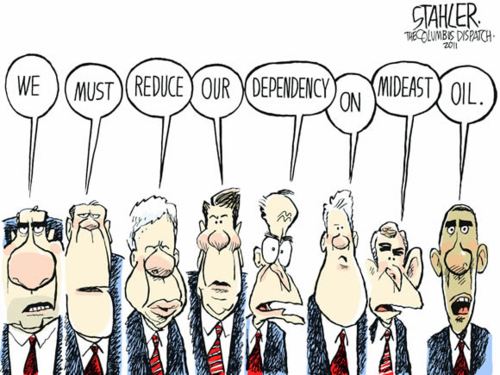
Courtesy Jeff Stahler, The Columbus Dispatch, 1 April 2011
“We’ve run into the same political gridlock and inertia that’s held us back for decades. That has to change,” said President Obama in his speech on March 30th, 2011. He seems to have finally turned his attention to energy, but now with the budget fights in Congress, will green energy be a loser?
On March 30th, Obama gave a focused energy speech, followed it up with a few points in radio talks, and then continued the discussion on April 6th, speaking at a wind turbine plant in Bucks County, PA. Unfortunately, more (more…)
[youtube http://www.youtube.com/watch?v=IzAL0W9I4u8&w=425&h=349]
In this episode of the 2GreenEnergy Video Report, I discuss the use of market research to gauge the overall size of a target market.
[youtube http://www.youtube.com/watch?v=4VvCB8ijr0M&w=425&h=349]
The world is embracing electric vehicles in a big way. But that doesn’t mean all companies offering EVs will succeed. Here, I make some predictions about the probable losers in the EV space.
[youtube http://www.youtube.com/watch?v=ciJv4exh8_k&w=425&h=349]
The other day I was asked to do an hour-long interview on KMST, talk radio in Mt. Sterling, KY. Here it is: pretty wide-ranging discussion of the need for clean energy, the potential solutions. Knowing that a great number of listeners are into coal, I tried to be compassionate but firm on the subject.
The national hospital community gathered in Phoenix in early April 2011 for the most influential conference on sustainable health care, “CleanMed.” Hospital administrators, clinicians, businesses and organizations servicing the health care community, such as green builders, were in attendance.
The conference included a complimentary solar tour of the Phoenix VA Medical Center compliments of SunWize, a company that provides solar solutions for hospitals. The tour was to the largest solar carport installation in the U.S., which started in 2010 and has expanded to 4.45 MW of power.
“The conference is the most important sustainability event of the year for the health care sector,” says Peter Diamond, (more…)
Until I actually read the article, I figured that this project must have been about generating a small amount of power to enable smart-grid communication. But no, it’s about generating meaningful amounts of power. Here are two points:
1) At $6 per watt, it’s clearly no bargain. But how could the idea of nesting small amounts of PV at the top of 200,000 different locations possibly be cost-effective? The industry is trying to get PV to $1/watt — and we’re already close. Paying $6 shows poor thinking, corruption, or some combination of the two. Though, from what I read, it’s not exactly as if either of these two concepts would be strangers to the state of New Jersey, would it?
2) To me, and I can’t imagine that I’m alone here, one of the key costs of renewables is aesthetics. The only reason we’re still using fossil fuels is their high “energy densities,” i.e., their ability to pack a lot of energy in a little space. This means that they can be kept in small, unobstrusive places, e.g., in our gas tanks, where each gallon gives us 35 kilowatt-hours of energy. Even the space in which to make this all happen is fairly compact; though no one wants to live next to an oil refinery, they occupy a relatively small portion of our land mass.
Clean energy, by contrast, requires certain amounts of space onto which the sun can shine or across which the wind can blow. Because of that, it’s incumbent upon us proponents of renewables to get clever in ways to deal with these issues — to try to hide our wind turbines, solar panels, etc., in places where they affect us the least. This, of course, is why the 6.6 gigawatt offshore wind project going in off the Atlantic coastline will be 12 miles offshore: far enough away so as to be invisible to anyone but marlin fishermen.
Having said all this, I would argue that the project in New Jersey is the worst of all possible worlds. Here, we have 200,000 assaults upon the natural beauty of the landscape that the NJ citizens have a right to expect to be preserved.
If they honestly wanted a better solution, all they needed to do was to ask me first… 🙂



![[The Vector] Energy Policy and Obama](https://www.2greenenergy.com/wp-content/uploads/2011/04/jeff-stahler-the-columbus-dispatch-april-1-20111.jpg)
![[The Vector] Clean Energy News from Around the Country: Green Hospitals](https://www.2greenenergy.com/wp-content/uploads/2011/04/doctors.jpg)
 The national hospital community gathered in Phoenix in early April 2011 for the most influential conference on sustainable health care, “CleanMed.” Hospital administrators, clinicians, businesses and organizations servicing the health care community, such as green builders, were in attendance.


