A reader asks for advice re: insurance companies’ treatment of computerized electricity systems (CES).

Craig, Can you help me find a way to get insurance companies to give policy discounts for the new CES panel that is on the market? It has built in spark/arc suppression, lightning suppression, removes the need for power strips, etc. If the insurance agencies would look at this in the same way as they do fire sprinklers, etc. we could put a lot of people to work retrofitting both commercial and residential buildings. The insurance savings (especially on the commercial side) would pay for the retrofit of the panels in a matter of months in most cases. Then we have built in savings on insurance and probably 20% automatic reduction in the energy savings. If you haven’t looked at these panels yet, check them out at www.c-e-systems.com. They are incredible and will be the next wave in our government mandates for energy monitoring and management.

I’m afraid I can’t be of direct help, other than to let others know about it.

But you bring up a point that has implications far beyond CES, i.e., the way in which a great number of eco-friendly systems in our homes are treated by insurance companies – and by banks as well. Right now, the solar array on your roof is not part of your mortgage; it’s treated as if it were an appliance like a refrigerator or dishwasher. But here’s a permanent system, like plumbing or central heating, with a guaranteed life of 25 years, that’s performing a useful task (lowering your electric bill) 365 days a year.

I see a day coming in which such systems are included in the value of your property, and rolled up in your mortgage.

Thanks for writing, and sorry I can’t be of more specific help.
Tagged with: , , , , , , ,

Frequent commenter and really smart fellow Alan Belcher writes:

Craig, as a suggestion, it would be wise/the right thing/common sense to start using the term “clean energy” in place of “renewable energy.”  I say this in view of the consequences of a senseless report that claimed that biofuels (wood chip, etc.) release considerably more CO2 into the atmosphere than coal used as a fuel.

This has caused some very negative side effects regarding some wood-chip fired electric generating facilities throughout the U.S. I have heard instances of permits being withdrawn and the like.

Just a thought. All the best with your new book!

To which I replied:

Thanks, Alan; excellent point. I would think, however, that “clean energy” carries with it its own set of issues as a piece of terminology. For example, is there such a thing as “clean coal?”  And what about nuclear?  No one’s saying that it’s renewable, but the industry is claiming that it’s clean. And they’ve got a point, if by that you mean, “doesn’t emit greenhouse gases.” Of course, if you mean “safe” or “hazard-free” (or any of the other things that any sensible person would associate with the word “clean”) that’s another issue. 

In any case, thanks for the good wishes, and please stay in touch.


Tagged with:

We need to come up with a very powerful argument for renewable energy that eliminates need for ALL burnable fuels.

My wife and I have asthma. She’s had it all her life. I’ve only developed it in my late 70s. Fortunately, mine is not very severe.

I only have to take a puff of Flovent in the evening and a puff of Albuterol when I go for a walk. Mary uses these aerosols more frequently.

We live in Seattle where there are enough hills that a short walk is aerobic. I don’t run very often at age 80, but Mary still runs at age 66.

We have a cabin in San Juan County, WA, whose official heat source is wood burning, but we no longer use the wood stove. Wood smoke is very hard on the lungs. Our 32’x20′ cabin is so well insulated it can be heated electrically by means of one or two electric plug-in 1500 watt radiators. I installed three electrical outlets with thermostats when I wired the cabin, which we purchased without electric power. It was originally 16’x20′, and I doubled it’s size, starting in 2002. Here’s a photo showing the wood smoke and Mary on the new front deck before I added the guardrail and new windows in the old front section. By the way there are many residents of Washington state whose only heat source is wood burning. That leads to some days when wood burning is limited to only those people because of the air pollution. We have a fire place in our Seattle living room, but we no longer use it. We would like to put in solar panels on our Seattle house and maybe this one, but it’s currently beyond our means until we sell one of these houses. Before the ‘great recession’ we could have sold the island property for maybe $300,000. There are 2 acres total, consisting of two 1/2 acre lots and half of a 2 acre lot which we share with neighbors and is fully forested. We have a nice view of water and Lopez island from the front. We’ll have water front after global warming takes over and floods the lot in front of us. The roof on that lot is about 40 feet below our deck. Because of the 2×4 construction, we insulated the cabin with styrofoam, which is R-5 per inch, so the walls are R17.5 and the floors and roofs are R-30. I replaced the old single pane windows with large insulated glass windows, so we have nice views all around. Unfortunately, birds occasionally hit the glass and are stunned. I don’t know if their lives are shortened as a result. We sometimes put markings on the glass to prevent that.

Tagged with: , , , , , , , , , , ,

…continued from earlier


Shifts Within the Industry

Pew’s researchers say that because scientific research, public policy, market forces, the economic recovery and new technology drive innovation and competition, leading sectors in today’s clean energy economy may not be so tomorrow.


The researchers for the Pew report broke the clean energy economy into five broad categories:


1)     Clean Energy (such as those directly working in solar or wind, like plant operators, installers, manufacturers, and technicians.)


2)     Energy Efficiency (such as Leed certified professionals.)


3)     Environmentally Friendly Production (such as electric car makers)


4)     Conservation and (more…)

Tagged with: , , , , , , , , ,

Several times a week I’m approached by cleantech businesspeople looking to raise investment capital to establish or expand their companies.  As I know I’ve mentioned, we at 2GreenEnergy do what we can to help; to this end, we’re constantly expanding our relationships with angels, VCs, private equity, and institutional investors.

But I’m always happy when I come across innovative groups and concepts along these lines that enable me to supplement what we’re doing here.  It was for this reason that I was thrilled to have been introduced to the California Coast Venture Forum (CCVF) earlier this month.

(more…)

Tagged with: ,

I was helping my daughter with an English assignment in which she needed to write a poem in iambic pentameter, styled after Marc Antony’s funeral oration for Caesar.  She was having trouble getting started, so I wrote her a sample to illustrate how this could go.  For grins, I thought I’d present it here: (more…)

Tagged with: , ,

Here’s a good discussion on some points near and dear to us here are 2GreenEnergy, especially the way in which the oil companies have systematically internalized their profits while externaling many of the most obvious and burdensome costs of their operations.   IMO, the most important concept in the whole conversation is the rhetorical position that environmentalism and capitalism as are odds with one another, i.e., that environmentalism comes at the expense of jobs and economic prosperity.  This, of course, is categorically false — yet it’s a theme that we hear constantly.

Tagged with: ,

Jobs: in order to examine where we are and where we are going, we need to look at where we have been. To gain perspective on America’s green energy economy, the Pew Charitable Trusts researched the green industry between 1998 and 2007.  “The Clean Energy Economy: Repowering Jobs, Businesses and Investments Across America“ analyzes all aspects of the green economy and views the industry as a critical component of our future. (more…)

Tagged with:

I thought I’d put up a post about my buddies at OnGreen.com, whose purpose is to build the green economy by helping with the creation of innovative businesses. In large measure, OnGreen parallels the work that we do here, assisting entrepreneurs in cleantech to succeed in bringing their ideas to market, and connecting with sources of capital.

I met one of the founders, the much-accomplished Nikhil Jain, at his office in West Los Angeles a couple of weeks ago. I’m always impressed with folks who can reel off their mission statement with both complete precision and total effortlessness; it’s obvious how real and deeply abiding it must be in their lives.  And you can’t help liking his ultra-personable style, brimming with well-earned self-confidence.

When you visit OnGreen’s website, you’ll note that anyone can post whatever business plan he wants. I like this type of egalitarianism, though, obviously, it comes at a cost. I’ve certainly been approached with some business ideas that didn’t make a heck of a lot of sense. Having said that, the inquiries I made to some random selections on OnGreen left me far more impressed with what I found than I expected to be.   Again, I hope you’ll check them out.

Tagged with:

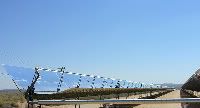
If you check out this little press release on Skyfuel’s new 50-megawatt parabolic trough solar thermal plant 400 kilometers east of Beijing, you’ll see why I favor this technology (concentrating solar power/CSP) as the future of clean energy. The company owns a subsidiary that using a low-cost reflecting film instead of glass. Lower costs, greater “constructability.”

And this is just the start; we haven’t even begun to see the costs come down here.

Tagged with: , , , , , , , , , , , , ,