PhotobucketYesterday’s guest blogger wrote:

The idea of collecting solar energy from the upper surfaces of already constructed buildings seems like the least intrusive and most efficient method to utilized light, in my opinion. It doesn’t shade the natural ecosystem and collects/distributes the energy where humans need it.

This is true. A few additional comments:

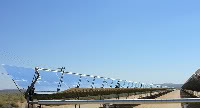
Obviously, the migration to renewables will be a blend of public and private projects. It’s good to see solar installations on a piecemeal basis on residential and commercial buildings. But clearly we need a real game-changer, and that has to happen at the utility level. And here, PV is one of many competing alternative energy technologies. As I’ve written often, I advocate large solar thermal farms in the southwestern deserts.

This brings me to my other point: the natural ecosystem. With very few (perhaps no) exceptions, generating renewable energy comes at the price of some level of violence to the local environment. In my conversation with Brian Rutledge of the Audubon Society, I ignored this; I made the mistake of referring to proposed solar thermal sites as “desert wastelands,” and Brian broke in: “They’re deserts, but they’re not wastelands,” he pointed out. Good point; I stand corrected.

I nevertheless contend that paying a certain well-defined ecological price for turning off fossil fuel and nuclear plants is a deal that we simply must make without shame or compunction. If we’re speeding the extinction of a rare desert lizard in the process of reverting the rise of greenhouse gasses and the terrible consequences to every species on earth that are very probably tied to this phenomenon, it strikes me as the bargain of the century. 

I’m not sure how anyone could object to this.  The only proviso here, I would think, would be that that such decisions be made on a fair and measured basis.  We need to study the issue carefully and pull the trigger only when we’re sure we’re doing the least possble damage.

Tagged with: , , , , , , , ,

My friend Geoffrey Nicholson comments my post “Renewable Energy and Basic Physics”:

Craig, I couldn’t agree more.

 Other than geothermal energy, all the other sources of energy available to us originally came from solar energy and with a rather lossy process. Petrochemical from solar growing primordial goo. Hydrokenetic from solar driven convection. Wind from solar convection with a bit of coriolis effect. Water from lightning from solar convection. Wood and alcohol from solar energized green growy things.

Gas turbines can be around 50% efficient burning fuel but, again, how efficient is the production and transportation of the fuel?

Steam turbines a bit more efficient.

Gasoline engines about half as efficient as turbines with Diesels a bit more efficient that gasoline.

Stirling engines are quite efficient but pound for pound don’t produce much work.

Interestingly, hydrogen fueled aircraft could be more efficient than kerosine since the specific weight of hydrogen is less than gas but the design of the aircraft would have to change dramatically since the specific volume of hydrogen is greater. Fat planes would result that would probably fly slower than today’s aircraft. Again, how would the hydrogen be produced?

The idea of collecting solar energy from the upper surfaces of already constructed buildings seems like the least intrusive and most efficient method to utilized light, in my opinion. It doesn’t shade the natural ecosystem and collects/distributes the energy where humans need it.

What do you think?”

To which I respond:

Thanks, Geoff.  Everything you write here is true, as far as I understand.  PV on rooftops makes a great deal of sense.  The costs and coming down, the efficiencies are going up, and the overall engineering is getting increasing clever.  See my post on California-based Solyndra as an example.

The only piece you’re missing, I feel, is solar thermal / concentrated solar power (CSP) as described at the bottom of the post.

Thanks for writing!

Tagged with: , , , , , , , , , , , , , ,

My old friend Peter Buzzard commented on my post “Molten Salt Energy Storage“:

“Craig, do you know if a Stirling engine would be more efficient than making steam for a turbine?”

To which I reply:

I don’t know know much about Stirling engines; I need to learn about these.  But it sounds like you may be comparing apples and oranges.

I’m sure you’re aware that devices that simply store energy (e.g., molten salt, batteries, capacitors) and devices that convert energy form one form to another (e.g., motors, turbines) are two different things. And as far as the latter is are concerned, electric motors, even using the technology of the very first ones 120+ years ago, are quite efficient; in fact, the AC induction motors that are used in today’s electric vehicles are close to 90% efficient. What’s not to like about that?

Thus, it seems to me that the real question is how to generate, store, and distribute the electricity.  Coincidentally, I was writing my book’s chapter on basic physics last night, in which I noted the following about the conservation of energy:

Once one really wraps his wits these basic ideas, one is in a terrific position to understand most discussions of energy. Here are two examples to make this clear:

Hydrokinetics: Every day, the energy from the sun evaporates water into steam that is later condensed into clouds, the precipitation from which forms rivers, some of which are in high altitudes. The kinetic energy of the water flowing back downhill can be converted into electrical energy. But the conservation of energy tells us that the most electricity one can possibly hope to generate from this water is the potential energy it had before it started to flow (which equals the weight of the water times the height of the elevation from which it fell). This is for this reason that hydrokinetics cannot provide a significant amount to the overall energy picture, regardless of how many dams, how efficient the turbines, etc.

Solar: On the other hand, the earth receives 6000 times more energy from the sun every day than mankind currently uses for all its purposes: transportation, heating, air conditioning, etc. Put another way, if we had the capability of capturing and distributing 1/6000th of the sun’s energy, we would not need to burn another lump of coal, spilt another atom, or pump another ounce of gasoline. This fact alone forms the rationale for our interest in solar energy.

I encourage readers to review all assertions about different forms of power generation — renewable or otherwise – to this discussion on the conservation of energy. When someone says, “This car runs on water,” ask yourself: water? Isn’t water already “burned” hydrogen and oxygen, i.e., the result after these two elements release energy by joining together? That’s like saying, “Let’s build a fire using those ashes for fuel.” Sorry, they’ve already been burned, meaning that the chemical energy that was once stored in the carbon bonds of the wood has already been converted into the heat, light, and sound of a fire. The ashes are the low-energy result of that process.

I got an email from a friend announcing a miracle car that runs on air. As it turns out, it actually runs on compressed air. The energy required to compress the air is stored in a tank and converted into kinetic energy. Trust me, there is not one bit of energy delivered to that car’s wheels that didn’t going into compressing the air in the first place.

At the end of the day, I think the energy direction of the planet is very clear:

Generation: solar, especially concentrated solar power (CSP).

Storage: molten salt (Note that storage is somewhat less important for solar than say, wind, as solar tends to be generated in congruity with times of peak need). Note also that solar it’s already heat energy; there is no need to convert it to something else.

Transmission: High voltage direct current (HVDC). This requires a build-out of our ancient power grid, but we need to do that anyway.

Thanks again for writing, Peter.  I hope this was useful.

Tagged with: , , , , , , , , , , , , ,

PhotobucketYesterday, I conducted an interview with Dr. V. “Ram” Ramanathan of the Scripps Institution. In the course of the talk, I asked Ram if he would comment on the likely outcome of the upcoming conference in Copenhagen — which he’ll be attending and the world will be anxiously watching.  In particular, I wanted to know if a rational person should hold out hope for any substantive agreements and subsequent changes of behavior with respect to global climate change — arguably the world’s thorniest problem.  Though he didn’t come out and say it, Ram didn’t appear optimistic.

He explained his concern in much the same way we hear the subject reported in the press:  The developing nations say, “You caused the problem; you fix it.” But the developed nations refuse to control emissions if the developing nations refuse to do so as well, as a large and growing contribution to current emissions is coming from these developing nations.  This standoff appears unlikely to resolve itself in Copenhagen — or anytime in the near future.

As always, the full interview will occupy a critically important chapter in my book on renewables. Suffice it to say that Ram, the man who was part of the team that discovered the phenomenon of global climate change in the 1970s, had plenty of insight into this matter — as well as many specific suggestions on renewable energy. 

There is true concern and sadness in his voice. “I’m not concerned about getting attacked by the oil companies,” he said when I asked him about that. “I simply feel sorry for the planet. We’re coming ever closer to the precipice.”

In response to my recent piece on solar thermal and molten salt, a reader admonishes:

You assume that “molten” salt is universally available over the entire power grid? Get real!

Apparently, I’m not describing this as clearly as I thought I was. As shown in this diagram on molten salt energy storage these devices wouldn’t need to be universally available over the entire power grid; units are located within solar thermal farms to store energy for distribution back onto the grid during the hours that the sun is not high in the sky. In other words, it’s part of the power generation plant, like a subsystem within a coal or nuclear plant.

Having made that clarification, if you’re referring to the expense of the migration to renewables in general — or to molten salt energy storage in particular, you have a point; I can’t say that this whole process will be cheap. But I do believe two things:

  • This is the least expensive (and most secure, reliable, and scaleable) alternative, and
  • We literally do not have a choice.

I don’t want to come off as an alarmist, but I do not believe that our civilization with survive the run-up of oil scarcity that it inevitably faces — not to mention the long-term environmental damage associated with consuming 100 million barrels of oil a day — until we run out.

Tagged with: , , , , , , , , ,

PhotobucketThe interviews that I am conducting that will eventually form the chapters of my upcoming book on renewables are, by design, on a variety of different topics.  Yet I can’t help noticing that powerful common threads are emerging from the words of a range of different types of professionals speaking on topics that, on the surface, have virtually nothing to do with one another. 

Perhaps the  most obvious example of this lies in the politics behind Big Energy.  Here are a few points of consensus:

  • A “cozy” relationship exists between government regulators and those they ostensibly regulate.
  • This relationship is spawned from the fact that regulators often come from — and later return to — those industries.
  • Political campaigns are financed largely from contributions from the corporate giants whose interests the legislators are asked to regulate, presenting huge and obvious conflicts of interest. 

All of this may sound like “old news” — so obvious that it hardly bears mentioning.  Yet here is a variation on this theme — perhaps more intersting — that actually comes up in our my conversations even more often that this “the fox is guarding the henhouse” discussion above:

The political cycle is two years.  Advocating an idea that does not produce demonstrable results in that time period is political suicide.  Such support has no upside, and will be used by the supporter’s opponents as evidence of stupidity or corruption.  Yet investment in renewable energy — in all its many forms — is long-term (certainly more than two years) by nature.  Throwing money quickly and carelessly at the energy problem without thinking it through is guaranteed to produce failure — including gross inefficiencies, and, ironically, more ecological damage.

And guess who wins when renewable energy projects misfire?  That’s right, it’s the status quo boys, heartlessly pumping their oil, greedily mining their coal, and recklessly splitting their atoms. 

Again, I point to our political machine as the true culprit underlying the horrible environmental effects that the energy industry is wreaking on us.  In particular, if we do not see intense grass roots efforts demanding a total reform of campaign finance law, it appears that we are doomed to sit idle while the last few billion barrels of oil are sucked from our earth and its exhaust fumes dumped into our skies.

I’d love to hear readers’ comments here.

Tagged with: ,

PhotobucketI just spoke with Dr. Greg Mitchell of the Scripps Institution of Oceanography, as the basis for my book’s chapter on biofuels.  Dr. Mitchell’s focus is on algae and cyanobacteria (a related photosynthetic, aquatic organism). He generously gave me a solid hour’s worth of proof-points that algae represents a critically important component in finding answers to civilization’s toughest questions on energy and food supply.
 
Biofuels store chemical energy that is ultimately derived from the energy of the sun. This potential energy is carried in carbon bonds that are then oxidized (burned) to produce useful work, e.g., heat energy to warm our buildings or kinetic energy to drive our vehicles. As an alternative to growing plants in sunlight, algae can be fed macronutrients, but the energy in those nutrients comes ultimately from the sun as well. Dr. Mitchell favors algae over other forms of cellulosic biofuels because “small is efficient”; a given amount of biomass in algae contains 10 – 50 times more energy than the same mass of terrestrial plants. About 35% of the mass in algae is converted directly into biofuel, and most of the rest becomes useable food.

As I’ve written in the past, I have been openly skeptical of the wisdom of biofuels, since they themselves are hydrocarbons. Why make and burn more of them if we’re concerned about CO2 in the atmosphere? Dr. Mitchell acknowledged the intuitive merit of this idea (or was just being kind?).  But he points out that there is a lot to like about algae. Here are few points I hadn’t considered. Algae:

  • does not require arable land for production
  •  

  • is irrigated with salt water
  •  

  • can photosynthesize using CO2 that comes from an external and controlled source

Dr. Mitchell showed me that there is enormous promise as this industry develops. The challenge at this point is a combination of the technological and the financial. Right now, in fact, there is indeed no industry — nor should there be, he says, while we take the time to pose and resolve a few basic and vitally important questions, e.g., the exact species to be developed, the methods of production and harvest, and the modes of processing and distribution.

Fascinating stuff.  And more coming soon.

Tagged with: , , ,

Photobucket“It’s distinctive without being bizarre.”

This is the description that Plug-In America’s Paul Scott bestowed upon the new Nissan Leaf, a sleek electric vehicle that will be introduced in the US next fall. I finding this telling, as it’s what I’ve advised the industry since I became involved as the VP Marketing at EV World 18 months ago: make the right statement with the design. The Aptera‘s design is cool, but how many people want a car that looks like that?

Understanding and appreciating the psyche of the customer is critical – and I normally like to do this by survey; it’s best when a client places a real value on market research and funds a statistically valid sample of one-on-one interviews that enables me to get my finger on the pulse of the market. Absent that, we have to guess, which is always a bit frightening.  But here, I think we can take a pretty darned good guess.

EV customers want to be noticed, respected, and tacitly yet sincerely thanked for their enlightened contribution to environmental stewardship.

EV customers do not want to be regarded as self-deprecating weirdos, ridiculed for their willingness to throw away all material comforts to protect some species of rare earthworm.

To me, design speaks to this very directly. And I agree with Paul: Nissan has nailed it. Let’s hope that behind this announcement there is full, unflagging commitment to production and distribution, and that we’re standing at the dawn of a new era of electric transportation.

Tagged with: , , ,

PhotobucketThis week’s news in electric transportation calls to mind the auto companies’ deceit a decade ago with California’s Zero-Emission Vehicle mandate.   According to the Automotive News, Chrysler has disbanded the engineering team that was working to bring three electric models to market as a rush job. This program, of course, was the basis on which they got every man, woman and child in the United States to bail them out with $12.5 billion in taxpayer money. And I suppose we have to add in the $70 million in grants that Chrysler took from the U.S. DoE to develop a test fleet of 220 hybrid pickup trucks and minivans — vehicles that are now scrapped as well.

I was speaking with my friend Bill Moore (of EV World fame) just now about how cheesed off we should all be by this. I mentioned that $12.5 billion is quite a heist. “Isn’t that one of the biggest burglaries in history?” I asked. “Yes,” Bill said. “But they’re too big to arrest.” 

Jay Leno, move over.

Tagged with: , , , ,

PhotobucketI must say that the process of interviewing subject-matter experts for my book on renewables is perfect for my temperment as a writer. I don’t aspire to be an authority on any one subject within the framework of renewable energy, but I certainly aspire to grasp fully the fundamental issues at stake in each, and to be able to learn from a good, engaging conversation. Thus it is with joy in my heart that I’ll be headed for the Scripps Institution of Oceanography next week for my interview with Dr. Veerabhadran Ramanathan. I’ll be speaking with a man, affectionately known as “Ram,” who is perhaps the most well-respected scientist on the subject of global climate change. In fact, his assistant told me that he is credited with discovering the phenomenon, correctly predicting in the early 1970s that there would be a measurable increase in the planet’s temperature by 1980. Unless something unforeseen takes place, the full transcript of the interview will occupy an important chapter.

In any case, the process of preparing for these interviews forces me to read and digest short but pithy articles like this one, and to familiarize myself with the nomenclature associated with the key issues. For instance, we all recall from Al Gore’s movie the cooling phenomenon of certain pollutants, which, when they are removed from the atmosphere, will actually increase global warming. This is known as AMGW, or aerosol mask global warming. Of course, there are dozens of such concepts into which to sink one’s teeth. I would say this would be unbridled fun, if it weren’t for the tragic circumstances and the severity of the consequences.

Tagged with: , , ,