I figured that my posts on Renewable Energy World on liquid ammonia would eventually get some response. I had been wondered how it could be possible that so few people were working on projects in this area, as it really does seem like an important idea. In particular, as a liquid energy storage medium, it has the potential to solve three tough problems simultaneously. In addition to being clean, safe, reliable, and scaleable, liquid ammonia can help in:
1) Moving large amounts of energy around a large land mass (like the lower 48 states) in a way that would compete with electrical. (Proponents point out that a great deal of this piping infrastructure is already in place.) (more…)
Following up on yesterday’s post about how investors should be prepared for BP to file for bankruptcy, the company’s CEO this morning reportedly said it’s “hard to speculate” on future dividend policy. That’s tantamount to BP’s saying it will reduce or eliminate its dividend. I’ll say it again: look for BP to file for court protection before the end of summer.
Many of my friends have asked my opinion on the likely impact of the Gulf oil spill on the trajectory for renewable energy. And although one might think that I’d be in a reasonably good position to answer a question like that directly and accurately, in truth, it really is hard for me –- or anyone, I believe — to predict the effect of this catastrophe on the world’s energy policy going forward. I offer a few points for discussion:
Many people suggest that, as horrific as the spill is, it comes with a “silver lining,” i.e., accelerating the demand for a replacement for oil as our predominant energy supply, brought about by an increased awareness of the many dangers of oil. Oh really? So the general public — normally fast asleep — has awakened? So a large flock of sheep had an epiphany on the dangers of oil and created a firestorm of outrage at the oil companies? So what? The same political forces that have continued to grant oil companies enormous subsidies through the last half century and made gasoline/diesel 98+% of our transportation fuel – even when we became aware of the dangers many decades ago — are still in place. And now those forces are working harder than ever. Do you think the corporate powers and (by far) the biggest lobby on the planet are updating their résumés and looking for new careers because of a lousy oil spill?
In addition to the big politics and big money, there legitimately are technology issues. Of course, these issues would have been largely mitigated, or eliminated entirely, if we had done what we should have been doing since the oil embargoes of the 1970s: running 1000 miles per hour toward electric transportation and various forms of renewables. Now, our oil addiction is so severe that the consequences of moving away from it are, like withdrawing from any addiction, quite unpleasant.
And consider global climate change. Some people say that the oil spill negates any point that the “deniers” may have had — i.e., now the validity of the global climate change theory no longer matters. Of course, that’s been the case for a long time as well. If you’re looking for a reason to break our oil addiction, the argument about global warming has been moot for many years; it’s been obvious to most of us that there are five or six different equally compelling reasons. I know there are people who disbelieve the climate change theory; I run into them all the time. But are there people who don’t believe in terrorism? In the consequences of a ballooning national debt? In lung cancer? In the dangers of weak national security? In ocean acidification? The spill is certain to weaken the position of the oil zealots (and whatever forces control them) — who try so hard to sell us on the idea that “oil business as usual” is a reasonable path towards a sustainable civilization.
So I suppose that there really is a silver lining here. It is precisely that now, anyone and everyone (you don’t have to be a clean energy editor/business analyst) can see the truth for what it is. There is one and only one winner in oil, namely the oil companies themselves. Recall the tobacco companies of the 20th Century, and their product — the only legal one that when used as directed causes death. At a certain point we all realized that cigarettes were very good for Philip Morris investors and executives – but that they were very bad for literally everyone else on the Earth. The issue is the same here. The oil companies are the sole beneficiary of oil. And now, finally, it’s clear to everyone.
Let’s acknowledge that we made a grievous mistake in the 1970s/1980s — and move on. And let’s keep our eye on the ball this time. Dropping the ball once is not license to drop it again. Use this as a litmus test for our leaders: an elected official who is really on your side (if there actually is such a thing) will take whatever political risks may come his way to stay the course in the development of clean energy solutions.
But it’s up to you and me to insist that our leaders do that. In case you haven’t noticed, they don’t do things because they’re right; they do them because they’re forced.
Paul Scott, co-founder of Plug-in America, speaks with 2GreenEnergy Report host Craig Shields about electric transportation and charging infrastructure.
The reason why the BP Gulf oil spill occurred was that nobody thought it would occur. Nobody asked the “What if . . . ” question.
Investors should not make the same mistake. With estimates of BP’s financial liability rising by the minute, at the very least investors should expect BP to suspend dividend payments. More than that, investors should be prepared for BP’s lawyers to walk into a friendly Texas courtroom sometime this summer and get a judge to grant them court protection against legal claims. Technically it will be a bankruptcy filing, although Americans will gnash their teeth at how BP continues to operate normally.
When the filing occurs, the whole market likely will take a tumble. A lot of other “What if . . . ” questions may be asked that destabilize markets for several months. I’ll try to ask a few of those “What if . . .” questions in my next few postings.
Paul Minett wrote a very cogent response in response to my post about the dubious validity of EV research. He is completely right that there are numerous battles to be fought along the way — and he nailed many of them.
In particular, Paul talks about trust — a critical aspect of the equation to be sure — and suggests that car salespeople need to rely on the trust they’ve built with customers to form the bridge from internal engines to EVs. While I’m not sure people trust car salesmen, they certainly trust the power of their own observation and the reports of their friends.
I harken back to an early article I wrote on the migration to EVs when I first began to learn about the subject a couple of year ago. I urged the industry: just let’s get a few of them out there. I suggested: “Once there are a few thousand full-size EVs (Teslas, LEAFs, etc.) traveling among us, pulling up to lights next to us, parking near us — the game is over. As soon as even a small percentage of us has a trusted neighbor or friend, or even a friend-of-a-friend zipping around, saving money in a car that lasts 10 times longer than the eco-polluter we’re driving ourselves, watch out. The internal combustion engine will be on its way out — and fast.”
For anyone who may be interested, here’s a link to an article Shannon Combs wrote on an apparent breakthrough at the University of Illinois in the use of gallium arsenide in photovoltaics.
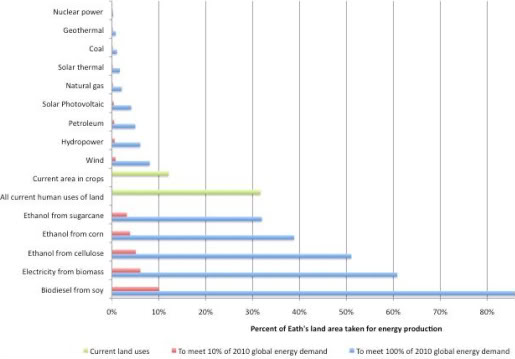
The migration to renewable energy is complicated by a great number of factors in the renewable energy “triumvirate” -technological, economic, and political. The chart below shows one of many different dimensions of this complexity: land use – which, when you think about it, touches on all three. The data in the chart is derived from:
1) a paper titled Alternative Energy and Land Use from Clinton Andrews et al.
2) land intensiveness data from McDonald et al (2009)
3) land area data from Melillo et al (2009), and
4) global energy demand data from EIA



 I figured that my posts on Renewable Energy World on liquid ammonia would eventually get some response. I had been wondered how it could be possible that so few people were working on projects in this area, as it really does seem like an important idea. In particular, as a liquid energy storage medium, it has the potential to solve three tough problems simultaneously. In addition to being clean, safe, reliable, and scaleable, liquid ammonia can help in:
 Many of my friends have asked my opinion on the likely impact of the Gulf oil spill on the trajectory for renewable energy. And although one might think that I’d be in a reasonably good position to answer a question like that directly and accurately, in truth, it really is hard for me –- or anyone, I believe — to predict the effect of this catastrophe on the world’s energy policy going forward. I offer a few points for discussion:
 The reason why the BP Gulf oil spill occurred was that nobody thought it would occur. Nobody asked the “What if . . . ” question.
 Paul Minett wrote a very cogent response in response to my post about the