I was on a conference call this morning with people in Los Angeles, New York, Dublin, London, and Istanbul, trying to raise money for a large run-of-river hydrokinetics project in Turkey.  I’d have to go back a long way to recall a conversation representing that many time zones.

What I find noteworthy here are two things:

1) Sadly, most of the really important renewables projects are happening outside the US. I’m reminded of this constantly – normally accompanied by a warning that the US really cannot afford to take a backseat in terms of the development and implementation of alternatives to fossil fuels. We’ve done a good job in information and communication technologies, with companies like Microsoft, Google, Oracle, etc., but we need to be equally aggressive – and ultimately successful — in leading the way to clean energy.

Renewable energy legend Bill Paul, who has joined us here at 2GreenEnergy as a financial writer, points out the importance of the European, Asian — even African markets virtually every time we speak.  Bill keeps his finger on the pulse of 75 different sources of information every single day — many of which feature projects in some fairly exotic places.  When we first met over lunch, he mentioned that it’s likely the Sahara will soon be the site of enormous amounts of solar thermal, providing power for much of Europe, and that this heightens the importance of following the stock exchanges in Tripoli and Algiers.  Wow – that’s a lot of information to juggle. 

2) The financial mechanics behind deals of this size (the project we discussed this morning is 109 million Euros) are incredibly complicated. I was so lost on this call I didn’t know which end was up. Fortunately, I was able to introduce the parties, mute the phone, sip my coffee, and listen quietly until it was time to thank everyone for participating and hang up. I’m blessed to be associated with people 10 times better at the financial side of this than I’ll ever be.

Calls like this remind me of the first video I made when we started this site, where I asked: “What’s causing the rapid migration to renewables? It’s business. The world is figuring out that there are enormous profits to be realized from pushing toward clean energy.”


Tagged with: , , , , , , , ,

PhotobucketTomorrow morning, I need to rush home from dropping my daughter off at school to be on a live radio broadcast, in which I’ll be speaking on the imperative to move to clean energy. Also featured on the program is a representative of the National Resources Defense Council. I interviewed someone from the NRDC for my book on renewables, so I’m fairly familiar with the cut of their jib. You have to like people who stand up and do the right thing under incredible pressure to yield.
In preparing for this live discussion, I’d like to try to concentrate on the basics of clean energy; I’d like to make this is simple and as black and white as possible. But that’s not easy. The more I learn about this the more complicated I understand it to be. There is a lot to discuss about the subject of global warming alone, for instance. But discussions on the subject are usually 10 parts politics for every one part honest, objective science. I could prove that 2 and 2 are 5, using logic that I find in a lot of places.

The fact is that almost everything you read was written for a reason – and that reason is very seldom to inform you of the complete unvarnished truth. We’ve all come across the idea that global warming is a hoax. There is a paper being circulated now that takes this a step further, alleging that the hoax is aimed at creating enough fear in people that they will accept increased infringements in their liberties and ultimately a unified and tyrannical world government.

Personally, I’m a bit skeptical. I have to ask — in my mind, who has more credibility: thousands of research scientists – many of whom I’ve met and come to know as trusted friends — or a guy writing a paper with outrageous ideas and essentially no supporting evidence? Hmmm.

Tagged with:

Continued from yesterday…..

Another drawback of tidal energy is the dependence on location for a successful project. As with most of other water based methods of energy generation, the location plays an essential role in harnessing the potential power source; site procurement costs gets high increasing the cost of the entire project.

Currently there are very few tidal power stations in the world. The largest and oldest is located in northern France at the La France river mouth estuary. The other sites suitable for the utilization of tidal power exist in many places around the world majorly in France, the United Kingdom, Former Soviet Union (now Russia), Canada, and the United States. Before setting up the plant, it is important to have a proper feasibility study.
(more…)

Tagged with: ,

Water covers about 70 percent of our planet, majorly composed of the oceans with endless waves and perpetual tides. Water is a source that lays the foundation for many forms of renewable energies like Hydro energy, Ocean energy, Tidal energy and Wave energy. With the advent of newer renewable energy sources, water is heavily counted upon as the source of green energy. The major advantage of water based energy sources is that water can be harnessed to create energy with almost zero carbon emission.
(more…)

Tagged with: , , , , , , , ,

PhotobucketA couple of readers have criticized me for not being specific in my rants on nuclear energy. It’s true that I do not perform independent research — and I suppose I can be taken to task for that.  But I do read a fair amount of others’ writing, and I try to be as specific as possible in supporting my beliefs. E.g., take my post on the Florida utility group FPL, in which I wrote the following. That was fairly specific, wasn’t it?
The actual cost of building these plants is almost never anywhere near the projected budget. Readers may want to Google “nuclear plant cost overrun,” and read a few of the 54,700 articles they’ll find on the subject. Here’s one that refers to a certain nuclear project as “satanic,” based on the actual amount of the overrun ($6.66 billion). The Florida utility, FPL Group, now estimates the cost of building a new nuclear power plant at over $9 billion, nearly double their previous estimate.

Tagged with:

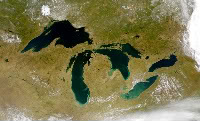
The Great Lakes of the United States and Canada, particularly Lake Superior, Lake Huron, and Lake Michigan, provide excellent opportunity for adequate and reliable green energy for the population near those lakes, as well, in a more limited form, of energy in the wider region. Lake Superior is the largest of the Great Lakes, and the deepest. And most of the water it receives comes from the North. This makes it a large reservoir of cold water. Thus, Lake Superior, of all the Great Lakes, has the greatest potential for the generation of green electricity. Northern Lake Michigan and Lake Huron also have potential, but I will concentrate on Lake Superior in this essay.


(more…)

Tagged with: , , , , , , , ,

It’s fast becoming apparent that large clean energy storage is needed for variable renewable energy integration into the grid, not only to stabilize that resource but to avoid inevitable curtailment due to transmission constraints. The resulting VERS (variable energy resources) losses incurred reduce the value of clean energy, particularly wind, in some cases by 50%. Detailed information of this nexus is spelled out in a subcontracted study by NREL released October 2009. (NREL/SR-550-46716)
(more…)

Tagged with: , , , , , , , ,

In your act of reading this, I can make certain assumptions. You have an interest in what might be broadly characterized as ‘not business as usual’. While possible, it is unlikely that your eyeballs got here through a Bing or Google mishap. Most such ‘mishaps’ involve the legal tender. You likely know Craig, or are ‘in circle’ (first three layers) in the six degrees of separation sense made popular by Facebook, et al. Your interest goes beyond the casual, else you would more likely be engaging in such profundities at your favorite watering hole (or equivalent) rather than the blogosphere.
(more…)

Tagged with: ,

I made another video using Windows Movie Maker just now, to promote our relationship with SustainableBusiness.com.   I take a certain joy in making this videos. I know I’m not Steven Spielberg in film-making, nor James Earl Jones in voice-overs — but it really is fun trying to get this done with reasonably good delivery and no major screw-ups.

I’ve enjoyed getting to know Rona Fried and working with her to co-promote sustainable living products and services. She’s extremely bright, as that Ph.D. after her name suggests, but she’s also very dedicated to the cause. Her website has been a beacon of commitment to environmentalism for 14 years. Impressive stuff.

Tagged with: , , , , , , , ,

Continuing my discussion of solar energy from yesterday ….

The intermittent nature of solar energy also raises questions on its feasibility in certain geographies. The Mojave Desert may get a lot of sun, but the same is not true for other parts of the country. Besides, most solar panels convert only 22 percent of the radiations they capture into electric energy. This means that a typical solar farm has to cover a big area to produce electricity in meaningful amounts, such as the one proposed by BrightSource Energy Inc. in Mojave.

The 600,000 acre solar farm never materialized as environmentalists opposed the idea of generating energy inside a national monument.
Even after much research, solar energy cannot solve energy problems singlehandedly. It is necessary to have continuous power supply which in turn means having to store excess energy. Many advances in solar thermal energy technologies are still unable to provide the required supply of strength.

Notwithstanding these issues, supporters claim that the issues aren’t with the technology but the implementation of the solar policies. Lack of a unified national policy is one of them. US has a piecemeal approach for the solar panel installations including different, local incentives on state level. An aggressive stance taken by the Spanish government last year caused a glut in the market. Companies lined up to take advantage of the generous government subsidies in Spain adding 2 GW of electric capacity in just 12 months. However, when the government announced to reduce the subsidies in September 2008, the move caused massive job losses and an eventual bust.

Quite opposite, US hasn’t implemented a unified, central policy. Experts claim that the lack of such a policy isn’t desirable. Instead, a cautious national approach such as the one taken by Germany is the best way to go about the solar equation. The German law requires utility companies to buy energy from solar plants at higher rates and to feed the energy into their grids, ensuring buying guarantees for solar plants. In US, California is one of the states with such a law. The state approved a feed-in tariff policy in October but the need for such a policy at national level is certainly felt in expert circles.

Absence of a national policy has also resulted in solar companies taking advantage of the taxpayer’s money by availing different subsidies from governments for same project. The state of Oregon had to enact new rules last month to make it difficult for companies to qualify for multiple tax credits.

Lately, the performance of solar companies has improved after the financial turmoil. Most of the solar companies have reported improved quarterly financials beating sales and earnings expectations. Although different formats of solar panels are emerging, both crystalline silicon and relatively new thin-film technologies are expected to flourish, crystalline silicon technology is expected to have an upper hand as far as installation on urban rooftops is considered due to higher energy efficiency.

ADRs of the China-based Trina Solar Limited, a monocrystalline PV module manufacturer have run up 46 percent in November. On the other hand, thin-film players might spring a surprise as the technology is blessed with lower cost of production.

In the long run, the emphasis on renewable sources including solar is likely to increase but in the medium term, the popularity of solar energy and other renewable sources is likely to remain a function of the availability of cheaper or easier alternatives.

Tagged with: , , , , , , ,