I find this completely credible, and here’s why.  When I do the right thing, even if it’s completely expected of me based on simple etiquette, like holding a door open for a lady coming into a grocery store behind me, I always go through the same basic three steps: (more…)

Tagged with:

There is no value in my being too rancorous about this impeachment proceedings, but nor is there value in ignoring them altogether, and the meme at left is a good example of the reason why that is, i.e., these are teachable moments.

We want our children to be brave and honest, and remain steadfastly loyal to the truth over everything else.  (more…)

Tagged with:

Renewable energy has become cheaper to implement in recent years, giving companies more incentive to use it in their daily operations. An increase in renewable energy means less reliance on fossil fuels — which the food industry frequently contributes to. Food manufacturing is an intricate process concerning the growth, harvesting, preservation and transport of goods. This complexity calls for a lot of energy, which facilitates harmful greenhouse gas emissions.  (more…)

Tagged with: , , ,

In my post of yesterday: Volcanoes and CO2 Emissions,  I quoted the U.S. Geological Survey (USGS) as follows: “The world’s volcanoes, both on land and undersea, generate about 200 million tons of carbon dioxide (CO2) annually, while our automotive and industrial activities cause some 24 billion tons of CO2 emissions every year worldwide.” Human activity therefore is a little over 100 times more potent than volcanoes. (more…)

Tagged with: , ,

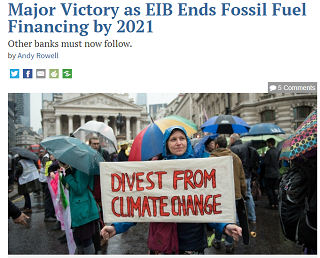
The European Investment Bank, the world’s largest multilateral development bank, is soon to end lending money to organizations associated with fossil fuels.

What happens when capital dries up?  The entire industry slides inexorably into oblivion.

Fossil fuels made the 20th Century what it was in terms of economic growth and massive improvements to human well-being.  Now it’s time to move on.

Tagged with: , ,

Harmful algal blooms are not new to freshwater lakes, but they’re getting worse. From this piece: “For the last 1 or 2 decades, we’ve made a tremendous amount of progress in terms of understanding the links between climate and water quantity—things like drought and flooding and extreme rainfall,” said Anna Michalak, a researcher at the Carnegie Institution for Science and a coauthor on the new study. (more…)

Tagged with:

From this article: Sales of plant-based versions of wings, burgers, and meatballs have risen by double digits over the past year — and sales of plant-based Italian sausage have skyrocketed by 416 percent. (more…)

Tagged with: , , ,

(More legible version of graphic below)

Frequent commenter Craig McManus, a solar installer in the Southeastern U.S. near the point that Alabama, Georgia and Florida meet, writes in:

The benefits of not penalizing solar energy: (more…)

Tagged with: , , , ,

Here’s an excerpt from an article in AutoNews on Nissan’s move to sell electric pick-up trucks here in the U.S., along with a few comments.

“Engineers at Nissan are working to electrify the company’s pickups, joining a growing field of competitors now interested in the segment. (more…)

Tagged with: , , , ,

This incredibly beautiful pyroclastic cloud from last year’s eruption of Mount Etna in Sicily calls to mind an element from climate change deniers’ disinformation campaigns, namely that volcanoes release more CO2 into the atmosphere than human activities, and thus mitigation strategies are useless.

According to the U.S. Geological Survey (USGS), the world’s volcanoes, both on land and undersea, generate about 200 million tons of carbon dioxide (CO2) annually, while our automotive and industrial activities cause some 24 billion tons of CO2 emissions every year worldwide.  Human activity therefore is a little over 100 times more potent than volcanoes.


Tagged with: , , , ,