I’m always amused when I see articles on subjects within the energy space that show that the author hasn’t the foggiest idea what he’s talking about. I’m reminded of my 6th grade course in meteorology, when one of my bottom-of-the-barrel classmates wrote his final exam essay on meteors.
Investments in Fuel Cells R&D is rising all over the world as the technology has (a) lot of growth potential and has various advantages over other renewable energy sources like solar, wind etc.
A fuel cell is not a source of energy, any more than the engine in your car; a fuel cell is a device that converts a chemical fuel into another chemical, releasing electrical energy in the process.
I wrote this post yesterday, when I was a few minutes early for the start of an event at the downtown Los Angeles office of the Nature Conservancy. I had come into the city for four separate meetings, of which this was my third.
The day started with an update from my friends at Green Motor Company, a group that is developing a low-cost and power-dense electric motor. The application that may come immediately to mind could be electric transportation, but, believe it or not, that’s not as attractive as one might have thought. As my friend Tom Gage, former CEO of AC Propulsion (developers of the electric drive train for the BMW Mini E) told me, “You could have a 99.9% efficient motor that’s the size and weight of a ping-pong ball, and you tell me I could have it for free, and that wouldn’t mean too much in this space.” He was, of course, referring to how incredibly important the size, weight, and cost of batteries are in comparison to everything else.
So, if not EVs, exactly what? Well, there are many hundreds of applications in our homes, office buildings, and industrial settings where the cost, size, weight, and efficiency of motors are extremely important. Think of pumps, especially for large volumes of water. Of course, this may be more obvious to me as I live in California, and such a percentage of our overall energy expenditure is made in moving water from one place to another. Water-related energy use in California consumes approximately 20 percent of the state’s electricity, and 30 percent of the state’s non-power plant natural gas (i.e. natural gas not used to produce electricity).
In any case, good news from Green Motors, and more to come, I’m sure.
All home-owners are always searching for something that would bring down their bills. Be it something that would help you with the electricity bill, or the water bill, investing in an appliance or some simple device that would increase the energy efficiency of your home is a very smart move. There are various products that can save you a lot of money, and make your house more eco-friendly.
Programmable Thermostat
These devices are some of the most highly-recommended products when it comes to energy efficiency. With the help of a programmable thermostat, you can have a complete control over how much energy is being used in your household, and adjust the temperature at all times. Since a lot of energy is being wasted while you are away on holiday, or during the night when everyone is sleeping, a device like this that can adjust a thermostat when you are not at home. So, with it, you can program the thermostat so that it turns the heating on or off whenever you want to, which is pretty convenient. You can find such devices for about $20-30, and buying one would help you save at least $200 a year.
Cellular Shades
This is not some high-tech green product, but a useful one, nonetheless. These shades are made of two separate layers of fabric, that are pretty soft, and prevent your room from getting too warm, by allowing only a minimum amount of heat to go through, and during the winter, you’ll house will stay warm as they won’t let the heat produced by your heating system to go out. This is a very good solution to all your energy loss problems, and with these shades you can reduce your energy losses for about 15%, saving as much as $150 a year, an investment that should be paid back in a couple of years, as fitting all your windows with cellular shades could cost you at least $900 – 1,000, depending on how many windows there are in your house.
Outdoor Motion Sensor
This is a relatively cheap solution, that can save a lot of money in energy expenses. You can purchase an outdoor motion sensor for $70, and you can expect to get your investment back in no more than a year. There is a rechargeable battery, where the energy saved during the day is stored. When the device detects motion during the night, it turns the light on. This way, you can save over a $100 a year.
So, paying a couple of hundreds of dollars for these products can turn out to be a wise investment, considering that you can save thousands of dollars in the next couple of years that way.
Jordan Perch is an active promoter of the new developments in the automotive industry. He is an author of many how-to articles related to DMV, safe driving, buying/selling vehicles, auto insurance etc.
Here’s a lecture on global climate change and peak oil by British geologist and author Dr. Jeremy Leggett. If you want to know why we need an aggressive policy that curtails the burning of fossil fuels, and you want to hear it from someone who can explain it with a great deal more precision than I can, Jeremy’s your man. This was recorded in 2007, so it’s a bit old, yet incredibly revealing of the basic issues.
Originally attracted because of the tie-in to what we’re about with respect to investment in cleantech, I quickly found that the club’s name belies its members’ extremely wide-ranging interests; in fact, the concept of investment per se has not figured prominently into any of the three of four meetings I’ve attended over the last six months or so. Folks seem to be keen on “big” topics that speak to who we are as individuals, as a civilization, where we came from, where we’re going, how we’re going to get there, etc. – and that’s just fine with me.
I’m hoping a lively conversation on sustainable energy policy, including the top-level concepts in technology, as well as the economics and politics of the matter, will get some juices flowing. I also want to pepper this with some philosophic points that I think will be well-received, e.g., our basic nature as human beings, the responsibilities we bear toward one another, and how all this drives how we govern ourselves and push ourselves along a sustainable course.
I’ll keep readers posted; perhaps some of you can attend.
Yes, the German program was overzealous; no one (no one I’ve come across, at least) disputes that. The program’s meteoric rise and fall over the past few years has sent huge shock waves all throughout the PV arena, and to the universe of clean energy as a whole. And those who follow the industry more closely than I tell me that the reverberations will continue to bounce around for many years hence.
I’m sure there is voluminous discussion as to exactly why and how this happened; I’m even more certain that I can’t answer those questions.
Having said this, all these events are happening within an even larger set of discussions: What is the proper role of government in our lives? In particular, how should the public sector react to the potential catastrophes that are headed our way if the nature and quantity of our energy consumption doesn’t change quickly? How should powerful interests be regulated, or provided incentives, such that the technologies they bring to bear change our world for the better, and keep our civilization from going over the edge as our population quintuples over a 100-year period?
Everyone can see that Germany made a misstep here. From there, they can proceed to point fingers, form snap judgments, and jump to irrational conclusions — and, if that is their mission, conclude that renewable energy doesn’t work.
Obviously, I don’t see it that way. At this point, it’s fairly clear that we either find a way to make public and private interests work together towards a clean energy future, or realize that we as a civilization are in for an enormous amount of suffering.
Hey there lighting fans! Dr. Bulb here with some thoughts on the rise of LED lighting in office buildings. The emergence of LED lighting is causing the lighting market to change rapidly as businesses around the world recognize the benefits of taking energy management seriously. LED lighting can save energy, reduce costs, and even increase the quality of light.
When lighting an office building there are two options as to where to delegate the costs:
Option 1: The first and more traditional option is to buy inexpensive lamps, such as incandescent and CFLs, and pay for the maintenance costs and to have the bulbs replaced every year or two. Large office buildings can house hundreds of lighting fixtures, the maintenance and replacement costs of these lights can be astronomical if they are burning out quickly.
Option 2: The second option is (the right option) to spend a little extra on LED lamps, and then reap the benefits of a maintenance free, energy efficient lighting solution. LED lamps often have a rated life of around 50,000 hours which means they will last over 11 years it they are on for 12 hours a day, everyday.
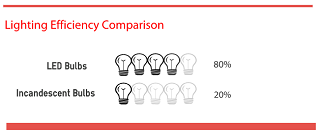
Energy management is a rising field, and businesses are saving thousands because of low energy bills. LED lighting has nearly 80% efficiency, which means that 80% of the electricity is used as light energy. Incandescent bulbs, on the other hand, operate at only 20% efficiency. This means that 80% of the electricity you pay for is being lost as heat energy when using incandescent bulbs! And, all that wasted electricity from incandescent bulbs converts directly into wasted money for the building manager. When a large office building has hundreds of lighting fixtures, each LED bulb that can save a few dollars adds up to hefty savings.
Being “green” is a must for businesses in today’s world, but there is a difference between having a few recycling bins around your office and actually embracing the environmental trend. LED lights are a great way to start becoming environmentally sustainable. Not only do they use less energy, but they are not manufactured with mercury or other toxic chemicals. Customers and stakeholders appreciate businesses that take an environmental initiative, so the benefits of LED lights go beyond a reduced electricity bill.
New technology always spurs questions; everything from the automobile to the iPad has been through public doubt. Often LED bulbs are looked at as a “green” option, but they are believed to provide lower quality light. I cannot stress enough how untrue that statement is! LED bulbs offer excellent light quality, even comparable to natural light. Also, LED bulbs are directional and can point light in the desired area, while other bulbs splash light in all directions.
No matter what your building’s lighting needs are, be it troffers or wall packs, make sure you know the financial and environmental benefits of LED lighting. And visit Drbulb.com for LED lighting industry news.
That sound you didn’t hear when that bike flew by at 170 mph was an electric engine. E-bikes have been popping up on streets for years, but they’re coming to a track near you. They’ll compete against gas bikes, inspire future gear heads and you might even end up building your own.
It’s Time to Stop Arguing and Start E-Racing
In 2009, electric motorcycle racing’s governing body split after the Isle of Man race, leaving two competing racing series. Sadly, electric racing suffered, producing less than exciting races. According to Bart Madson, Managing Editor at MotorcycleUSA.com, some of the TTXGP North America races didn’t even have enough racers to fill a podium. Thankfully, March of 2013 saw the factions united in an announcement that means sunny days for electric racers. The FIM and TTXGP will unite to form a single electric racing series.
2013 will see a 4-round North American and 4-round European championship, concluding in a united global final. This global final will take this yet-unnamed racing series to Asia for the first time. In 2014, the overall format will change to a more traditional World Championship. Rather than a global final race, the Championship will be awarded based on total points accumulated. 2015 will see a completely electric global championship, featuring races on North America, Europe, and Asia.
Can E-Bikes Take on Gas Racers?
There’s a unified electric racing series, but they’ll just race each other, right? Wrong. In a first for e-bikes, the AFM will allow Brammo to enter electric bikes in their race series. A recent article on Torque News lays out the steps for qualification. After a rider is approved for AFM racing, their motorcycle must meet technical specs and their crew must abide by mandatory pit safety practices. Don’t think this is a gimmick, these guys are racing to win.
While Brammo cycles have posted speeds and laps that match gas racers in the TTXGP World Championships, nowhere in the standards does the AFM dictate a motorcycle must be a certain Brammo model. That’s right, you don’t have to run a Brammo to race an e-bike in the AFM. Any bike manufactured by anyone who meets the specs can race.
Enter the DIY Racers
If all this talk about e-racing has you interested in building your own bike with motorcycle parts at BikeBandit.com, you’re not alone. A team of students from Virginia Tech placed seventh overall at the Laguna Seca race in the TTXGP series. This wasn’t the kiddie division — the competition included some big names in the e-racing industry like Brammo, Zero Motorcycles, and Lightning; this wasn’t the kiddie division. Their bike, known as BOLT, was built specifically to compete in this racing series and they plan to race it at Daytona in the fall.
Virginia Tech doesn’t hold the monopoly on self-made electric bikes; Kevin Clemens actually set world records with the e-bike he built with his own hands. A former writer for “Automobile” magazine, Kevin found a passion for electric transportation while completing a Journalism Fellowship at the University of Michigan. He wrote a book, “The Crooked Mile,” about energy, infrastructure, and how we can better our transportation system for tomorrow.
Setting world records on his electric bike is Kevin’s way of spreading his message, inspiring kids and wrench monkeys all over the country to see e-bikes as more than a curiosity or a gimmick. They are a viable form of transportation — given his world-record speed — a quick one as well.
Ready to build a bike? Peruse your online parts catalog and get wrenching. You may not set world records or win a Grand Prix race, but you can certainly join the electric revolution.
The truth of the matter is, all cars pollute. It doesn’t matter if they run on petroleum or diesel. Even hybrid and electric cars have been accused of contributing to pollution, at least indirectly. So how do you balance the necessity of driving with caring about the environment? It helps to know just how bad your car really is and what you might be able to do to minimize the damage. The main toxins that come from cars are Carbon Dioxide, Nitrogen Oxide, and Hydrocarbons. These chemicals are worse when they come from bigger engines and when the car is idling, which is why traffic jams cause pollution most of all. It’s important to understand the factors that determine how much pollution your vehicle generates as well as tricks you can try to make your car a little greener.
1. Fuel Consumption
Basically, cars that burn more fuel will cause more pollution, which is essentially a no-brainer. That’s why large SUVs and trucks are much more of a hazard to the environment than the average four-door sedan. Improving your fuel economy does more than help you drive greener; it also saves you a lot of money. There are several ideas for reducing the amount of gas your car consumes. It can be as simple as braking farther back or turning your air conditioning off when you don’t really need it. It’s important to remember that cars burn more fuel when they accelerate, so just by maintaining a constant speed and watching for hazards ahead, you are helping reduce pollution. Also remember the importance of traveling light. You shouldn’t drive around with equipment or stored cargo you don’t need, because it makes the car drag and costs you more in gas.
2. Idling
Reducing the amount of idling your car does every day is perhaps the easiest way to help the environment. There are times you won’t be able to help it, such as when you’re sitting at stoplights or in slow traffic, but there are also times where you don’t have to. If the traffic is stopped for more than a few seconds, you should turn your engine off. The idea that this wastes gas is a myth – you actually waste more gas by idling, and you release tailpipe emissions into the air that can be dangerous for your health and the health of your town or city. You never need to warm your car up in the morning, either. This has long ago been proven unnecessary, and your engine won’t really be warmed up until you’re driving. For every 10 minutes your car isn’t running, you stop one pound of carbon dioxide from being released into the air. That’s an incredible difference!
3. Car Maintenance
Keeping your car operating smoothly can go a long way towards improving fuel economy and reducing pollution. Many times, there can be a problem with your engine that you don’t even know about which is affecting your gas mileage, which is why it pays to have a mechanic look at the vehicle regularly. Problems with spark plugs, dirty or damaged air filters, and your fuel injection system can all affect how much fuel you burn. But there are also some simple ways you can reduce fuel consumption yourself. Make sure the gas cap is on tight enough. Nearly 150 gallons of gas per year are lost because it evaporates into the air due to a loose gas cap. Also make sure your tires have enough air in them. Driving on partially-deflated tires can severely reduce your fuel economy, and it’s such an easy fix.
4. Driving Less
You probably already know the benefits of reducing the time you spend in the car, but it’s still the number one way to be a greener driver. When you eliminate short car trips and decide to walk or bike instead, you’re helping the environment as well as yourself. Carpooling is another tried and true way to help the planet, and you should offer rides as well as accept them whenever you can. There’s no denying that carpooling decongests roads and saves everybody money. You might be lucky enough to live in an area with great public transportation, too. You don’t have to give up your car entirely, but being conscious of how much you use it means cheaper insurance, less money spent on gas, and better health for you and the environment.
Until everyone is driving biodiesel cars or some other form of clean energy is produced, it’s never going to be totally environmentally friendly to get behind the wheel. But you can be conscious of how much your driving habits affect the environment, and you can make sure your car is pumping as few pollutants as possible into the air. You may find that thinking about safe, green driving has way more benefits than one.
The repercussions about climate change are pretty diverse and prove out to be very much damaging to millions of people dwelling at different parts of this planet especially to the people based in developing nations. Most of the climate changes taking place bring in a number of negative economic consequences to these nations and the people residing there. For instance, a wide range of weather events including the hurricane, avalanches and droughts could be counted in the list of climate change consequences, which have led to billions of dollars in economic damage to the affected nations. The below is the list of the bad effects of climate change found inside the world. Let’s check them out:
Stronger and more recurrent weather events
The most obvious ill effects of climate change include a much stronger events occurring on a frequent basis. A number of weather events including floods, precipitation, waves, hurricanes, droughts, windstorms and avalanches seem to be increasing in the coming years owing to the climate change. If you look at the recent events, the extreme weather conditions seem to have worsened since past few years. In the 2003, the extreme and abnormal heat waves have killed around 35,000 people in Europe alone. In the year 2005, more than 1300 people were killed due to the Hurricane Katrina in United States giving a total loss of 135 billon dollars. As per the experts, the increase in the intensity of hurricane is only due to the climate change taking place since 1975. According to a report published in Nature Journal in 2005, the intensity of hurricane has increased all these years along with changing the ocean warming trends in the past few decades and will continue the same. Also, the issue of extreme weather also seems to have erupted due to the climate change.
Rise of sea levels
Another implication of climate change is the rise of sea levels, which seems to have accelerated since past few years owing to the land based ice melting and because of the thermal expansions of oceans. As per the eight arctic nations based forum- ACIA (Arctic Climate Impact Assessment), since the past twenty years the rise of sea level is around 8 centimeters all across the globe and it also predicts around 10 -90 centimeters in the coming decades. With such projections, you would see threat of floods for more than ten million people dwelling across the coastal areas all across the globe. One of the biggest concerns is melting of Greenland Ice Sheet that has been melting since the late 70’s in a rapid manner as expected. The drastic change in climate will certainly going to have adverse effects on it’s melting, which can raise the sea levels up to 7 meters.
Water shortages and the food security threats
Currently more than one billion people all across the world are facing the issue of water scarcity. The climate change could aggravate this serious issue in different forms like prolonged droughts and spreading desertification, which will simply make the situation from bad to worse. The regions, which depend upon the glacial melt water during their dry season including the Himalaya-Hindu Kush region (spreading over India, China and other Asian countries), which is actually a home for more than 50% of population in the world is likely to be hit the most as the glaciers are seen receding while the dry season water sources are unable to refill. Moreover, these changes in climate could also bring in the global food security threat since the agricultural production is likely to be hit at the tropical and subtropical areas owing to excessive droughts and heat.
Disease and several other health implications
The climate change is more likely to expand the geographic distribution and thus bringing in a number of contagious diseases including, dengue, malaria, Lyme, cholera, and fever at places like Latin America, Africa and North America since the presence of warm weather simply allows these diseases especially at places, which were earlier too cold. As per WHO, the changes in climate seems to have hampered the 150,000 fatalities among the people living all across the world in the year 2000, while the latest figure seems to be double. The fatalities that result due to the climate change include diseases like the respiratory issues and cardiovascular mortality and the tainted transmission of infectious diseases along with the rise of malnutrition cases going up due to the crop failures.
Final word
Climate change has already started hampering the world and people living over this planet and is certainly going to do the same in the coming times. With the consistent changes taking place in climate, people and the planet both have now started encountering the above said implications of climate change, which will aggravate in the coming future.
About The Author: Alia is a writer/blogger. She loves writing, travelling and reading books. She contributes to ReputationChangerWikiManagement.com


 All home-owners are always searching for something that would bring down their bills. Be it something that would help you with the electricity bill, or the water bill, investing in an appliance or some simple device that would increase the energy efficiency of your home is a very smart move. There are various products that can save you a lot of money, and make your house more eco-friendly.
 Here’s a lecture on
  I’ve been asked to speak at an upcoming meeting of the