Green roofs are engineered vegetated roofing systems where plants and soil have replaced, or been put on top of, traditional concrete, roof tiles or shingles.
The breathing living roofs provide numerous benefits to buildings including protection against stormwater runoff, conservation of energy and noise reduction. They provide a good ecosystem for plants and bugs, which further enhance the benefits. In fact, green roofs have also been shown to increase people`s productivity. (more…)
I’m a big fan of renewable energy in all its forms, but, as I’ve often commented, efficiency is really the low-hanging fruit in terms of reducing the environmental footprint associated with energy. In the U.S. alone, the efficiency technologies we’ve deployed reduced our energy consumption by 112 terawatt-hours last year. That’s sufficient to drive a Nissan Leaf 400 billion miles, 13% of our overall vehicle miles traveled.
I get the sense that more people every day are catching on to the importance of being better consumers of energy; in fact, it strikes me as credible that we will see something of a renaissance in terms of caring for our Earth. Yes, there are still people driving Chevy Tahoes, Cadillac Escalades, and Hummers, but I think you’re going to see fewer of them each year, as public awareness of and concern for the environment continues to rise. At the point it becomes “cool to be green,” the whole subject of eco-consciousness could really explode.
One of the elements of new technology that investors hate is “technical risk,” the chance that a certain concept, when deployed in the real world, will simply fail to work. I run across things like this all the time and dismiss them without commenting publically. Here’s one that’s noteworthy, if only for its sheer size. As I just told the entrepreneur, “Wow, this is the poster child for technical risk. You want investors to back a project that will cost billions of dollars, and there is no working model, regardless of how small, showing that it will work? My hat is off to you!”
The LCA of fossil fuel (or nuclear) powered electricity production presumably shows a good return in terms of direct power out vs. power consumed. Until, that is, you start to quantify the externalities – pollution, climate impact, resource depletion, security, legacy management, etc – which is no mean feat and open to dispute on every point. It would be very interesting to see a calculation that attempts this challenge.
That’s pretty hefty, when you think about it. And it doesn’t contemplate other key ingredients in the cost equation. How many extreme weather events will be caused by global climate change, and what will be their price in terms of property damage and human fatalities? What will be the cost of dealing with tens of millions of “climate refugees?” Droughts that cause food and water shortages? Loss of biodiversity? Ocean acidification?
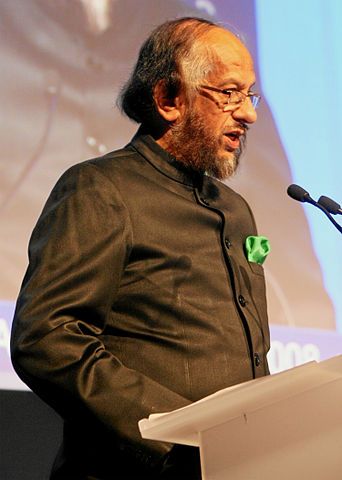
I’m delighted to announce that I’m going to be interviewing Dr. Raj Pachauri during his upcoming trip to the U.S., in preparation for my next book, Renewable Energy — Following the Money. For those who may be unfamiliar with Dr. Pachauri, below is an excerpt from the website of The Energy and Resources Institute (TERI). Thanks to my friend and 2GreenEnergy “Associate” Vijay Rochlani for suggesting the idea, and arranging the meeting. I’m really looking forward to this one.
Dr Rajendra K Pachauri assumed his current responsibilities as the Chief Executive of TERI (The Energy and Resources Institute) in 1982, first as Director and, since April 2001, as Director-General. TERI does original research and provides knowledge in the areas of energy, environment, forestry, biotechnology, and the conservation of natural resources to governments, institutions, and corporate organizations worldwide. Since August 1998 he has also been Chancellor,TERIUniversity. In April 2002, Dr Pachauri was elected the Chairman of the Intergovernmental Panel on Climate Change, established by the World Meteorological Organization and the United Nations Environment Programme in 1988 (Re-elected in September 2008). IPCC along with former Vice President Al Gore has been awarded the “Nobel Peace Prize” for the year 2007. He was the Founding Director of the Yale Climate and Energy Institute (YCEI) from July 2009 till June 2012 following which he has been appointed as Senior Adviser to YCEI. He has been active in several international forums dealing with the subject of climate change and its policy dimensions.
Relevance: Political organizations that don’t have to disclose their donors to the public have proven immensely popular – and powerful. Two conservative nonprofits, Crossroads GPS and Americans for Prosperity, have poured almost $60 million into TV ads to influence the presidential race so far, outgunning all super PACs put together.
In the last couple of months, I’ve become friendly with the fine folks at The Eleos Foundation, known for the investments they make in start-up companies located in developing countries, especially Kenya and other parts of East Africa. I’ve developed a great deal of affinity and respect for Andy Lower, Eleos’s executive director; in fact, I ran across him the other day, as we both volunteer as advisors to the Clean Business Investment Summit, and we both moderated discussions at the 2012 event.
At a certain level, one could liken the Eleos concept to micro-lending, in that participants expect to be repaid. But this model takes the whole idea of business support several steps further. Here, fledgling portfolio companies receive a capital infusion that may total millions of dollars, which enables their rapid expansion.
The criteria, insofar as I understand them, include two key ideas: the business must put a significant number of people to work, and the product of the business needs to offer a demonstrable social good, perhaps potable water or better hygiene. And this is not an idle notion; Eleos has numerous case studies under its belt, some of which will bring tears to your eyes; please trust me on that.
Hey, what about clean energy? Why not build wind turbines, perhaps using our client WindStream’s hot new concept in low-cost micro-wind, which has already proven itself effective in delivering a compelling cost per watt? Admittedly, these are not the giant megawatt – or even kilowatt — machines we envision when we think about wind turbines. So we won’t be powering cement factories of charging a fleet of Nissan Leafs with them. But in this environment, that’s hardly the point.
Here, we could be bringing life-giving electricity to a huge population in the Third World that has never had it before. We could be coupling micro electric generation capacity with high-efficiency lighting, enabling an entire population to read after the sun goes down. We could be conjoining that capacity with computing, providing hundreds of millions of islolated people with access to the World Wide Web.
I think we have something to talk about here. Tomorrow morning, I’ll call my people at Eleos and see what I can do to facilitate this idea.
2GreenEnergy financial guru Bill Paul writes in response to my piece on Sane Energy Policy:
I think that if you look at what’s happening in countries OTHER THAN the U.S., there’s reason for optimism. In Japan, South Korea and the EU, governments are working with companies for everyone’s benefit.
You’re absolutely right, Bill. Isn’t that amazing? We were brought up to believe in the greatness of the U.S., and just look at what’s happened. I suppose one could have made a strong case for it in the 20th Century. Certainly the Second World War and the post-war industrial boom made us the envy of the world: financially, militarily, technologically, and, to a certain extent, ethically. But what a disaster this century has been so far.
If there is a silver lining here, it will become visible when and only when we get a grip on corruption, on the power of Big Money to get what it wants from government, and to subjugate the common man. And, as we’ve discussed here so often, if there’s a chance for that, it lies in MoveToAmend.org.
Not to look a gift horse in the mouth, but, obviously, these favorite projects of mine would enjoy even greater support if the incentives in question were not subject to cancellation at the whim of a Congress that may look at things differently a year or so down the line. I’m reminded of a conversation I had with a guy at a conference a year or so ago; he looked down his nose at me and said, “I wouldn’t want to work in any industry, for instance clean energy, that receives federal subsidies.” When I pointed out that fossil fuels receive several times that amount of subsidies, he modified his position: “I guess what I mean is that I wouldn’t want to work in an industry that receives federal subsidies that might go away.”
It’s so invigorating to see raw courage like that. 🙂
In a few hours, we’ll bid so long to another summer Olympics. I always hate to say goodbye; I sorely miss them when they’re gone. The concept of being that good at anything is so impressive to me; I have to think that we all feel the same type of inspiration.
I’ll leave this subject with a couple of notes, both of them items that appear to be gone forever in the televised coverage of the Games:
Gone are the days of controversy. We didn’t detect a nanosecond of an American calling himself the greatest (or even good), or suggesting that one participant was sure to win or lose, or, God forbid, of bringing up an issue that could have the most remote political implication. In interviews in which two people from the same team were interviewed on camera, we could plainly see the one who was not speaking looking expectantly and fearfully at the other, as if to say, “Please be careful; PLEASE don’t say anything wrong here.” Perhaps the 1968 Games in Mexico City was the high-water mark of using the Olympics to make such statements. London was distinctly the low-water mark. It’s not a great reflection on our times that this needs to be such a sterile experience. (more…)


 In the last couple of months, I’ve become friendly with the fine folks at

 In a few hours, we’ll bid so long to another summer Olympics. I always hate to say goodbye; I sorely miss them when they’re gone. The concept of being that good at anything is so impressive to me; I have to think that we all feel the same type of inspiration.


