I got home late last night from a visit to the East Coast that featured a trip through Baltimore to visit my much-respected friends at GreenChipStocks. I spoke for an hour and change with Jeff Siegel, and then went upstairs to meet Nick Hodge. These are fantastically astute folks, and I’m thrilled to know them.
I’ll be at the Utility Scale Solar show in San Diego on Wednesday. I know this is a debatable topic, but I tend to get more excited about utility scale anything, not because I think we can count on utilities to be progressive in the migration to renewables. (Do I look like I just fell off a turnip truck?) I just think it’s asking too much to hope for millions of people to make individual decisions to install rooftop solar (or wind, or whatever) and create a “farmers’ market” of renewables.
It’s also true that some of the most promising technologies don’t make sense at small scale. You can’t make economically viable 10 kW systems for solar thermal, geothermal, or algae biofuel.
The transition to renewable can happen – and will happen – when enough people demand it.
If you are in the San Diego area and want to come by and say hello, please hit “contact” and let’s set up a meeting.
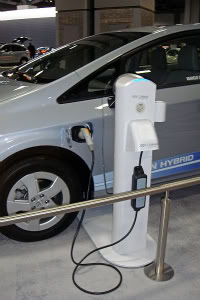
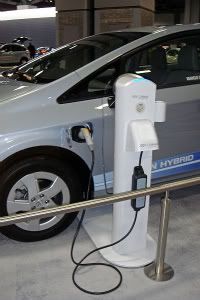
General Electric (GE) has some exciting things going on. GE is a top 10 world manufacturer of wind turbines, and is active in renewable energy efforts on several fronts. Many have heard the recent announcement of the GE WattStation. For electric vehicles to advance in the U.S., to be used easily and accepted, the infrastructure has to be in place and available – and that includes availability of chargers. GE is, in fact, a technical advisor for Project Get Ready, a non-profit initiative led by the Rocky Mountain Institute. Project Get Ready is all about helping communities prepare for use of electric vehicles on a (more…)
As I’ve mentioned in previous posts, I’m in the process of studying the size and shape of job creation that will come as a welcome by-product of the migration to renewables.
How this sits in the constellation of benefits to renewables depends on whom you ask. But regardless of the level of importance that job creation has compared with national security, fiscal responsibility, the health and safety of the world’s population, and stemming the long-term ecological damage wrought by extracting and burning fossil fuels, it’s got to be in there someplace.
Yet job creation is a very complicated subject, as it comes with so many moving parts:
What percent penetration of renewables are we talking about? What type? In what time-frame?
How are market forces affected by the actions of Congress (e.g., removing/perpetuating subsidies that keep the price of oil artificially low, creating incentives for renewables, state legislatures enacting renewable portfolio standards)?
What’s happening outside the US, where many countries are taking aggressive action to move to renewables?
What are the strategies of the corporate giants like GE and Siemens in this global economy? From here, it looks like they don’t care where the green jobs are; if the US misses the boat, that’s too bad. Is that true?
What brown jobs will be lost (e.g., coal mining) simultanously to the build-up of green jobs? Do we have the political stomach to deal with any job loss?
What will be the impact of all the green job training in the community colleges?
I’ve become particularly interested in the issue of subsidies, as they seem to be so critical in forming the climate in which private investors will climb on board the clean energy bandwagon. But because macroeconomics isn’t my strength, I’m going to have to speak with a great number of economists, analysts, and political pundits to get this right.
It appears that the reason this is so complicated is that subsidies take many forms, some of them (deliberately?) hidden:
Construction bonds at low interest rates or tax-free
Research-and-development programs at low or no cost
Assuming the legal risks of exploration and development in a company’s stead
Below-cost loans with lenient repayment conditions
Income tax breaks, especially featuring obscure provisions in tax laws designed to receive little congressional oversight when they expire
Sales tax breaks – taxes on petroleum products are lower than average sales tax rates for other goods
Giving money to international financial institutions (the U.S. has given tens of billions of dollars to the World Bank and U.S. Export-Import Bank to encourage oil production internationally, according to Friends of the Earth)
The U.S. Strategic Petroleum Reserve
Construction and protection of the nation’s highway system
Relaxing the amount of royalties to be paid – apparently, we get about 40% of revenues from oil on public land vs. 60% – 65% in most other countries
Not forcing the industry to deal with the “externalities” – healthcare costs, long-term environmental damage, etc. — costs that are becoming increasingly clear and subject to quantification
If anyone has a suggestion for people I should interview in this regard, please let me know.
Progress Energy Florida claims that its “Save the Watts” program is a success. The Fortune 500 company says in a recent announcement there has been a 45% drop in energy use since it started the program in 2007 through 2009. That is 87,000 megawatt hours in savings. (2010 figures are not yet available.)
Progress Energy reveals that in 2009 its customers participated in 56,000 free home energy checks, the most performed in any year. The company is headquartered in Raleigh, NC and has 22,000 MW of generation capacity.
The “Save the Watts” program mission is to help 1.6 million Florida customers reduce and conserve energy. The program (more…)
When I was back in New York a couple of weeks ago, I took a walk with some friends around Lake Onondaga, arguably the most polluted lake in the country. The lake was ruined primarily with industrial dumping and sewage contamination; the main culprit was the contamination from some 82 tons of mercury dumped into the lake over decades by the former Allied Chemical factory complex (now Honeywell) in neighboring Solvay.
When I asked what was being done to remediate the situation, my friends explained that there are a few good ideas, but that each one (dredging, filtration, lining the bottom of the lake, etc.) is prohibitively expensive. Each year, a gaggle of engineers and chemists submits a new set of ideas, only to be rebuffed due to the enormous costs.
I bring this up not to point fingers, but to remind us of the extreme consequences of our turning our backs to environmental damage.
I recently became aware of the picture here – Adam Nieman’s incredible 2003 work, aimed at getting us to appreciate the environmental challenges we face. It depicts the actual size of the Earth’s oceans (the small blue sphere on the left) and atmosphere (if it were at sea-level air pressure, the small white sphere on the right).
It may be expensive to keep our planet clean, but it’s even more so to clean it up once it’s dirty.
Over the next few months, I have committed myself to performing comprehensive research into the pragmatic issues that prevent a rapid migration to renewables. I’m not 100% sure how to organize this research, and even less sure how to present the findings, but for now, I’m just trying to make a list of the big, obvious issues, and then do enough reading and interviewing that I feel I’ve reached a reasonable conclusion.
Of course, each major country on Earth is going to have its own story to tell. To whatever degree I’m able, I’d like to explore the workings of places like China and Brazil, where, I’m told, they get things done by government mandate. I’m more familiar — though not completely so — with the US, in which we have a weird balance between the public and private sectors — part of the ongoing debate on limits of governmental power to regulate, etc.
I’ve decided to start looking at the issue of job creation in the US. Part of the accepted reality that has existed since the 1930s’ response to the Great Depression is the idea of governmental regulation into most if not all of the macro-economic factors that form the framework in which we make our basic business decisions: borrow money to start or expand businesses, hire people, purchase capital equipment, sell our products to customers outside the US, etc.
Government always wants high employment (especially now with the crisis) knowing that unemployed people are angry people who vote to remove incumbents. But there are obvious limits to the government’s ability to fork over money that it doesn’t have to stimulate job growth in renewable energy or any other area.
Here are a few questions:
How true is it that a concerted effort to move away from fossil fuel consumption will add net new jobs in significant number?
How does this work, exactly? Suppose the Congress passes a certain “clean energy jobs” bill. How — and how quickly — does that translate in public or private organizations actually hiring people?
What will most of these jobs probably be like? I would think that society would consider it a net “win” to have jobs mining coal replaced with building PV or CSP plants. But is that true? I’d be surprised if the coal industry saw it that way.
Doesn’t almost all of this surround subsidies? The price of oil determines essentially all of this, doesn’t it? Everything from unconventional oil extraction techniques like tar sands and shale oil to the dozens of different forms of clean energy are contemplated vis-a-vis the competition that oil provides at a certain price. So let’s look at the oil and gas industries and try to understand what actually determines those prices.
For this we will turn to dozens of researchers and analysts.
We will also explore the conditions by which capital formation occurs, noting that this is the worst environment for capital formation since the 1930s. Why is that? How and when is this likely to change?
When I started to think about this, I Googled “renewable energy job creation,” I noticed that the first item offered me was an article from Fox News, that, predictably, ridiculed the idea that significant numbers of new jobs could come from clean energy, for a variety of reasons including the notion that migration to renewable energy is a pipedream anyway. The author pointed out that the number of solar panels shipped from 1982 to 1998 would make only an infinitessimal contribution to the total energy required. This makes one wonder why they chose 1998 — he couldn’t find any data on the subject for the last 12 years? That seems unlikely.
But I wonder why Fox News came up first here in any case. In the discussions of net neutrality, we see what various groups are doing to forward certain sets of beliefs vs. others.
Every time I come across this idea, I wonder exactly what the writer means. Obviously, people in one-car families who take that car on frequent long trips will be extremely unlikely to put up with the inconvenience of a pure battery electric until fast charging stations are ubiquitous – and we’re certainly a million miles from there.
But isn’t it equally obvious that many people in multi-car families with garages will be eager to replace one of their cars with something that costs 80% less to fuel – and even less to maintain? I know there people who don’t care about the environment. But even people who can’t spell “ecology” or “terrorism” or “war casualties” or “lung cancer” will see very quickly that an EV is a good idea purely on a dollars and cents basis. After rebates, the Leaf will cost under $20,000 in many states. Nissan — and those who follow — won’t be able to build enough of them.
In August 2010, Siemens Energy, Inc. received an order for 98 wind turbines originating from Oklahoma Gas & Electric (OGE). The turbines are destined for the Crossroads wind power plant in Oklahoma, located about 100 miles from Oklahoma City in Dewey County. Construction of the 227.5 MW wind power project is scheduled to start later this month (August), and the first turbines are scheduled to be delivered in April 2011.



 I got home late last night from a visit to the East Coast that featured a trip through Baltimore to visit my much-respected friends at GreenChipStocks. I spoke for an hour and change with Jeff Siegel, and then went upstairs to meet Nick Hodge. These are fantastically astute folks, and I’m thrilled to know them.
 I’ll be at the

 As I’ve mentioned in previous posts, I’m in the process of studying the size and shape of job creation that will come as a welcome by-product of the migration to renewables.
  Progress Energy Florida claims that its “Save the Watts” program is a success. The Fortune 500 company says in a recent announcement there has been a 45% drop in energy use since it started the program in 2007 through 2009. That is 87,000 megawatt hours in savings. (2010 figures are not yet available.)
 When I was back in New York a couple of weeks ago, I took a walk with some friends around Lake Onondaga, arguably the most polluted lake in the country. The lake was ruined primarily with industrial dumping and sewage contamination; the main culprit was the contamination from some 82 tons of mercury dumped into the lake over decades by the former Allied Chemical factory complex (now Honeywell) in neighboring Solvay.

 I commented last week on the
  In August 2010, Siemens Energy, Inc. received an order for 98 wind turbines originating from Oklahoma Gas & Electric (OGE). The turbines are destined for the Crossroads wind power plant in Oklahoma, located about 100 miles from Oklahoma City in Dewey County. Construction of the 227.5 MW wind power project is scheduled to start later this month (August), and the first turbines are scheduled to be delivered in April 2011.


