
I’ve been fascinated recently with the subject of the macroeconomics that surrounds renewables, and, in particular, the subsidies that keep fossil fuels in place by holding the price of oil down artificially. In response to this discussion, frequent commentor Dr. Bob Goldschmidt writes:

The biggest subsidy of all is the $500+ billion a year of military costs used to secure the world’s imported oil supply. This does not appear at the pump and is paid for by the American taxpayers. If, because we have not made a timely effort to reduce oil consumption, Iran has enough income to go nuclear, how much will that cost?

I’m about to conduct a series of radio and TV interviews to promote my book, and I intend to make this the overall theme of the tour, i.e., clean energy is the bargain of the century. We don’t have to look too far to see the incredible costs of our current energy policy (or lack thereof). 

The optimist in me thinks it’s only a matter of time until enough people see through this, realize the outrageous fiscal and moral costs of our nation’s refusal to take a leadership role in energy, and insist that we change our course here.

Tagged with:

Another report from the Los Angeles Auto Show: the car companies continue to impress me with their wisdom.  Here’s a minor example: their presence at shows like this is almost exclusively made by young, attractive people.

Who’s talking up the 2011 Buick? A portly 65-year-old Viagra customer (that may typify the actual Buick buyer)? Hell no. It’s an energetic 28-year-old kid with fantastic biceps, an engaging smile, and a $75 haircut.  It’s image, my friend, and no one knows more about creating and maintaining that than the carmakers.

Tagged with: , ,

I spent a few hours this afternoon at the Los Angeles Auto Show, checking out the displays of the carmakers that are in the process of rolling out EVs. This year, I went on a “public” (vs. “press”) day, to get a sense for the overall market appreciation for EVs: How many people are interested? Who are they?

Here’s an observation:

If you spend time at EVWorld or AutoBlogGreen, you may conclude that the whole world is beating a path to EVs. Of course, the vast majority of this super-skewed audience craves EVs, but they’re not at all representative of the typical car consumer; just a few seconds at today’s show served as a slap-in-the-face type reminder of this obvious fact.

At a certain point, I found myself standing in Nissan’s area — a bright, clean car lot of a half-acre or so in size, with many dozen gas-powered cars and trucks — and one lonely EV: the LEAF. I couldn’t help notice the swarms of people taking pictures of one another smiling in front of the sleek, shiny, GT-R sportscar — and the occasional tree-hugger asking questions of the lady assigned to the LEAF.

So let’s start with what we knew all along: the first EV adopters will be a slim minority with a decided commitment to eco-friendliness. The question then becomes: how quickly will everyone else follow? (more…)

This is a follow up to a Vector story that appeared August 24th, 2010, called “Opposing Ethanol”.  In that story, we discussed that an effort in the form of an energy bill was poised to allow an increase of ethanol mix. The mix was 10%, but the bill was seeking to raise this to 15%.

Many from various sectors and industries were very opposed to this.  Why?  Ethanol can be damaging and corrosive to engines, and is known to damage engines as well as exhaust systems; and increasing emissions from engines defeat emission control devices. I will add that in my opinion, corn-based ethanol has many problems (discussed in the August 24th post.)

Despite reasonable science, and despite heaving lobbying against raising the cap of ethanol allowed to be mixed into gasoline, the EPA (Environmental Protection Agency) passed the bill on October 13th. It seems ironic that an agency that is supposed to protect the environment and our safety would allow this.  The EPA says that from its testing, cars built in 2007 and forward “shouldn’t” be damaged from the new blend called E-15. (Cars owned that were built in 2007 and later accounts for 18% of our nation’s cars, according to David Sedgwick at Translogic).  The EPA will apparently test older cars later to see what they find. 

In the meantime, gas station owners are furious. They are afraid of being sued if a car is damaged, even if EPA labels are put (more…)

Tagged with: , , ,

From what I hear from those who have attended, there is nothing magically different about this year’s Los Angeles Auto Show.  Of course, it would be hard to expect anything markedly different, with the economy continuing to spuitter; it’s only when car-buyers have money burning a hole in their pockets that the car companies really pour on the promotional dollars. 

Yet the total number of alternate fuel vehicles continues to grow;  there are 50 AFVs on display, according to this list from the show itself. 

I missed the Press Days last week, but I plan to attend one day this week as a regular guy, to check out the outward, consumer-facing progress that the electric vehicle world is making. If anyone wants to meet me down there for a cup of Joe, please hit the “contact” button and I’ll get right back to you.

Tagged with: ,

When my father left this Earth a couple of months ago, he left me some stock in ExxonMobil.  I posted my musings on the subject here, on my blog at Renewable Energy World.

Tagged with: , , ,

The proper role of government in our lives is the biggest single issue confronting politically involved Americans today. Want to rile up an audience about healthcare, for instance? Just tell them either:

a) The government with its bloated bureaucracies, inefficiencies, and corrupt catering to special interests is taking over healthcare and doling it out, at your expense, to people who haven’t earned it, or

b) Healthcare should continue to be run by profit-motivated corporations whose goal is to minimize costs by denying medical coverage (especially to those who need it most) — and government has no business interfering in this cruel and inhuman process.

The same polar arguments could be made for financial regulation, labor and unemployment, economic stimulus, and almost every other major area of debate we face as a society.

I bring this up because (more…)

Tagged with: , ,

I had the pleasure of meeting 2GreenEnergy associate Annemarie Osbourne for lunch yesterday. Annemarie is lucky enough to live “bicontinentally,” with homes both in Ansbach (near Nurenberg) Germany and Orange County, CA.

A skilled and savvy PR professional, Annemarie is a constant reminder to me of how much bang for one’s buck public relations can deliver. I came across a dilemma recently that served as the perfect illustration: A client with a consumer product with a tiny budget (about $50K) that wanted to tell its story to the world.

So we had a choice:

a) Recommend some essentially unresearched creative and run a few fairly insignificant ads, or

b) Suggest that Annemarie ply her trade, using her vast network of relationships, and more important, her genius in presenting the concept in a unique and clever way to an entire universe of print and electronic media editors.

It was something of a no-brainer.

Tagged with: ,

The National Renewable Energy Laboratory (NREL), which is under the Department of Energy, announced selection of nineteen national leaders for its 2010 Executive Energy Leadership Program. Now in its fourth year, the 5 month program gives executive decision-makers at local levels in-depth knowledge and skills about renewable energy and energy efficiency technologies.  The program includes briefings from NREL, technology experts, and well as research lab tours and visits to field applications along with classroom study. At the end of the program, the students each present a viable renewable energy project.
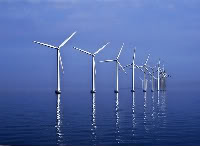
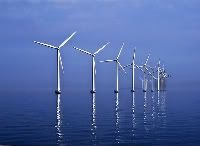
In the first three years of the program, participants were solely based in Colorado. NREL said it was ready to expand the Colorado-based pilot to a national scale.  “As a national laboratory, we launched this (more…)

Tagged with: , , , , , , , , , , , , ,

I just got off the phone with Christopher Barry, a fascinating naval engineer who comes from decades of work in nautical science.  Chris was good enough to take me through scads of examples all of which illustrated a very important fact:

There are dozens of points of crossover between the tons of engineering work that has already gone into the traditional world of shipbuilding and offshore drilling – and what the renewables industry is now trying to accomplish in offshore wind and ocean energy, e.g., tidal, wave, etc.

(more…)

Tagged with: , , , , , , , ,