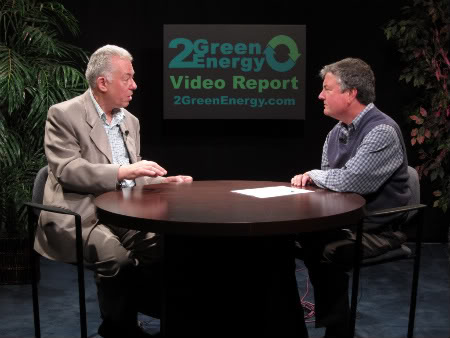
Michael Scholey, CEO of e-bike start-up EMCycle, visited me on the 2GreenEnergy report for a show we taped yesterday, to be aired shortly. As you’ll see in the show, EMCycle boasts a cool, futuristic design for eco-sensitive drivers of short distances: commuters, shoppers, students, etc.
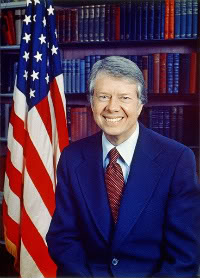
A friend from the UK asked for my take on a new Swiss movie on Jimmy Carter’s efforts to reduce the United States’ dependence on oil at the end of the 1970s. He points out, “I am sure it will not be well known in the States. Perhaps it should be.”
The movie in question, “The Road Not Taken,” is a documentary centering around President Jimmy Carter’s having a series of solar panels installed on the roof of the White House. At the time, he told the crowd gathered to mark the installation of the new units:
“A generation from now, this solar heater can either be a curiosity, a museum piece, an example of a road not taken, or it can be just a small part of one of the greatest and most exciting adventures ever undertaken by the American people – harnessing the power of the sun to enrich our lives as we move away from our crippling dependence on foreign oil.”
A few years later, President Ronald Reagan famously had the solar panels removed.
I wrote back:
In my mind, there is no doubt that the conversation, mute as it is in the US, has already added luster to Carter’s star and, I suppose, some tarnish to Reagan’s. But I’m more interested to know what this means in terms of the future. We’re still subsidizing fossil fuels. There are still 7000 lobbyists cruising around the Beltway influencing lawmakers to ensure that that oil, coal, and gas remain at the core of our energy future until the last drop of crude is sucked out of the Earth, we’ve ripped the top off the last mountain, and fracked the planet’s crust to smithereens.
Having said that, there are hundreds of lively discussions in the blogosphere every day about the R&D for clean energy. Bill Gates’ 2010 TED talk is getting some very good distribution. Perhaps this stark dichotomy between these two US presidents and the concept of the “road not taken” will be viewed as an iconic piece of US history — and perhaps it can be spun into the idea that “it’s not too late to get back on the right road.”
I had a chance conversation with Nick Roberts, VP Sales of GlobalNES recently – a company in renewables that boasts an interesting angle.
GlobalNES offers to arrange financing for, engineer, and install a range of commercial-sized clean energy systems – depending on the customer’s location and thus its access to resources, often including solar, wind power, geothermal, grey water reclamation, energy efficiencies, LED lighting, hydro technologies and fuel cell applications.
The typical project is in the hundreds of kilowatts – perhaps a shopping center, an industrial park, or some facet of a municipality.
I find two things interesting about the company:
They perform a comprehensive (“360-degree”) set of work actions virtually – that historically have required a traditional workplace environment. Practitioners sign up to be a part of Global NES in far-flung geographies, and then tap into veins of expertise and product/service delivery capability that are plugged in as required:
Assess Energy Performance and Needs
Analyze and Design
Customer Proposal
Project Implementation
Sustainability
This strikes me as quite creative.
The other interesting facet is that the company aspires to build a brand so strong that customers – and new people in the field – seek them out, and form an ever-increasing network of delivery.
Tuesday afternoon I’m headed to the television studio – Channel 6 — in beautiful Ventura, CA for my monthly taping of a couple of shows of the 2GreenEnergy report. My first guest is the CEO of Emcycle – an e-bike company that shows terrific promise. As I’ll explain to viewers, Emcycle is one of about 10 business plans that I’ve chosen to represent to investors, out of many hundreds I’ve reviewed in the past year or so.
There are a few features that attract me to the company and cause me to believe that they will ultimately succeed. First, they boast a unique and (I believe) a compelling product design. Of course, no one can predict market acceptance for a futuristic design. It’s easy to speculate in hindsight why the Ford Edsel of the 1950s failed and the Mustang a decade later was a smashing success. But try to do that looking into future – now more fraught with economic and sociologic uncertainty than perhaps ever before. Having said this, I hope readers will tune into the show or check out the videos online; I think you’ll see instantly why I’m so impressed with the overall concept.
The second reason I find even more compelling. These people are in a class by themselves in terms of what I would call “aggressive business posture.” Where some start-ups may be tenacious in terms of raising money, Emcycle has taken their product concept to the market – in advance of having a product for sale. The company’s principals have traveled the world, signing up an impressive network of of distributors who anxiously await the product, each champing at the bit to sell the product the moment it becomes available.
As I like to ask my start-up mode clients, “Are you sure you need to sell a few million dollars of equity? Wouldn’t you rather go out and get a few million dollars in purchase orders? It’s not as hard as it looks.”
Again, I hope you’ll tune in; I think you’ll be impressed with these people and the direction in which they’re headed.
Sam Smith discusses Bermuda’s migration to electric vehicles with me on a recent episode of the 2GreenEnergy Report.
Full disclosure: I’m part of the effort to bring EVs to Bermuda.
Sometimes I challenge myself with tough projects, but sometimes I snap up the easy ones — like this. Hmmm. How to sell EVs in a place that has expensive gasoline, short driving distances, wealthy citizens, huge government incentives, and eco-sensitive tourists?
Funride’s Director of Operations Pat Mahan discusses alternative fuel vehicles and the fantastic social and personal benefits of car sharing with me on a recent episode of the 2GreenEnergy Report. I’ve known about Funride for a couple of years, and I was delighted to have Pat on the show. Car sharing generally is a phenomenon that I expect to see enjoy a meteoric rise over the coming 10 – 20 years, and Funride’s “car sharing with a twist” (AFVs) is in prime position to lead the way.
Many of the great consultants in green business practices have developed ways of introducing their clients to topics like LEED (Leadership in Energy & Environmental Design – the internationally recognized green building certification system) and biomimicry (taking lessons from the ways of nature and evolution in the development of our products and processes). Somewhat less frequently discussed is the so-called “precautionary principle,” i.e., the idea that if proposed action is suspected of containing a risk to public health and safety, the burden of proof that it is not harmful lies on those proposing to take that action.
Am I missing something, or are we as a civilization a million miles from this point currently – and getting further from it every day? The idea that our system of international business affairs, ethics, and justice could get us to a meaningful implementation of this idea requires a jolting suspension of disbelief.
Does anyone really think that there is no potential public harm in the chemically raised food we eat, the vigorous marketing of alcohol and prescription drugs, and the steady relaxation of moral standards in the television programming and movies we show our children? I could go on – and so could you; the list of threats that we openly welcome is large — and growing each year.
Of course, when we get down to brass tacks in the area of clean energy, the issue is even more obvious. Is anyone asking for the oil and coal companies to address the burden of proof that the energy policies they work so hard to protect do not bring with them tremendous threats to public safety? The Gulf oil spill is an opportunity to ask questions like these. Could it, perhaps, representing a turning point for our friend — the precautionary principle?
Occasionally I write on political and philosophical points that have important but indirect effect on renewables. As a result, folks sometimes want me to link to their blogs in spaces that are off-topic to clean energy.
If you’re interested, here’s something that I wrote this morning on campaign finance reform and the First Amendment. As far as I’m concerned, these people are on the wrong side of this issue, but I wanted to acknowledge the work they’re doing on Free Speech anyway. To me, the idea that campaign contributions from corporatations should be protected under the first amendment is a gross perversion of its intent.



 A friend from the UK asked for my take on a new Swiss movie on Jimmy Carter’s efforts to reduce the United States’ dependence on oil at the end of the 1970s. He points out, “I am sure it will not be well known in the States. Perhaps it should be.”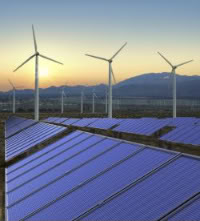
 I had a chance conversation with Nick Roberts, VP Sales of

 Many of the great consultants in green business practices have developed ways of introducing their clients to topics like


