I’m writing this on a US Airways flight, kicking off my trip to interview Dr. Raj Pachauri. Everything’s running right on time so far.
To their credit, the airline has an active recycling program. But might they be overzealous? For the third time on this flight, they’ve come by to try to recycle the plastic cup I’m keeping to drink water. In another hour, they’ll be coming back through offering more water – and more cups to replace the ones they recycled an hour ago.
This, by the way, is why the adage: “Reduce, re-use, recycle” is in that particular order. If you can not use something at all, that’s best. If you have to use it, try to re-use it. If you cannot do either, recycle.
There are those who argue against the validity of the electric vehicle movement, on the basis that, in most cases in the US, putting additional load on the grid means burning more coal. Yet regardless of the extent to which this is true, the position completely evaporates in the face of distributed generation.
I’m going to be helping my friends at Continental Wind Power tell their story of midsized wind (200 – 900 kilowatts) to an audience of managers of factories, farms, schools and universities, municipalities, military bases, etc. It’s easy to see how well this plays into an integration of EVs. For instance, I would tell a farm: If you’re in a decent wind area, install one of our 400 kilowatt turbines and knock out about 2000 kilowatt-hours per day off your electric bill. Or install two, and, on top of that, charge your fleet of electric farm vehicles. Cut out all that diesel from your budget – and all that pollution from our skies.
I often write short, high-level pieces summarizing the pros and cons of the oil economy vs. a transition to renewables, and I like to refer readers to others’ work when I come across articles that I think will resonate. Linked above is a very good one by columnist Sarah van Gelder, co-founder and executive editor of YES! Magazine: a “national, nonprofit media organization that fuses powerful ideas with practical actions.”
Republicans may object to her using words like “dirty” and “deadly” to describe the Romney ticket’s energy plan, but, to be fair, we need to admit that the U.S. energy policy is very much at stake in the 2012 elections, and Americans aren’t exactly feelin’ the love from the Republicans vis-à-vis renewable energy and environmental responsibility.
I’m leaving for the East Coast tomorrow morning for a series of meetings, including what I call my “anchor appointment” (i.e., the one event that absolutely shouldn’t be postponed or conducted by phone/email), my interview with Dr. Raj Pachauri, one of the most prominent players in the international climate change scene. We’re meeting at his office at Yale University.
I’m ashamed to say that I’ve never been on the Yale campus. I did my undergraduate work at Trinity, less than an hour north, but never got down there. In the 1970s, their squash team was too good for us, and I never attended any of the guest lectures they hosted. I’ll arrive an hour or so early, just to walk around, take in some of that ivy, and nod hello to a few bright young people.
Here’s a podcast in which Toronto Star writer Tyler Hamilton talks about some of his picks for clean energy start-ups. He and I agree univocally on a number of issues, like the imperative to move away from fossil fuels, and the mixture of crackpots, frauds, and legitimate innovators that are coming out of the woodwork to present potential solutions as a result of the ever-heightening demand for alternative energy sources. I’m not as bullish on some of the ideas he supports as he is, but he obviously has a great deal on the ball, and I recommend readers check this out.
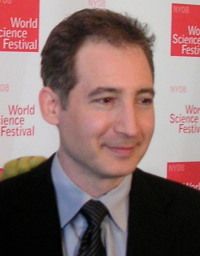
I remember the first evening of a course in existentialism I had 37 years ago this fall, in which I asked the professor, “According to (Nobel prize-winner and existentialist superstar) Albert Camus, ‘suicide is the only valid philosophical question,’ implying that all the work of people like Socrates, Descartes, and so forth is ‘invalid.’ This strikes me as patently wrong. What am I missing here?” Fast-forward to last week, when I began Brian Greene’s The Fabric of the Cosmos, and was thrilled to see that he opens with the precise same point about Camus.
It’s seems pretty clear that there is a great deal of validity to the work humankind has done, especially over the past few hundred years, in trying to decipher the riddles of matter, energy, space, and time. What really is all this stuff? Where did it come from? Why is it here? Is there a limit to our ability to perceive and understand it (especially now that it seems reality exists in more than three spatial dimensions)?
I’m happy to note that the realms of science and philosophy are re-converging into one another, after the fairly hostile divorce that lasted several centuries. In any case, Brian Greene is one of my new-found heroes. If you want a good introduction without going to a 500-page book, here’s one of his Ted Talks, in which he explains superstring theory.
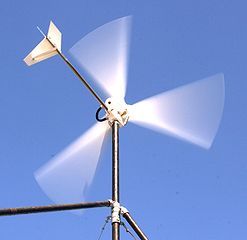
Those of us who maintain optimism for a future than includes sustainable practices in energy generation place a great deal of hope in “distributed generation” – the concept in which the model of buying electricity from huge utilities becomes increasingly irrelevant, and in which individual users generate more – or all — of their own. Such a schema has many obvious advantages, especially that it encourages renewables; users will not be building their own coal-fired power plants, for example, but they will deploy solar and wind power.
Yet there are equally obvious challenges. Though distributed generation has been with us since the dawn of time, it is just now coming back into the mainstream after a century in which centralized generation had become the norm, at least in the developed world. That means a great deal of inertia that needs to be overcome, in several different forms, one of which is legal.
Suppose my friends at Continental Wind Power, for example, want to lease one of their 400 kilowatt wind turbines to a factory, or a farm, or a school. Can the transaction be based on a standard lease agreement? Not in today’s world. A gaggle of lawyers is going to be involved on both sides for quite some time. That’s not how established businesses and industries work; can you imagine telling a car salesman that you’ll have your lawyer redraft the lease agreement on that new Buick?
Distributed generation has a long journey ahead of it, but the destination will be more than worth the trip.
Yesterday I had the pleasure of providing an interview for one of the key researchers of the Germany-based think-tank Borderstep Institute. Their mission:
Through scientific and applied research, the Borderstep Institute contributes to future-oriented solutions and innovations that are economically successful, supportive to climate protection and the conservation of natural resources, and embody the societal responsibility of economic actors.
One of its key players, Dr. Severin Beucker, co-founder of the institute, sat down with me in a lovely park in Santa Barbara that I use as a kind of outdoor office, and asked a series of questions designed to help Germany’s Ministry of Economy and Environment better quantify the amount of innovation in cleantech coming from start-ups. How many such start-ups are there in a given industry segment? Where are the sources of these numbers? How reliable are they? (more…)
Daniel Yergin, in his book “The Quest”, writes that a critical shift from carbon-based to non-carbon-based fuels has begun, along with a parallel movement towards higher levels of efficiency in industrial processes and energy movement. It seems we are shifting from a mentality of exuberant excess towards one of resource and energy conservation in light of our evolving understanding of ecosystems and health impacts, with a healthy push from markets to hedge against rising fuel costs. Will these critical shifts take place in time, before the oceans fill with toxins, before a gas mask and SPF 2000 will be required for your evening walk? How quickly can we optimize efficiencies? What are the major forces countervailing against this progress and how do we get to where many intelligent and passionate thinkers say we need to be in order to survive?
The biggest threats to this progress, to my mind, are infrastructure zombies. These are individuals, companies and governments that have over-invested in infrastructure that perpetuates our global addiction to fossil fuels and inefficient processes, and deride any alternative to the status quo, usually in the name of profits or politics. These entities are enemy number one to current and future generations. (more…)


 I remember the first evening of a course in existentialism I had 37 years ago this fall, in which I asked the professor, “According to (Nobel prize-winner and existentialist superstar) Albert Camus, ‘suicide is the only valid philosophical question,’ implying that all the work of people like Socrates, Descartes, and so forth is ‘invalid.’ This strikes me as patently wrong. What am I missing here?” Fast-forward to last week, when I began Brian Greene’s
  Those of us who maintain optimism for a future than includes sustainable practices in energy generation place a great deal of hope in “distributed generation” – the concept in which the model of buying electricity from huge utilities becomes increasingly irrelevant, and in which individual users generate more – or all — of their own. Such a schema has many obvious advantages, especially that it encourages renewables; users will not be building their own coal-fired power plants, for example, but they will deploy solar and wind power.
 Yesterday I had the pleasure of providing an interview for one of the key researchers of the Germany-based think-tank
  Daniel Yergin, in his book “The Quest”, writes that a critical shift from carbon-based to non-carbon-based fuels has begun, along with a parallel movement towards higher levels of efficiency in industrial processes and energy movement. It seems we are shifting from a mentality of exuberant excess towards one of resource and energy conservation in light of our evolving understanding of ecosystems and health impacts, with a healthy push from markets to hedge against rising fuel costs. Will these critical shifts take place in time, before the oceans fill with toxins, before a gas mask and SPF 2000 will be required for your evening walk? How quickly can we optimize efficiencies? What are the major forces countervailing against this progress and how do we get to where many intelligent and passionate thinkers say we need to be in order to survive?


