I just got home from the TV studio after shooting three hours of videos. Each time I do this, I come away wondering if there could possibly be more exhausting work. I would have hoped that after all the time I’ve spent recently on radio and TV, I would have become fairly comfortable with a mic/camera in my face, but honestly, I was totally baked after three short hours. (more…)
Think we advocates of renewables in the U.S. have trouble? Our friends in the U.K. are running into a buzzsaw of misinformation, like the report “Renewable Energy: Vision or Mirage”, published today by the Adam Smith Institute and Scientific Alliance. The report includes:
“Wind does little to reduce carbon emissions.”
and
“Nuclear and gas are the most viable energy sources for the near future.”
What a remarkable thing to say, when the U.K. has already installed enough wind turbines to provide clean electricity to more than 3.2 million homes, according to RenewableUK, the trade association representing the wind, wave, and tidal energy industries.RenewableUK also makes the point that I always do about nuclear: even if you consider it safe, it takes a minimum of eight years to permit and build a reactor, and the cost overruns are legendary. Referring to it as “viable” seems ridiculous.
In April 2010, the UK government introduced their own version of a feed in tariff scheme to help boost our renewable figures and to cut carbon emissions. It is a scheme where homeowners are paid 41.3p for generating electricity with photovoltaic solar panels on their roof, and they are then extra in the case that they don’t use the electricity. Combining the average bill savings with these payments amounts to approximately £1,000 per year at today’s prices. With the scheme lasting for 25 years, the panels will pay themselves off over time, usually 9 to 10 years, and then they will start to generate a healthy income. Our national solar panels company has seen demand for solar skyrocket by over 400% from before the FIT was introduced. (more…)
Is Bill Gates’ nuclear reactor a good idea? Oh, crap! There are a thousand ways he could put his money to use – and not endanger all of us in the doing!
Seriously. But I always wonder about the motivation of people of his stature; it’s certainly not the money — which so clearly drives the fossil fuel people. And with renewable energy’s efficiencies rising and costs falling? Hmmm.
From Gates’ TED talks, we can see that he totally grasps the reality of the global energy challenge. So why this? I’m as perplexed as you.
This article, I hope, will set the tone for a series of others that will follow by revealing the origins of the petroleum industry in the United States. The main objective of these pieces is to provide the reader with a historical notion of shocks in the oil business in order to better understand the background of fluctuations in petroleum prices. Later on, other writings will cover more recent material on the subject and a final piece will offer the reader my predictions of what the future of oil prices might look like in the short, medium and long term.
The task at hand is ambitious, but its significance is enormous. Everyone feels a pinch when the prices at the pump crawl higher and higher with no end in sight. History has repeatedly proven to be the best thing we have to go on and in doing so, we will establish a solid foundation from which we will make an educated guess about the future of the oil industry as a whole and what it means for civilization.
THE FULL ARTICLE WILL BE AVAILABLE ON: December-19-2011
Does anyone know how many kilowatt-hours we in the U.S. dump back to ground each night? If so, please comment, and add a link to the source. Cycling coal plants shortens their lives and adds to the cost of maintenance, and is therefore unappealing. But I’m having the devil’s own time coming up with this datum.
The use of off-peak power is directly relevant to the case for EVs. (more…)
My team at 2GreenEnergy and I are having fun with theseinfographics on energy, and I think they serve a useful purpose in presenting a few of the basics on the subject of clean energy at a high level – appropriate even for relative newcomers to the subject. If you have a spare minute or two, I’m wondering if you’d like to make a suggestion for the topic of future energy infographics.
Here are a few ideas of my own:
Global climate change – predominant beliefs of its causes and effects
Alternative fuel vehicles – the pros and cons of each
Concepts in energy efficiency
Countries with progressive (or backward) energy policies
Again, I’d appreciate any direction you may be able to provide.
The beauty of the Internet is that it connects so many people with a large and ever growing world of content. People who would have been difficult and expensive to identify 20 years ago are just a mouse-click away. Here’s a review of Renewable Energy — Facts and Fantasies by Wayne Hurlbert in Winnipeg, writing for Blog Business World.
Conserving energy and natural resources can reduce economic waste by 40 percent or more. The problem is that conservation is counterproductive to our current production based economy. I’m working on a new paper “Corrosion Economics, The Psychology of Paint” that explains how this modern trend affects the $60 billion per year coating industry.
Thanks, Jim, but I’m not sure if this really is a modern trend. Consumers tend to have huge “discount rates,” i.e., overvaluing the present at the expense of the future. This unfortunate phenomenon lies behind a great deal of the pain we’re causing our environment: favoring cheap but dirty fuels, postponing global climate change mitigation, and maintaining the status quo with internal combustion engine transportation.
Geothermal technology and GeoExchange technology are often confused with one another in the mind of the public. This confusion is understandable as the term ‘Geothermal’ is often applied to both technologies – even by industry practitioners.
‘True’ Geothermal, also referred to as ‘hot rocks’, can be characterized as seeking a source of high – temperature heat from within the Earth with the goals of either producing electricity or providing space heating. Super-heated water or steam from Earth’s interior can be utilized to run turbines in a conventional power plant to generate electricity. Technologies currently in use include dry steam power plants, flash steam power plants and binary cycle power plants. Geothermal electricity generation is currently used in approximately 24 countries around the world. Geothermal space-heating involves harnessing a source of heat, most commonly hot springs, and distributing that source water to buildings via a piping network employing heat exchangers. Geothermal heating is globally in use in approximately 70 countries.
Geothermal power is considered to be sustainable because the heat extraction is minimal compared with the Earth’s heat content. The emission intensity of existing geothermal electric plants is on average approximately 122 kg of CO2 per megawatt-hour (MW/h) of electricity – approximately one-eighth that of a conventional coal-fired plant.





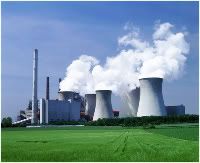

 Does anyone know how many kilowatt-hours we in the U.S. dump back to ground each night? If so, please comment, and add a link to the source. Cycling coal plants shortens their lives and adds to the cost of maintenance, and is therefore unappealing. But I’m having the devil’s own time coming up with this datum.